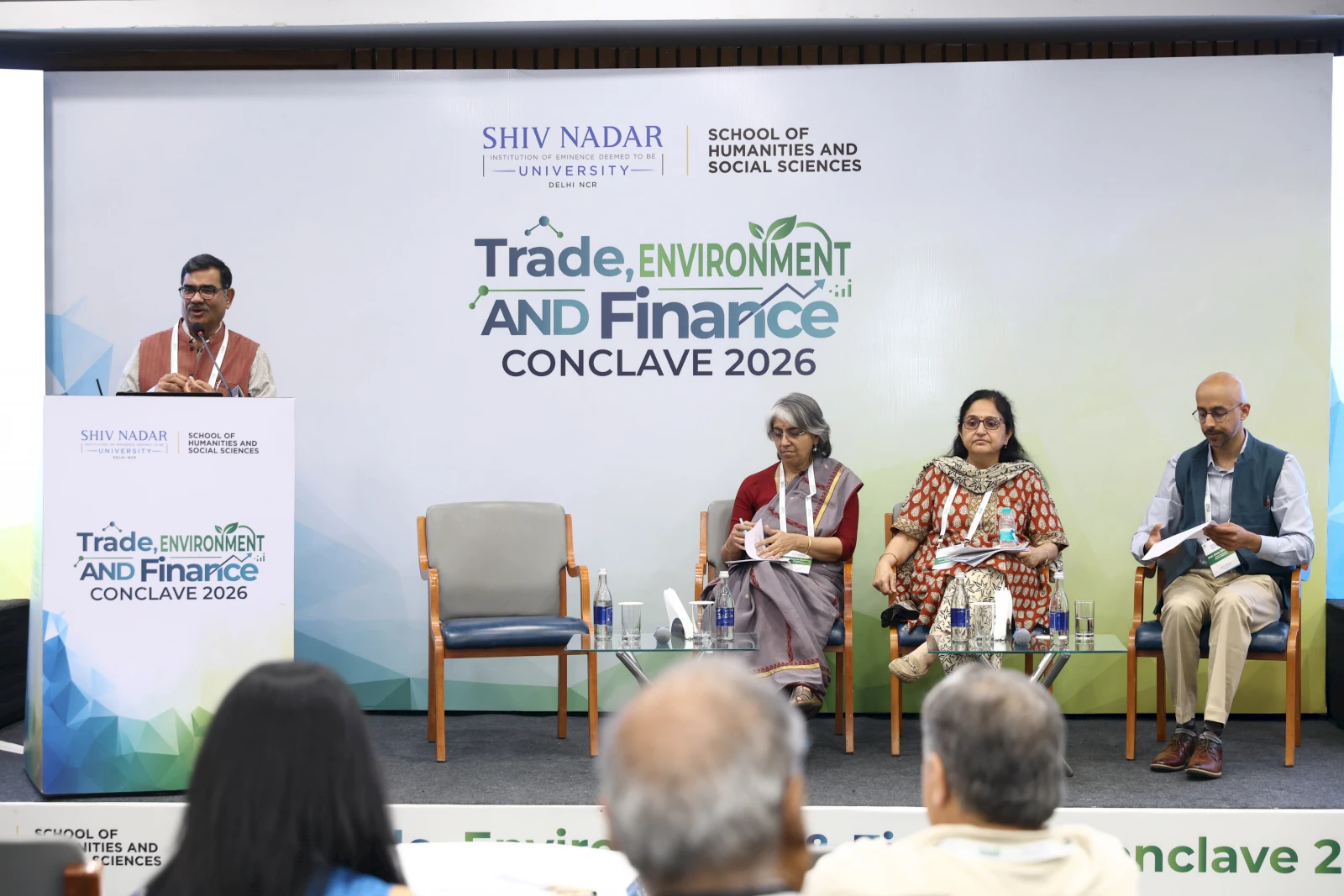
TEFC 2026 debates India's path through a splintering trade system
As trade tensions intensify and climate regulation begins to reshape the architecture of global commerce, economists, policymakers and financial practitioners gathered at the Trade, Environment and Finance Conclave 2026 at the India International Centre in New Delhi. The conclave, hosted by the university's Department of Economics, examined how the intersection of trade policy, environmental governance and financial systems is redefining economic strategy for both developed and emerging economies.
The forum brought together scholars, government officials, financial-sector practitioners and students to debate the emerging global order. The discussions reflected growing concern that the post-Cold War model of open multilateral trade is giving way to a more fragmented system shaped by geopolitics, climate policy and financial volatility.
Convened by Professor Rajat Kathuria, Dean of the School of Humanities and Social Sciences, and Dr. Punarjit Roychowdhury, Head of the Department of Economics, the conclave sought to create a platform for direct interaction between academic research and policy debates. The conclave aimed to examine how environmental regulations, carbon border measures, and capital flows are increasingly influencing global trade and industrial competitiveness.
The opening panel examined the theme "Green Protectionism: Can India Navigate the New Trade–Environment Nexus?". Moderated by Professor Kathuria, the discussion brought together Professor Meeta Mehra of Jawaharlal Nehru University, Professor Aparna Sawhney, also of Jawaharlal Nehru University, and Professor Aman Srivastava, Fellow at the Sustainable Futures Collaborative and Visiting Faculty at the Kautilya School of Public Policy.
The panellists explored whether emerging environmental standards—such as carbon border adjustment mechanisms—represent genuine climate action or disguised protectionism. Professor Mehra highlighted how climate-related trade measures could reshape export competitiveness for developing countries, particularly those with carbon-intensive manufacturing sectors. Professor Sawhney discussed the growing role of environmental provisions within the World Trade Organization framework and the need for developing economies to align their trade policies with sustainability objectives.
Professor Srivastava emphasised the economic implications of climate transition policies, noting that trade, industrial strategy and climate finance are increasingly interlinked. He argued that developing economies must balance decarbonisation goals with industrial development, especially as global supply chains begin to incorporate carbon-related standards.
The second panel, titled "Global Trade at the Crossroads," examined the evolving structure of international trade in an era marked by geopolitical tension and supply-chain realignment. The session was moderated by Professor Manoj Pant.
Participants included Dr. Sonia Pant, an Indian Economic Service officer; Aarushi Gupta, consultant at NITI Aayog, Dr. Pritam Banerjee, Head of the Centre for WTO Studies; and Professor Harsha Vardhana Singh, Chairman of IKDHVAJ Advisors LLP.
The panellists analysed the trajectory of global trade since the global financial crisis and the disruptions caused by the COVID-19 pandemic. Barthwal reflected on the challenges facing the multilateral trading system, particularly the World Trade Organization's declining authority to resolve trade disputes. Dr. Banerjee emphasised the increasing importance of logistics and trade facilitation in sustaining export competitiveness.
Gupta discussed the rising importance of services trade in India's economic strategy, highlighting the growing contribution of digital services to the country's export earnings. Professor Singh addressed the broader geopolitical dimension, noting that trade agreements and economic partnerships are increasingly shaped by strategic considerations rather than purely economic logic.
The afternoon session focused on the financial dimension of the trade–environment nexus under the theme "The Future of the Indian Rupee in a Changing Global Economy." Moderated by Professor Indranil Sen Gupta, the panel brought together leading figures from finance and industry.
Speakers included Vineet Sood, Executive Vice-President for Finance and Treasury at HCL Technologies; Aastha Gudwani, Chief Economist at Barclays; Joydeep Sengupta, Founder and Chief Executive of Five Sens Capital and former co-head of Asia FICC at Bank of America; and Saurabh Sinha, Director of Asian Equities at Lion Global Investors Limited.
The discussion examined the role of capital inflows in financing India's current account deficit and the implications of currency depreciation for macroeconomic stability. Gudwani noted that global capital flows and financial market sentiment increasingly influence exchange rate movements. Sengupta highlighted how financial markets are adjusting to the rising importance of climate-related investment risks and sustainable finance frameworks.
Dr. V. Anantha Nageswaran, Chief Economic Advisor to the Government of India, delivered the keynote address. He argued that the global economic system is undergoing a structural shift away from the rules-based multilateral order towards a more fragmented landscape characterised by strategic competition. "India must build strategic resilience by strengthening manufacturing capacity, diversifying supply chains and investing in infrastructure. Intelligent import substitution, export competitiveness and domestic industrial capability will help stabilise the rupee and position India as a strategically indispensable economy," he said.
Dr. Nageswaran emphasised that manufacturing remains central to long-term economic resilience. While services exports have been a major driver of India's growth over the past three decades, he argued that a strong manufacturing base is essential for stabilising the currency, generating employment and strengthening strategic autonomy.
The conclave concluded with valedictory remarks by Professor Ananya Mukherjee, Vice-Chancellor of Shiv Nadar University. Professor Mukherjee emphasised that universities must serve as platforms for interdisciplinary dialogue on complex global challenges. She argued that the interaction among trade policy, environmental governance, and financial systems requires collaborative research involving economists, policymakers, and industry leaders.
She added that academic institutions have a critical role in shaping evidence-based policy debates, particularly as economies confront climate transition risks, geopolitical uncertainty and technological change.
The discussions at the Trade, Environment and Finance Conclave 2026 highlighted the extent to which trade, environment and finance have become inseparable elements of economic policy. Climate regulation is altering the competitive landscape of global trade, while financial markets are increasingly central to funding the energy transition.
For India, the challenge is to balance growth with sustainability while navigating a world of shifting alliances and evolving economic rules. The conclave demonstrated that such challenges cannot be addressed within traditional policy silos. Instead, they require dialogue across disciplines and institutions.
In that sense, Trade, Environment and Finance Conclave 2026 served not merely as an academic gathering but as a forum for strategic thinking about India's place in a changing global economy.