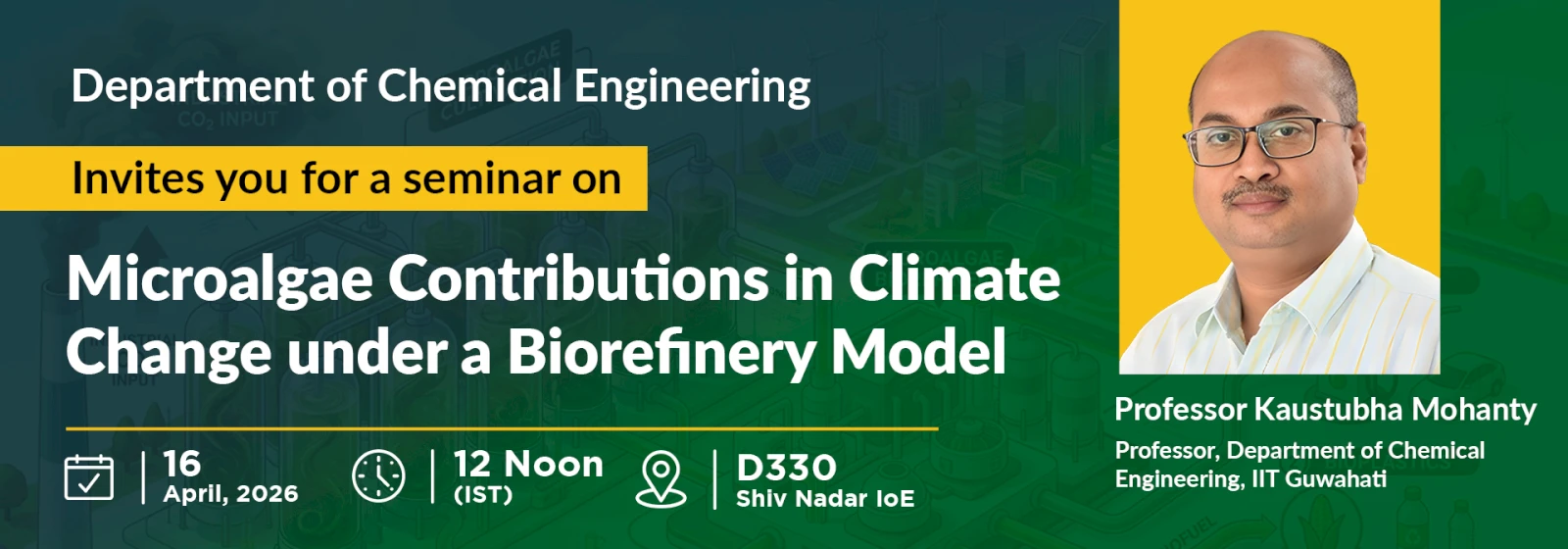
Microalgae Contributions in Climate Change under a Biorefinery Model” scheduled on April 16, 2026
Abstract of the Talk
Microalgae are among the most influential yet often overlooked driving contributor of the Earth’s climate system. As primary producers in aquatic ecosystems, they are responsible for nearly half of global photosynthetic carbon fixation, drawing down atmospheric carbon dioxide and releasing oxygen, capable of fixing up to ~273.75 g CO₂/L under optimal conditions. Through mitigation of greenhouses gases microalgae plays a role in buffering a climate change. Additionally, microalgal activity affects nutrient cycling, cloud formation via dimethyl sulfide emissions, which collectively shape global climate. It is proposed through CLAW Hypothesis that when warming increases, dimethyl sulfide (DMS) emissions also increase, enhancing the cloud condensation nuclei (CCN) formation. The increase in CCN enhance cloud albedo property and thus cooling the earth surface. A field investigation in the Artic in 2010 observed increasing atmospheric DMS helps in new particle formation and growth, supported the hypothesis of significant increase in CCN. It is also observed that DMS oxidation in marine system generate hydroperoxymethyl thioformate (HPMTF), eventually forming carbonyl sulfide (OCS) and sulfur dioxide (SO2). This HPMTF is efficiently taken up into marine clouds i.e marine boundary clouds (MBL), arresting OCS and SO2 formation. This reduction contributes to new-particle and CCN formation. Still, the change in climate alter the productivity of microalgae, creating complex feedback closed loop that may either amplify or dampen global warming trends. As this algal biomass can be converted to valuable bio-products like biodiesel and bio-oil, it is important to understand these interactions for predicting the trajectories in climate change and for exploring the sustainability of microalgae in carbon sequestration, bioenergy and environmental reconditioning.
About the Speaker
Dr. Kaustubha Mohanty has obtained his PhD degree in Chemical Engineering from Indian Institute Technology Kharagpur and is currently working as Professor of Chemical Engineering department at Indian Institute Technology Guwahati. His key research areas are biofuels, biological wastewater treatment, membrane technology, microalgae biorefinery, biomass pyrolysis and water-energy nexus. He has published more than 250 research papers in peer-reviewed journals. He is serving the Editorial Boards of various journals such as Renewable Energy, Renewable and Sustainable Energy Reviews, ACS ES&T Water, ACS ES&T Engineering, Journal of Analytical and Applied Pyrolysis, Biomass Conversion & Biorefinery and Journal of Institution of Engineers (India) Series: E. He is a Fellow of Royal Society of Chemistry (UK), Fellow of International Association of Advanced Materials (Sweden), Fellow of Biotech Research Society of India, Fellow of Institution of Engineers (India) and Fellow of Indian Institute of Chemical Engineers. Scholar GPS has ranked him as the top 0.5% of the Scholars in the discipline of Chemical Engineering and specialties of Biomass and Pyrolysis.
Share this: