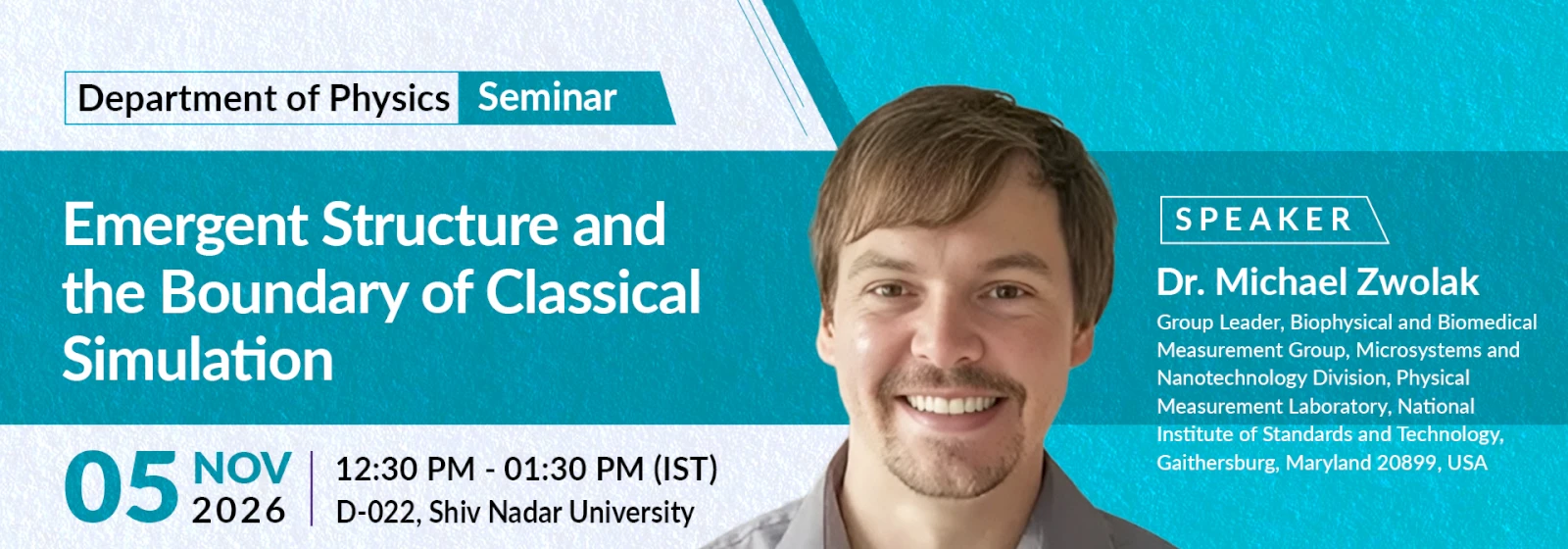
Emergent Structure and the Boundary of Classical Simulation
Abstract:
Where is the boundary beyond which quantum phenomena become intractable for classical computers? Hilbert space is a big place, after all, creating a formidable challenge for computation. Yet physical systems often possess hidden structure arising from conservation laws, correlations, and separation of scales. Tensor networks offer a compact representation of quantum states when entanglement remains sufficiently limited, allowing us to exploit this organization. Far from equilibrium, however, quantum correlations can proliferate, overwhelming our ability to uncover and harness that structure. Quantum transport provides a striking example. In real space, electrons scattering at interfaces steadily generate entanglement between spatial regions, making conventional tensor-network calculations exponentially more difficult with time. Yet elastic scattering conserves energy, and the resulting correlations predominantly connect pairs of reservoir states at matching frequencies. This suggests rotating our perspective within Hilbert space. By arranging these states together in a mixed representation, we suppress the dominant linear growth, leaving only a logarithmic increase. We trace this residual behavior to an infrared divergence associated with sharp occupation changes at the Fermi edges and show how its magnitude depends on the scattering properties of the system. Our analysis strongly suggests that this approach can reduce the computational cost of tensor networks from exponential to polynomial growth in time for noninteracting systems, providing a promising foundation for tackling interacting transport. More broadly, these results illustrate how uncovering emergent structure in quantum dynamics can shift the practical boundary of classical simulation and make the intractable tractable.
Where is the boundary beyond which quantum phenomena become intractable for classical computers? Hilbert space is a big place, after all, creating a formidable challenge for computation. Yet physical systems often possess hidden structure arising from conservation laws, correlations, and separation of scales. Tensor networks offer a compact representation of quantum states when entanglement remains sufficiently limited, allowing us to exploit this organization. Far from equilibrium, however, quantum correlations can proliferate, overwhelming our ability to uncover and harness that structure. Quantum transport provides a striking example. In real space, electrons scattering at interfaces steadily generate entanglement between spatial regions, making conventional tensor-network calculations exponentially more difficult with time. Yet elastic scattering conserves energy, and the resulting correlations predominantly connect pairs of reservoir states at matching frequencies. This suggests rotating our perspective within Hilbert space. By arranging these states together in a mixed representation, we suppress the dominant linear growth, leaving only a logarithmic increase. We trace this residual behavior to an infrared divergence associated with sharp occupation changes at the Fermi edges and show how its magnitude depends on the scattering properties of the system. Our analysis strongly suggests that this approach can reduce the computational cost of tensor networks from exponential to polynomial growth in time for noninteracting systems, providing a promising foundation for tackling interacting transport. More broadly, these results illustrate how uncovering emergent structure in quantum dynamics can shift the practical boundary of classical simulation and make the intractable tractable.
All are cordially invited.
Share this: