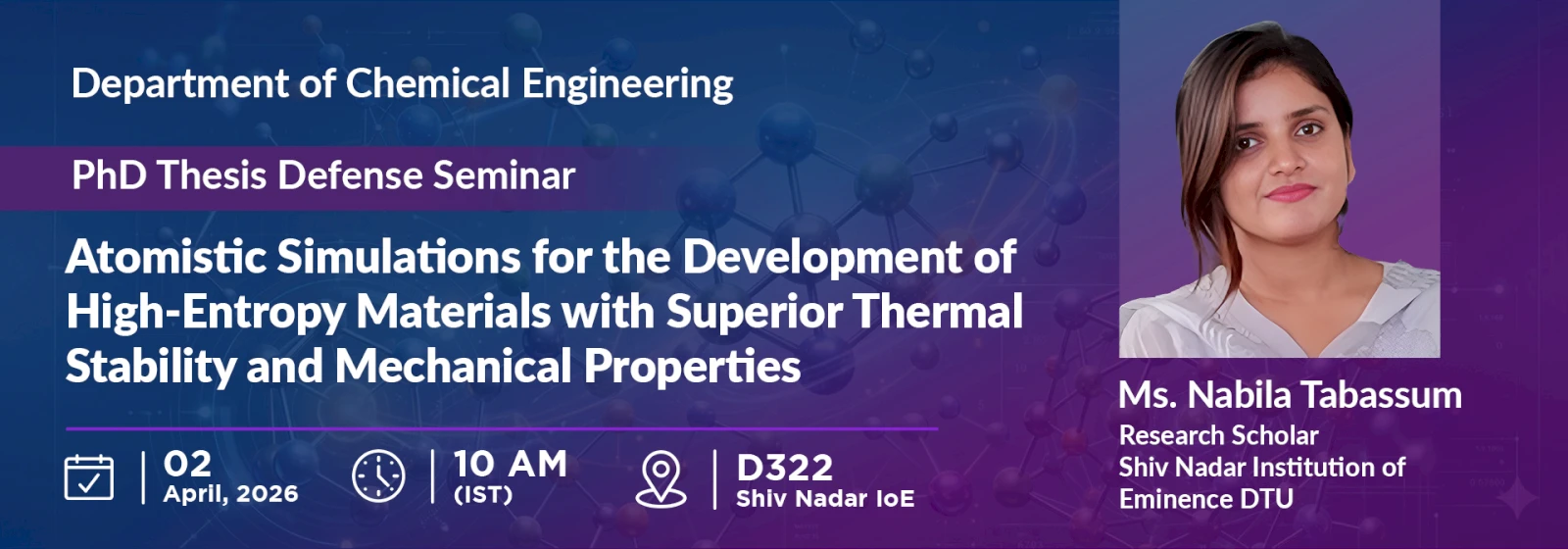
Atomistic Simulations for the Development of High-Entropy Materials with Superior Thermal Stability and Mechanical Properties
Abstract: High Entropy Materials (HEM) such as High Entropy Alloys (HEAs) and High Entropy ceramics (HECs) are known as “4th Industrial Materials of 21st Century” due to their remarkable properties which can change the face of several applications operating under harsh environments such as thermal barrier coatings, high temperature applications, nuclear reactors, electrocatalysis, energy storage, aerospace, and biomedical applications. The tunable composition, as per the target properties and applications, distinguishes them from other materials. HEAs are metallic materials comprised of five or more metals in nearly equal atomic fractions. HECs are ceramics comprised of four or more metallic cations in near equal atomic fractions along with one or more non-metal anions such as oxygen, boron, carbon, or nitrogen. Due to the special atomic scale effects such as lattice distortion, sluggish diffusion, and cocktail effect, the HEMs have the potential to exhibit exceptional strength, superior wear resistance, corrosion and oxidation resistance, and excellent thermal stability. Atomistic simulations play a pivotal role in uncovering the fundamental insights and underlying mechanisms behind various properties of the materials to accelerate the development of HEMs with optimum properties. This would potentially reduce the time-consuming and economically extensive experimental trials, especially at the exploratory stage. The present thesis seeks to expand the theoretical underpinnings of high entropy alloys and high entropy ceramics by filling the gaps by investigating compositional tuning in AlCoCrFeNi HEA, (TiHfZrV)B2 and (TiNbHfTaW)C HEC. The present research also focuses on investigating the “NiCrAl substrate – AlCoCrFeNi HEA coating” interface interactions at high temperatures to investigate the stability of interface and microstructure evolution and probing the high-temperature stability analysis of AlCoCrFeNi HEA coating.
The present study investigated the effect of Al concentration on the structural, thermodynamic, electronic, thermal, and mechanical properties of the HEA AlxCoCrFeNi (x= 0.0, 0.1, 0.3, 0.5, 0.9, 1.0, and 2.0) using density functional theory calculations. The present study discusses in detail about how the FCC phase stabilization of AlxCoCrFeNi at low Al concentrations, results in more strength, while the higher Al concentration with BCC structure show a more ductile nature and also special properties exhibited by the alloy when x=2.0. The effect of Al concentration and the resulting phase stability effects on mechanical and thermal properties were evaluated. Further, the effect of microstructure on the thermo-mechanical stability of equiatomic AlCoCrFeNi was evaluated using Atomistic simulations in a temperature range of 300 – 2500K. The studies revealed that tuning the annealing protocol to stabilize the HEA preferably in the FCC phase instead of the typical mixed phase (FCC+BCC) is advantageous to achieve superior thermo-mechanical stability. For instance the mixed phase stabilized AlCoCrFeNi displayed phase transition at 1700 K while pure FCC phase stabilized alloy was stable till 2100 K. The NiCrAl substrate – AlCoCrFeNi HEA interface simulations confirmed the HEA microstructure evolution and stability of the interface at higher temperatures of 1720K, which confirms the suitability of the HEA as a bond coat. Higher oxidation resistance of HEA compared to NiCrAl was also established using DFT studies. Furthermore, the DFT studies to identify optimum compositions of Ti, Zr, Hf and V based high entropy diborides and Ti, Nb, Hf, Ta and W based high entropy carbides with superior structural, electronic, mechanical and thermal stability also revealed a critical information that there are other non-equiatomic compositions which can potentially show superior thermal and mechanical properties than the most widely explored equiatomic compositions.
All are cordially invited.
Share this: