Women, Wheels and Modern India

Editorial / August 04, 2026
For much of the twentieth century, the bicycle symbolised freedom, mobility and modernity in India, but those freedoms were largely reserved for men. Yet Indian cinema repeatedly presented women cycling confidently through cities, parks and countryside landscapes, creating images that often stood in sharp contrast to everyday social realities.
In this conversation, Dr Divya Kannan, Assistant Professor in the Department of History and Archaeology, speaks to Manoj Ramachandran about her latest article "There She Goes': Cinema, Youth and Bicycles in Mid Twentieth Century India,", published in South Asia: Journal of South Asian Studies, which explores how films, advertisements and popular culture helped shape public imagination around women's mobility in post-Independence India. Rather than asking whether women cycled, her work examines why cinema kept returning to the image of the woman on a bicycle, and what that revealed about changing ideas of gender, aspiration and modernity.
What inspired you to study women riding bicycles in Indian cinema?
I started this project during Covid while reading David Arnold's well-known book- Everyday Technology, when I noticed that there was barely any discussion on women's cycling. This was the initial start. Soon, I began to look for primary sources and realised that Indian cinema, especially during the 1950s-70s, frequently depicted women protagonists riding bicycles at a time when relatively few women had the freedom to cycle in everyday life. I became interested in understanding what it revealed about ideas of gender, mobility and modernity in post-Independence India.
Your research isn't really about whether women cycled. What is the central question?
The question is not whether Indian women rode bicycles, because many did not, and a minority did so only under certain social conditions, especially in the 1950s-70s. Instead, I ask what meanings are associated with women's travel mobility and what it means that films consistently portrayed young women cycling even when such freedom was uncommon.
Why was the bicycle such an important symbol in post-Independence India?
The bicycle had been a powerful symbol of mobility and modernity since its arrival in India in the latter half of the nineteenth century. Later, government policies supported bicycle manufacturing and encouraged ownership, but these programmes largely benefited men. As a result, bicycles became closely associated with male mobility, while women continued to face social restrictions on availing private transport, including bicycles.
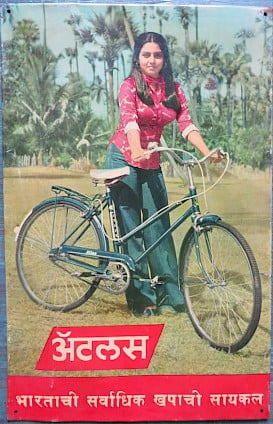
Atlas- Advertisement
Filmindia magazine, 1941. Cover page depicting actresses in the movie Khazanchi.
Yet films showed women cycling freely. What do you think filmmakers were communicating?
I think the cinematic and creative license utilised by filmmakers allows us to impart new meanings to commodities that are otherwise socially limited in their reach. At the same time, they also reflect a possibility and an imagined future in which women could move confidently through public spaces alone or otherwise. That distinction is historically significant because it shows how cinema helped shape modern aspirations before society fully changed.
Your research also looks at advertising. What did advertisements reveal about changing attitudes?
Advertisements reveal a gradual shift in consumption patterns and behaviours. A 1959 Hercules advertisement in a Tamil magazine framed cycling as something a responsible father allowed his daughter to do to avail a college education. By the 1970s, Atlas advertisements portrayed women cycling independently through open landscapes. Although these images were used in marketing to attract new consumers, they helped slowly normalise the idea of female travel mobility, especially for the growing middle classes, as useful and respectable.
How did films use bicycles as a storytelling device?
Cycling sequences often appeared early in films to signal various encounters indicative of romance, friendship, humour, youth and optimism. The bicycle became part of a broader visual language associated with industrial change and social progress, particularly in Hindi and Tamil cinema.
But your research also points to contradictions in these portrayals.
Yes, as is the case with the consumption of several technologies. While films celebrated women cycling and appealed to audiences, they also often framed them through the male gaze. In some films, women cyclists became objects of pursuit or desire, showing that ideas of freedom coexisted with traditional gender attitudes. Besides, I have also never seen films depicting older or married female cyclists.
Did women in film songs enjoy the same freedom as male cyclists?
Not really. Male characters were often shown cycling alone, indulging in philosophical soliloquies in the form of songs, or as carefree travellers. Young women usually appeared in pairs with romantic partners or with groups of friends enjoying picnics. The image of a woman simply cycling independently was still largely absent.
Was there a film that particularly stood out during your research?
The song Akkam Pakkam in the Tamil film Neethikku Pin Paasami is especially interesting because the female protagonist's ability to ride a bicycle becomes central to the plot. She is portrayed as a village woman with naive mannerisms who is taught how to cycle by the hero. But rather than treating cycling as merely decorative, the film presents her skill with the machine as meaningful and essential to the story's resolution.
What broader message do you hope readers take away from your research?
I hope readers will pay more attention to the historical and meaning-making processes that occur in everyday life through film songs, advertisements, and other elements of popular culture. Today, the bicycle is considered a very liberating mode of transport, but it occupies a complex social life, as various cycles, their designs, and prices represent different statuses. I also hope readers will understand the broader history of cycling, which saw challenges and resistance from women, and the ripple effects it had on education, dress reform, and suffrage, among other areas, across the world. At the same time, in a country like India, where gender inequalities remain massive, and women are seeking new ways to assert their autonomy, these cultural representations remain important.
How does this change the way we think about the history of women's mobility in India?
Histories of mobility often focus on infrastructure, big technology, and government policy. My research suggests that we should also pay attention to gender, spatiality, and culture as arenas of negotiation and contestation that influence our everyday ideas of what it means to be free and mobile, and what it entails for the creation and governance of public spaces.
More Blogs

The Hawthornden Literary Retreat bestowed on Dr Sambudha Sen to complete the manuscript of a novel
Professor Sambudha Sen, Head of the Department of English at Shiv Nadar Institution of Eminence, Delhi-NCR, was awarded a residency at the...
The Power of the Moving Body
Movement is an innate bodily action that humans have been exhibiting for the longest time. Long before language was invented, the body was the...

How Does A Multi-Disciplinary Approach To Education Enhance Learning And Prepare Students For A Multi-Faceted World?
In today’s world, where businesses are changing almost every day, it is the responsibility of educational institutes to provide holistic...