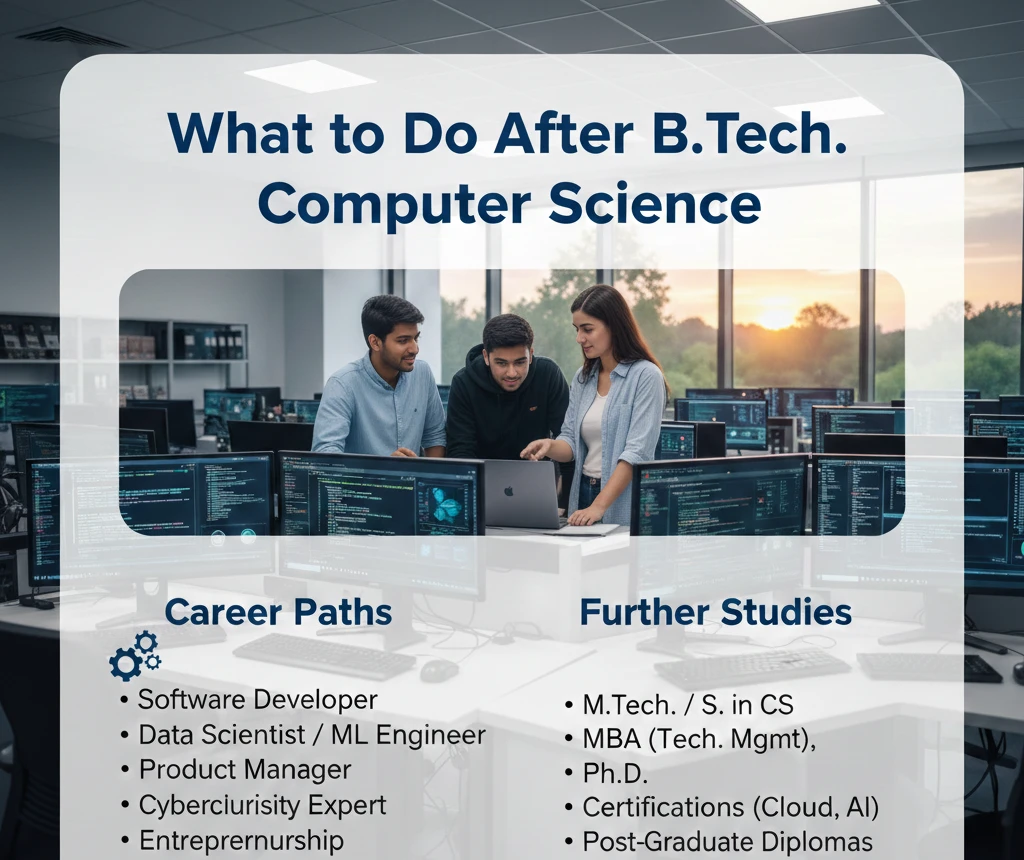
What to Do After B.Tech. Computer Science: Job vs Higher Studies vs Startups?
Blog / December 18, 2025
The final B.Tech. semester ends, placements feel uncertain or overwhelming. Suddenly, you often hear everyone's opinion about your future. Like-
- Take a job
- Do a master’s
- Start something of your own
This stage feels more confusing than exciting. The problem is not about lack of options- it’s about having too many.
As we know, computer science is recognized as one of the most popular and flexible engineering degrees today. You can step into the industry, pursue higher studies as well as build your own startup. Each path comes with its own risks and rewards. This blog clearly helps you make an informed decision about “What to do after B.Tech. Computer Science?”
What to Do After B.Tech. Computer Science?
When students ask what to do after B.Tech. CSE course, they usually need clarity- not just options. The answer completely depends on your interests and career goals. Below is a general overview of careers after B.Tech. CSE-
|
Career Path |
Who Is It Best For? |
Key Benefits |
Typical Outcomes |
|
Jobs |
Students who want to start earning and gain industry exposure early |
|
Software roles, data & cloud jobs, government jobs after B.Tech. in Computer Science |
|
Higher Studies & Specialization |
Those aiming for deeper expertise or leadership roles |
|
Senior technical roles, management positions, higher-paying jobs |
|
Startups & Entrepreneurship |
Self-driven graduates with a risk-taking mindset |
|
SaaS products, tech platforms, AI-powered solutions |
What are the Jobs after B.Tech. in Computer Science?
Many B.Tech. graduates choose to work right after college. Students will explore a diverse range of the highest paying jobs after B.Tech. CSE. Let’s explore-
- Software Developer
Job Role- Developing software applications, coding, debugging, and, testing
Skills Needed- Programming languages like Java, Python, C++, or JavaScript
Average Salary- ₹4-9 LPA
- Data Scientist
Responsibility- Data analysis, building predictive models, and generating insights
Key Skills- Proficiency in Python, R, SQL, machine learning, and data visualization tools
Average Salary- ₹7-17 LPA
- Artificial Intelligence and Machine Learning Engineer
Career Role- Designing and deploying AI and ML models, working with neural networks, and natural language processing
Must-Have Skills- Expertise in TensorFlow, PyTorch, AI/ML algorithms, and big data tools
Average Salary- ₹5-12 LPA
- Cloud Solutions Architect
Key Duties- Working on cloud strategy development, deployment, and maintenance
Essential Skills- Knowledge of AWS, Azure, Google Cloud, and DevOps practices
Average Salary- ₹10-28 LPA
- Cybersecurity Analyst
Scope of Work- Monitoring and mitigating cyber threats, and implementing security protocols
Core Skills- Ethical hacking, cryptography, and risk assessment tools
Average Salary- ₹4-8 LPA
- Blockchain Developer
Key Responsibilities- Developing blockchain-based systems, and writing smart contracts
In-Demand Skills- Solidity, Ethereum, Hyperledger, and cryptographic algorithms
Average Salary- ₹4-10 LPA
- Full-Stack Developer
Primary Role- Developing web applications, integrating user interfaces with server-side functionality
Key Skills- HTML, CSS, JavaScript, React, Node.js, and database management
Average Salary- ₹4-10 LPA
- DevOps Engineer
Job Role- Automation, CI/CD pipeline development, and system monitoring
Primary Skills- Jenkins, Kubernetes, Docker, and scripting languages
Average Salary- ₹5-12 LPA
- Computer Network Architect
Core Duties- Develop network layouts, maintain routers/switches, and optimize connectivity
Skills Required- Networking, Cisco Systems, Firewalls, Cloud Platforms, Troubleshooting
Average Salary- ₹13.8-28 LPA
- Database Administrator
Scope of Work- Oversee database design, performance tuning, backup, and recovery processes
Core Skills- SQL, Oracle/MySQL, Data Modeling, Problem-Solving, Attention to Detail
Average Salary- ₹4-10 LPA
Government Jobs After B.Tech. in Computer Science
If your dream is to secure high-paying govt jobs after B.Tech. CSE, you should explore the table below for an informed choice.
|
Category |
Details |
|
Top Recruiters |
ISRO, DRDO, NIC, BHEL, ONGC, GAIL, Public Sector Banks |
|
Common Job Roles |
|
|
Skills Employers Look For |
|
|
Average Salary |
Entry-level roles- ₹6-12 LPA Experienced positions- ₹15-25 LPA |
What are the Higher Studies After CSE?
Higher studies after B.Tech. CSE helps you sharpen your expertise, secure senior job roles, as well as earn better salaries over time. But many students are unsure about the other pathways apart from routine coding. This is where you can explore specialization courses after B.Tech. CSE.
Below are some popular options for higher studies after B.Tech. CSE that emphasizes skills that the industry demands.
- Data Science & Analytics- Prepares you for data-driven roles across industries
- Artificial Intelligence & Machine Learning- Opens doors to advanced tech and research roles
- Cybersecurity- Trains you to protect digital systems and networks
- Cloud Computing & DevOps- Builds expertise in scalable, modern infrastructure
- Full Stack Development- Enables end-to-end application development
Preparing for High-Growth Careers Through B.Tech. CSE at Shiv Nadar University
A successful career after B.Tech. Computer Science and Engineering completely depends on how the course prepares you for real-world technology roles. The B.Tech. CSE program at Shiv Nadar University emphasizes a career-first approach by combining strong fundamentals with future-focused specializations to meet industry demands.
Students can explore various options to specialize in
- Artificial Intelligence and Machine Learning
- Data Science and Big Data Analytics
- Cyber Security and Privacy
These domains consistently feature among the highest-growth and highest-paying areas in the tech sector. Also, these specializations help you gain knowledge and build expertise for advanced technical, research, and leadership roles.
If you are ready to build a future in computer science, explore Shiv Nadar University B.Tech. CSE programs that align with your career aspirations.
Conclusion
If you are unsure about “what to do after B.Tech. Computer Science?”, the answer is simple. You have plenty of career options. The field provides you with flexibility across jobs, higher education, as well as entrepreneurship. You have to assess your interests, strengths, and career goals to make the right choice. This will lead you toward a rewarding and future-ready career.
Ready to build a successful career in the computer science field? Enroll in Shiv Nadar University’s B.Tech. CSE courses to prepare for a rewarding career.
FAQs
What to do after B.Tech. CSE if not interested in coding?
You can move into data analytics, cybersecurity, cloud management, product management, MBA, or government roles where you can do more than daily coding.
Which course is best after B.Tech. in Computer Science?
The best course depends on your goals. Popular options include Data Science, Artificial Intelligence, Cybersecurity, Cloud Computing, M.Tech., MS abroad, or an MBA in Analytics or Technology Management.
Can I get 1 lakh salary after B.Tech.?
Yes, you can earn ₹1 lakh per month with strong skills, internships, and the right role.
How to get a job after B.Tech. CSE?
You have to focus on core concepts, build practical projects, strengthen problem-solving skills, gain internship experience, as well as prepare for interviews.
Which government job is best after B.Tech. CSE?
Top government jobs include Scientist or Engineer roles in ISRO and DRDO, PSU jobs through GATE, IT Officer roles in banks, and technical positions in NIC and government IT departments.