Want to Create New Materials, Medicines, and Energy Solutions? Start with B.Sc. Chemistry
Blog / September 24, 2025
B.Sc. Chemistry subjectsB.Sc. Chemistry SyllabusEvery invention you rely on—your phone’s battery, the medicine in your cabinet, even the water purifier at home—exists because someone studied chemistry deeply.
Think about it. The screen you’re reading this blog on works because of some materials engineered at a molecular level. The air that you breathe stays cleaner thanks to the chemical processes that remove toxins. Even the colors in fireworks lighting up the sky have some chemistry behind them.
It seems easier when we see chemistry as just formulas, equations, or lab coats. But practically, there is some science that is responsible for nearly every innovation we use today. It involves healthcare and clean energy in everyday household products, and chemistry makes the lives we live possible.
That’s where a B.Sc. Chemistry degree comes in. This program is not about memorizing reactions or just mixing some chemicals—it’s about exploring the very subjects and concepts that lead to the life we live because of all the discoveries made. The syllabus you get in this course will take you from the foundations of matter and bonding all the way to advanced applications in medicine, energy, and materials science. And if you’ve ever wondered how curiosity in the lab turns into answers for real world problems, this degree is where you start your journey.
Chemistry is Everywhere, You Just Need to Notice It
Before we dive further into any of the details, let's take a pause for a moment. Notice the things around you. The plastic on your chair, the glass on your window, even the ink on your notebook—all these products are a result of some chemical research.
That’s why studying chemistry is more about noticing the invisible hands shaping your everyday experiences. A B.Sc. Chemistry degree gives you the lens to see these hidden connections and the tools to start shaping them yourself.
What Does the B.Sc. Chemistry Degree Really Cover?
If you think this degree is only about the periodic table, you’re in for a surprise. The program is designed to take you through a whole set of subjects, each unlocking a new layer of understanding.
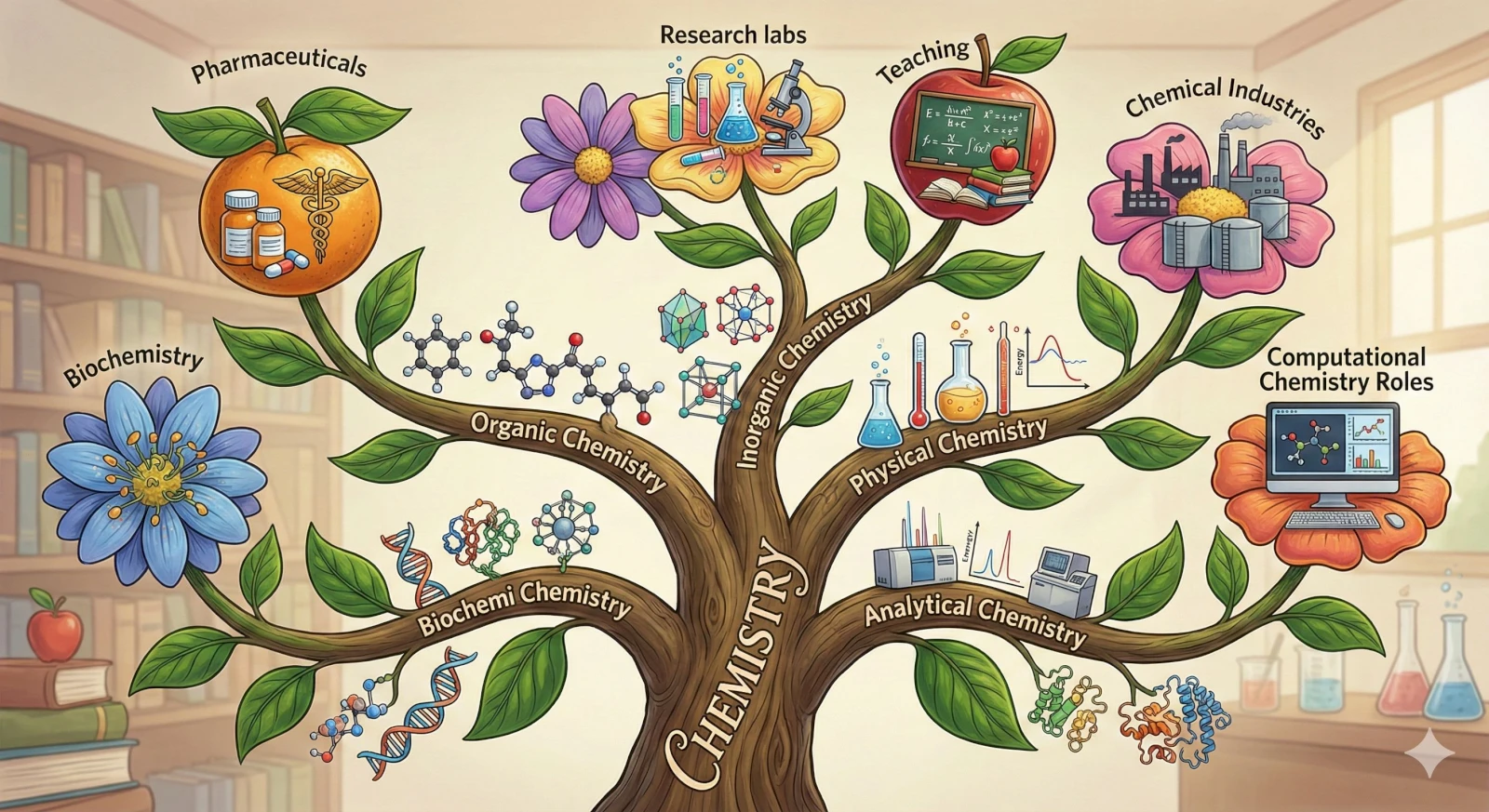
Some of the core B.Sc. Chemistry subjects you will study are:
- Organic Chemistry
- Inorganic Chemistry
- Physical Chemistry
- Analytical Chemistry and
- Biochemistry
Alongside, a few electives and lab work push you to apply concepts rather than just memorize them.
Your Three Year Journey Through Chemistry, Broken Down
So, what does the B.Sc. Chemistry syllabus look like in practice? Let’s explore!
|
Year |
Core Areas |
Key Subjects and Topics |
Practical / Lab Focus |
|
Year 1 |
Foundations of Chemistry |
|
|
|
Year 2 |
Expanding Knowledge |
|
|
|
Year 3 |
Advanced Learning |
|
|
|
Capstone / Outcome |
Integration & Research |
|
|
By the end of the degree, you don’t just “know chemistry”—you’re trained to think like a chemist.
Why Should You Care About All This?
Let’s take a look at how chemistry graduates aren’t locked into one narrow career. With a B.Sc. Chemistry degree, you can head into research labs, pharmaceuticals, forensic science, energy companies, environmental agencies, or even teaching.
Think of it as a passport. The subjects and syllabus you study offer credibility and your curiosity for its applications of open doors across industries. And with the world pushing for sustainable fuels, greener technologies, and new medical solutions, chemists are more in demand than ever.
Learning That Exceeds the Textbook
One of the biggest misconceptions surrounding chemistry is that it exists only in equations and theory. But in reality, much of your learning comes through practical experiences. Experiments in the lab teach you patience, how to solve problems, and most of all, precision—all these qualities are valued in industries.
You’ll also be surprised after finding out how chemistry overlaps with various fields like computer science (think computational chemistry) or environmental studies (like pollution control). This field and course keeps evolving with time, and the syllabus reflects those changes.
Why Choose B.Sc. (Research) in Chemistry at Shiv Nadar University (Institution of Eminence)?
Starting B.Sc. (Research) in Chemistry at Shiv Nadar University means getting into an environment that focuses on research and connects what you learn in class with practical applications. The program promotes original research to help students strengthen their chemistry knowledge through experiential learning. Here is what it offers:
- A broad curriculum with the flexibility to combine Major and Minors
- State-of-the-art laboratories for hands-on experience with modern analytical instrumentation
- Opportunity to engage in research through collaborative projects from diverse scientific disciplines
- "Learn by doing" teaching approach to make the learning process explorative, and enjoyable
By choosing Shiv Nadar University you step into an educational path that is not limited to textbooks. You get a platform where you get to explore, innovate, and contribute to the scientific community. If you feel that the X-factor for chemistry lies in you and are eager to make an impact, then the B.Sc. (Research) in Chemistry at the School of Natural Sciences, Shiv Nadar University, is the ideal starting point.
To Wrap it Up
So the takeaway you get is that chemistry isn’t just about some experiments and classroom formulas. It’s about finding out how the world works, questioning the processes, and innovating solutions that last. A B.Sc. in Chemistry degree offers you a structured path to step into this exciting world. It equips you to transform your curiosity into something that matters through its diverse subjects and syllabus.
And who knows—the next medicine, battery, or clean energy source on which all life depends might just come from someone like you.
FAQs
Is Chemistry as a course difficult?
You may feel it challenging at times, especially with advanced subjects like organic synthesis. But if you have that curiosity in you, a routine full of consistent practice, and lab experience will surely make it manageable and worth pursuing.
What are the listed career options after B.Sc. Chemistry?
Graduates can explore careers in:
- Pharmaceuticals
- Research labs
- Teaching
- Chemical Industries and
- Computational Chemistry Roles
How long is the B.Sc. Chemistry course in India?
A B.Sc. Chemistry degree spans 3 years, covering six semesters. Some programs involve research at Shiv Nadar University and may include extra research projects or internships to give better practical experience.