Top B.Sc. Courses After 12th That Are Quietly Gaining Massive Demand
Blog / March 05, 2026
Everyone knows someone doing B.Tech. Fewer people talk about the B.Sc. student who graduated, went on to work in genomics, got shortlisted for a space mission support role, or joined an AI drug discovery lab at the age of 23. More and more people are starting to notice B.Sc. courses after 12th grade in 2026. This rise in interest is because the science sector is growing quickly, and employers are specifically looking to hire graduates from these programs.
This is not about B.Sc. being the backup option when engineering did not work out. Several of the most in-demand roles in pharma, data science, climate tech, and space research are filled by B.Sc. graduates are often more focused and have research exposure that starts earlier. Here is a look at the courses gaining real traction and what they actually prepare you for.
B.Sc. Courses After 12th- The Complete List
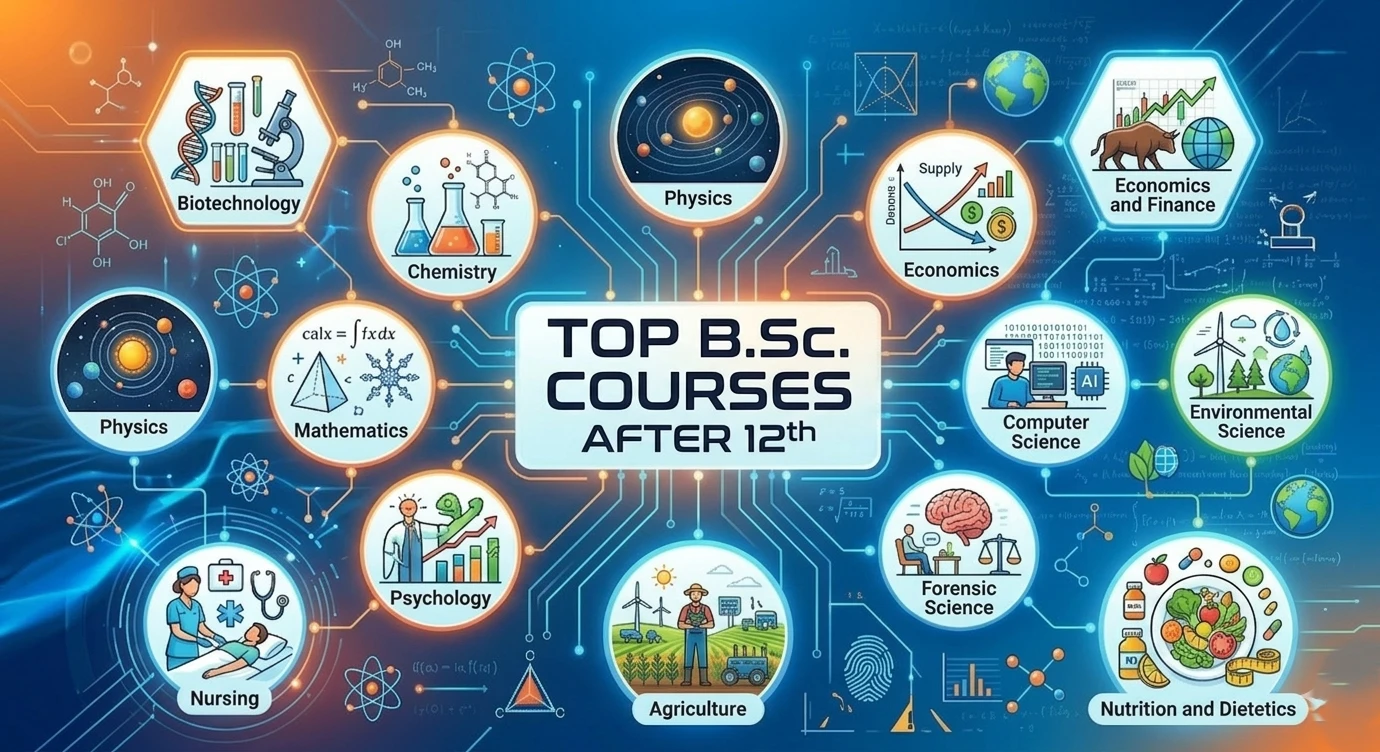
Below is a comprehensive overview of the B.Sc. courses available after 12th, from the established mainstream options to the ones quietly building serious demand.
|
B.Sc. Course |
Duration |
Best Career Paths |
Growth Outlook |
|
3-4 Years |
|
Very High |
|
|
3-4 Years |
|
High |
|
|
3-4 Years |
|
High |
|
|
3-4 Years |
|
Very High |
|
|
3-4 Years |
|
High |
|
|
3-4 Years |
|
Very High |
|
|
3-4 Years |
|
Very High |
|
|
B.Sc. in Environmental Science |
3-4 Years |
|
High |
|
B.Sc. in Nursing |
4 Years |
|
Very High |
|
B.Sc. in Agriculture |
4 Years |
|
Moderate to High |
|
B.Sc. in Forensic Science |
3-4 Years |
|
Moderate |
|
B.Sc. in Psychology |
3 Years |
|
High |
|
B.Sc. in Nutrition and Dietetics |
3-4 Years |
|
High |
The Courses Quietly Gaining the Most Demand
Not all B.Sc. courses are growing at the same rate. Some are being pulled forward by specific industry shifts that did not exist five years ago. Here are the ones seeing the sharpest rise in demand and why.
-
B.Sc. in Biotechnology
Biotech has moved from niche to critical infrastructure. Investment in genomics, vaccine platforms, and diagnostic technology has not slowed since the pandemic, and biotechnology graduates are entering roles in CRISPR-based research, bioinformatics, and cell therapy development that were postgraduate-only territory a decade ago. Research exposure in a strong B.Sc. Biotechnology program is now genuinely competitive with what the industry needs at the entry level.
-
B.Sc. in Mathematics
Mathematics has become the backend of almost every high-value sector. Data science, quantitative finance, AI model development, cryptography, and actuarial science all hire mathematicians directly from undergrad. The degree is also one of the strongest foundations for postgraduate work in economics, statistics, and computer science, and it now has more direct employment routes than ever before.
-
B.Sc. in Economics and Finance
This is one of the newer interdisciplinary offerings and it is filling a very specific gap. Pure economics graduates often lack the financial modelling depth that investment banks and consulting firms want. Pure finance graduates sometimes lack the macroeconomic grounding that policy and research roles require. This combination degree sits neatly in between and is gaining traction fast among students who want options across both sectors.
-
B.Sc. in Physics
Physics is undergoing a quiet career renaissance. Quantum computing, space technology, semiconductor research, and photonics are all sectors actively recruiting physics graduates, often at stronger packages than peers from more traditional tracks. Indian space institutions, defence R&D labs, and global semiconductor companies are all part of the hiring ecosystem for physics graduates with solid computational and instrumentation skills.
Where B.Sc. Graduates Are Actually Working in 2026
|
Sector |
Roles B.Sc. Graduates Fill |
Example Employers |
|
Pharma and Biotech |
Lab analyst, research associate, QC scientist, clinical data coordinator |
Sun Pharma, Biocon, Dr. Reddy's, biotech startups |
|
Technology and AI |
Data analyst, bioinformatics specialist, algorithm support, QA engineer |
TCS, Infosys, AI-first startups, genomics firms |
|
Space and Defence |
Junior scientist, telemetry analyst, instrumentation support, mission data role |
ISRO, DRDO, HAL, defence PSUs |
|
Finance and Consulting |
Research analyst, risk modelling associate, economic policy researcher |
McKinsey, Deloitte, investment banks, RBI |
|
Climate and Environment |
Climate risk analyst, environmental consultant, sustainability researcher |
Government bodies, NGOs, sustainability consulting firms |
Where Research Begins Early- B.Sc. Programs at Shiv Nadar University (Institution of Eminence)
If research exposure from the very first year is something you are looking for, Shiv Nadar University's unique B.Sc. (Research) programs are structured quite differently from the standard three-year degree. Here is what makes them worth considering for aspiring scholars and future leaders in various fields-
- Six B.Sc. (Research) Programs on Offer- Biotechnology, Chemistry, Physics, Mathematics, Economics, and Economics and Finance. Each is designed as a research-led degree, not just a taught qualification.
- Research Built Into the Program, Not Bolted On- The B.Sc. (Research) format includes a dedicated research year where students work in active labs on funded projects. This is what separates graduates from institutions like Shiv Nadar University when they apply for postgraduate programs abroad or competitive research roles in India.
- Interdisciplinary Flexibility- Students can combine a Major in one subject with a Minor from a different school entirely. For example, a Chemistry Major can opt for a Minor in Economics. A Physics Major can pursue a Minor in Computer Science. This cross-disciplinary training is increasingly what employers in data science, climate tech, and biotech actually want.
- Strong Graduate Outcomes- Shiv Nadar University’s B.Sc. graduates have gone on to PhD programs at institutions in the US, Europe, and Singapore, and into direct roles at pharma companies, research labs, and financial firms. The program's global recognition is built on placement outcomes, not just rankings.
Conclusion
B.Sc. courses after 12th are not the cautious, safe-fallback choice they were once perceived as. Many of these courses now lead to jobs in areas like biotechnology, climate research, and space organizations, where B.Sc. graduates are being hired for specialized scientific roles. Students usually benefit most when they choose a subject they truly enjoy, study at a university with strong research exposure, as well as actively apply what they learn via projects and internships.
If you are in 12th grade and working through this decision, you can use this guide as a starting point. Next, check the research exposure, faculty background, as well as career outcomes before choosing a program. The degree matters. Where you study it matters just as much.
FAQs
Which B.Sc. is best in the future?
B.Sc. programs in Biotechnology, Mathematics, Computer Science, Physics, and Economics and Finance offer strong future prospects, as they connect directly to fast-growing sectors.
Which B.Sc. has a high salary?
B.Sc. degrees in Mathematics, Computer Science, Biotechnology, Physics, and Economics and Finance often lead to higher-paying roles.
How many years is B.Sc. after 12th?
Most B.Sc. programs take three years, while some specialised or research-focused degrees extend to four years, offering deeper research exposure and stronger preparation for industry roles or postgraduate study.
Which is the best course in B.Sc. after 12th?
The best B.Sc. course depends on your interests, but Biotechnology, Mathematics, Computer Science, Physics, and Economics and Finance are popular choices due to strong demand and diverse career opportunities.