Should You Choose BSc Chemistry? A Deep Look at Subjects & Learning Curve
Blog / January 21, 2026
Should You Choose B.Sc. Chemistry? A Deep Look at Subjects & Learning Curve
If you have ever been fascinated by the molecular machinery of life or how fundamental principles govern the nature of the universe, a degree in chemistry might be your calling. Often referred to as the "central science," chemistry serves as the vital link between physics and biology, playing a crucial role in nearly every scientific field.
In this blog, we take a deep look inside the B.Sc. Chemistry subjects that bridge the gap between high school and university-level science. From understanding the "learning curve" to exploring high-growth research opportunities, this guide will help you decide if this challenging but rewarding path is the right fit for you.
B.Sc. Chemistry Program Overview: What to Expect
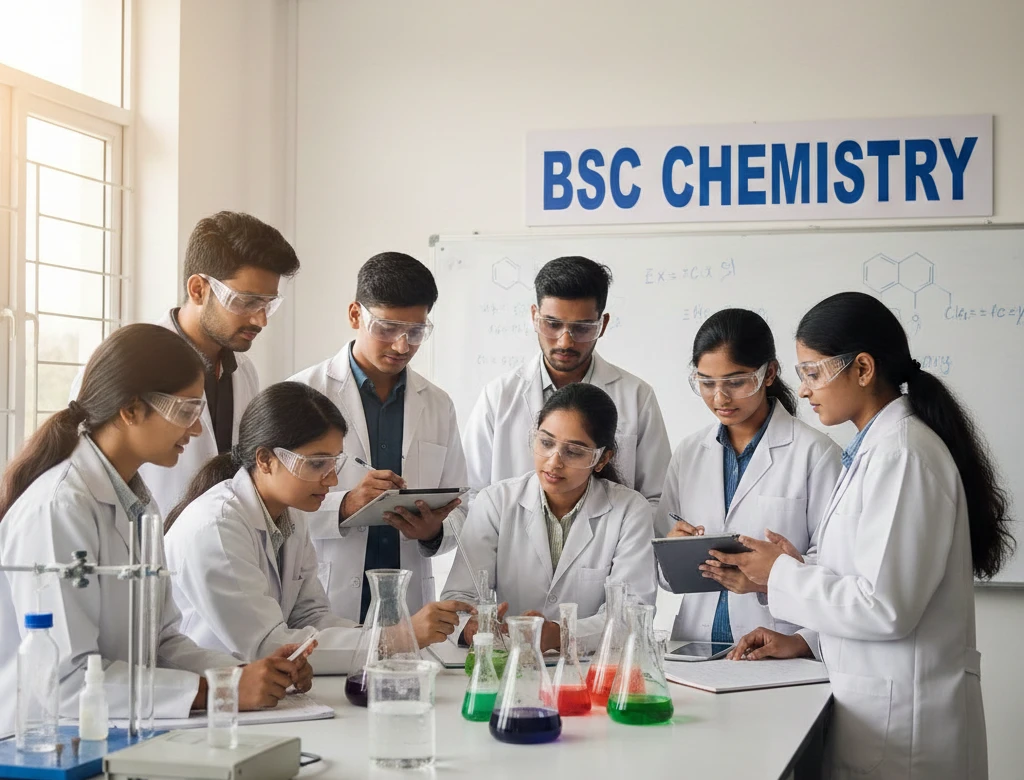
While specific course titles vary by institution, most undergraduate chemistry programs follow a structured progression from introductory concepts to specialized research.
|
Feature |
B.Sc. Chemistry Details |
|
Common Degree Name |
B.Sc. (Research) or B.Sc. Honors |
|
Duration |
3 to 4 Years (depending on research focus) |
|
Core Methodology |
Theoretical Lectures + Intensive Laboratory Practice |
|
Primary Focus |
Organic, Inorganic, Physical, and Analytical Chemistry |
|
Professional Skills |
Problem-solving, data analysis, and technical communication |
B.Sc. Chemistry Subjects: The First-Year Foundation
Your first year focuses on building a "common grounding" in basic chemical concepts while bridging the gap between high school and university-level science. The table below details the specific B.Sc. Chemistry subjects 1st year students typically encounter:
|
Semester |
Course Title & Key Focus |
|
Semester 1 |
Inorganic Chemistry I: Atomic structure, chemical bonding, and periodic properties of elements. |
|
Physical Chemistry I: Kinetic theory of gases, liquid states, and fundamental mathematical concepts for chemists. |
|
|
Organic Chemistry I: Basics of organic reaction mechanisms, electronic effects, and stereochemistry. |
|
|
Semester 2 |
Inorganic Chemistry II: Detailed study of s- and p-block elements, redox reactions, and metallurgy basics. |
|
Physical Chemistry II: Chemical thermodynamics, energetic applications, and ionic equilibrium. |
|
|
Organic Chemistry II: Chemistry of aliphatic hydrocarbons, including alkanes, alkenes, and alkynes. |
If you want to explore the remaining years' syllabus of B.Sc. Chemistry, visit the page to get in-depth insights about the subjects: https://snu.edu.in/site/assets/files/6939/b_sc__research_in_chemistry-prospectus.pdf?v=2
The Learning Curve: Is Chemistry Right for You?
Chemistry is intellectually demanding, but most programs structure the learning curve to be manageable. You will start with macro-level observations in the lab and gradually move toward complex molecular modeling. Success in this field requires a blend of curiosity, mathematical logic, and the patience to perform precise experiments.
Navigating the Curriculum: Core and Electives
Modern degrees often move away from rigid schedules, allowing you to tailor your education through a credit-based system.
- Core Courses: These are mandatory classes in organic, inorganic, and physical chemistry that provide the breadth needed for any scientific career.
- Electives: Many universities allow you to take "University-Wide Electives" (UWE) in subjects like economics, computer science, or environmental studies to broaden your perspective.
- The Major Project: Many top-tier programs culminate in an original research project where you apply everything you have learned to a specific chemical problem.
Career Pathways: Where Can Chemistry Take You?
A degree in chemistry offers diverse career opportunities across industries that drive the global economy. Graduates find high-demand roles in pharmaceutical development, biotechnology, agricultural technology, and materials science. Additionally, the rise of Artificial Intelligence has created new niches for chemists who can utilize computational platforms to solve healthcare and environmental issues.
Top 5 Careers for Chemistry Graduates
The following roles represent some of the most dynamic and financially rewarding paths available to modern chemistry professionals:
- Pharmaceutical Research Scientist: You will design and test new drug compounds to combat diseases.
- Analytical Chemist: You will use sophisticated instrumentation to ensure the quality and safety of everything from food to consumer electronics.
- Materials Scientist: You will develop next-generation materials, such as biodegradable plastics or high-efficiency battery components.
- Forensic Scientist: You will apply chemical analysis to legal investigations, helping to solve crimes through trace evidence.
- Environmental Consultant: You will analyze chemical pollutants and develop strategies for sustainable industrial practices.
Advancing Your Research at Shiv Nadar University (Institution of Eminence) with B.Sc. Chemistry Program
If you are looking for an environment where undergraduate research is the priority rather than an afterthought, Shiv Nadar University offers a world-class experience. The B.Sc. (Research) in Chemistry program integrates research from the very beginning through the "Research Experiential & Applied Learning" (REAL) platform. Students have access to state-of-the-art laboratories equipped for advanced molecular modeling, crystallography, and spectroscopy.
Whether you choose to specialize in Chemical Biology, Material Chemistry, or Computational Chemistry, the curriculum ensures you are prepared for leadership roles in both global academia and high-tech industries.
Conclusion
Choosing a B.Sc. in Chemistry is a commitment to understanding the world at its most fundamental level. From the foundational subjects of your first year to the complex research projects of your senior year, this degree transforms you into a versatile problem-solver. Whether your goal is to innovate in a corporate R&D lab or pursue a PhD at a top international university, the skills you gain in this program will remain in high demand.
Are you ready to start your journey into central science? Explore our program details and take the first step toward a career that changes the world.
FAQs
What are the subjects in B.Sc. Chemistry?
The core subjects generally include organic, inorganic, and physical chemistry, supplemented by analytical chemistry, biochemistry, and molecular modeling.
Is B.Sc. Chemistry easy?
It is a rigorous science that requires strong analytical and mathematical skills, but the structured curriculum helps students build confidence as they move from basic to advanced concepts.
What is the B.Sc. 1st year syllabus?
The first year usually focuses on foundational subjects like Chemical Principles, Mathematics for Chemistry, Inorganic Chemistry I, and Basic Organic Chemistry I.
Is a B.Sc. better than a BA?
A B.Sc. is typically better for those pursuing technical or scientific careers, as it emphasizes laboratory work, mathematics, and empirical research.
Is B.Sc. Chemistry a good career?
Yes, it is highly versatile. Graduates are in demand in pharmaceuticals, biotechnology, forensic science, and even the tech industry.
What are the top 5 chemistry careers?
The top paths include Pharmaceutical Scientist, Analytical Chemist, Materials Scientist, Forensic Scientist, and Environmental Consultant.
How many subjects are in B.Sc. Chemistry?
A typical 4-year research degree requires approximately 73 credits of core chemistry subjects, along with various electives and a significant senior research project.