Reading the Envelope: The Hidden Physics of Cells’ Tiny Messengers
Editorial / November 26, 2026
At Shiv Nadar University, Dr Tatini Rakshit explores what the physical properties of cells’ tiniest messengers can reveal. Her research suggests that how these tiny packages feel and behave may matter as much as what they carry.
Among the many ways cells communicate, one involves tiny membrane-bound packages known as extracellular vesicles (EVs). Released into their surroundings and body fluids, these vesicles carry a variety of biological material, including proteins, lipids, sugars and genetic material. Their contents can reflect the state of the cells from which they originate.
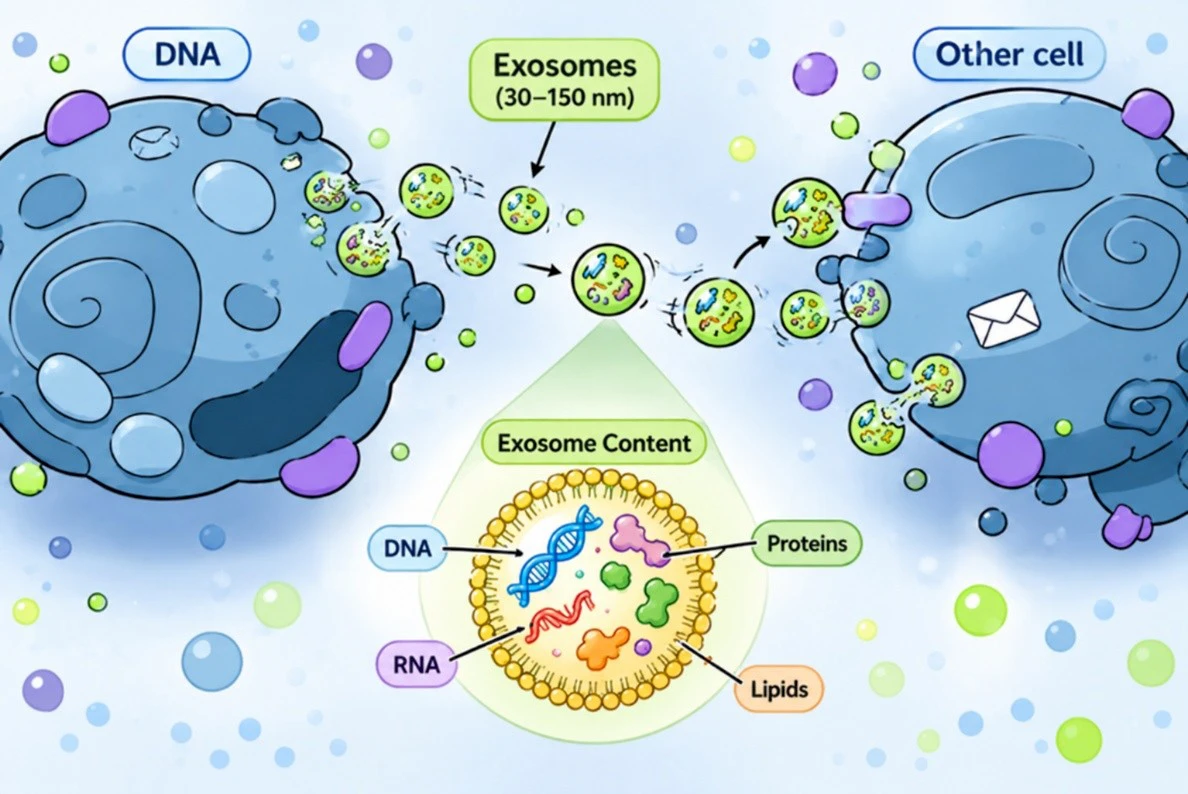
Exosome-mediated intercellular communication, illustrating the transfer of DNA, RNA, proteins, and lipids from donor to recipient cells.
First reported in the 1940s as particles released from blood platelets, EVs were recognised as participants in cell-to-cell communication several decades later. The discovery in 2007 that they can transport functional genetic material between cells helped spark the interest that continues today. Researchers are now investigating their potential as disease biomarkers and as vehicles for delivering therapeutic molecules.
The promise is considerable, but so are the challenges. EVs vary in size, molecular cargo, membrane composition and surface properties. Isolating sufficiently pure and consistent populations, producing them at scale and understanding how they behave inside the body remain major obstacles. As Dr Rakshit and her co-author noted in their review, Extracellular Vesicles for Drug Delivery and Theranostics In Vivo, no EV-based therapy had received regulatory approval to date.
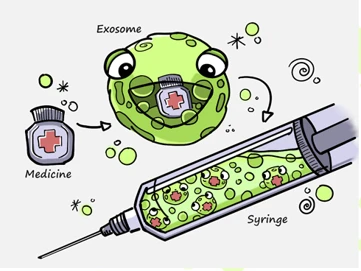
Exosomes as nanocarriers for therapeutic agents, highlighting their potential for targeted drug delivery to recipient cells.
Dr Tatini Rakshit, Assistant Professor in the Department of Chemistry at Shiv Nadar University, and her collaborators approach this complexity by looking beyond the molecules contained within a vesicle. They investigate what its surface and mechanical properties can reveal about its identity and behaviour.
Her lab uses atomic force microscopy (AFM), in which a needle-fine probe scans a surface and measures the forces it encounters, much like reading Braille. The researchers also use spectroscopy, which helps identify molecules by examining how they interact with light. These techniques offer ways to investigate very small biological structures without relying entirely on fluorescent labels.
One area of the lab's research focuses on hyaluronan, a naturally occurring sugar polymer involved in tissue hydration and organisation. Its levels and organisation can change in certain cancers. In studies comparing EVs released by colon cancer cells with those from normal colon cells, the researchers used spectroscopy and AFM to investigate hyaluronan-associated signatures. They found a higher surface density of hyaluronan on cancer-derived vesicles.
But could hyaluronan also change how a vesicle feels and behaves?
Using single-molecule force spectroscopy, the researchers examined individual vesicles and found that cancer-associated vesicles carrying shorter hyaluronan chains were more elastic than their normal-cell counterparts. Their findings suggested that the arrangement of the sugar chains, together with the layer of water surrounding them, could contribute to this difference. Since hyaluronan can bind to CD44, a receptor found on many cancer cells, these findings also raise questions about how the surface properties of EVs may influence their interactions with other cells.
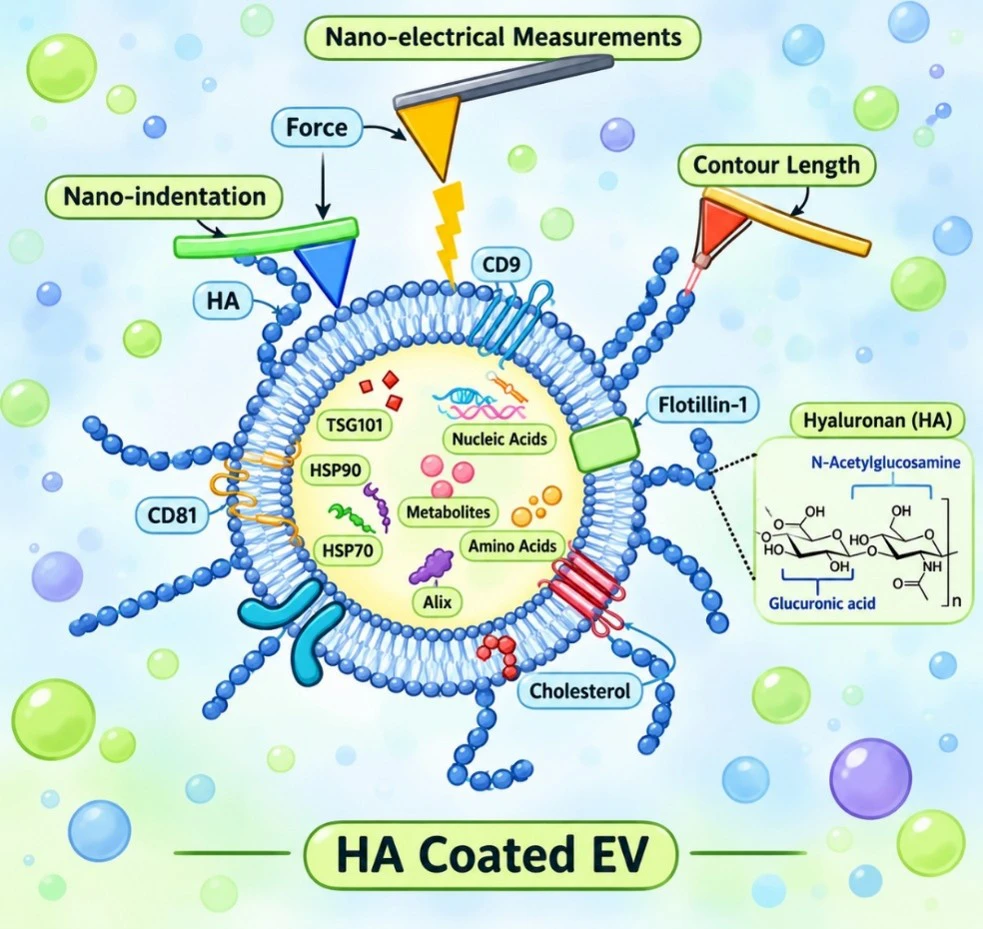
HA-coated EV architecture and their nanoscale biophysical characterization using AFM-based nano-indentation, force spectroscopy, and nano-electrical measurements.
From understanding vesicles to engineering them
Understanding what makes a vesicle distinctive is one challenge. Learning to put its properties to work is another. Could these naturally derived structures be adapted to carry therapeutic molecules into cells?
This is one of the questions driving research into EV-based drug delivery. Small interfering RNA (siRNA), for example, can selectively reduce the expression of a particular gene. However, getting it across a cell membrane and delivering it to the intended cells is not straightforward.
Liposomes—artificially prepared lipid-based particles—are widely investigated as drug-delivery vehicles. EVs offer a biological alternative, but their drug-loading capacity can be limited, and they may be cleared rapidly from circulation or aggregate, affecting their delivery efficiency.
One approach explored by Dr Rakshit and her team was to combine the properties of biological vesicles with those of synthetic carriers. They fused microvesicles released by breast cancer cells with positively charged liposomes, using polyethylene glycol (PEG) to form hybrid vesicles. The formulation proved important: at an intermediate PEG concentration, the hybrid vesicles delivered fluorescent model siRNA into breast cancer cells more efficiently than either liposomes or microvesicles alone.
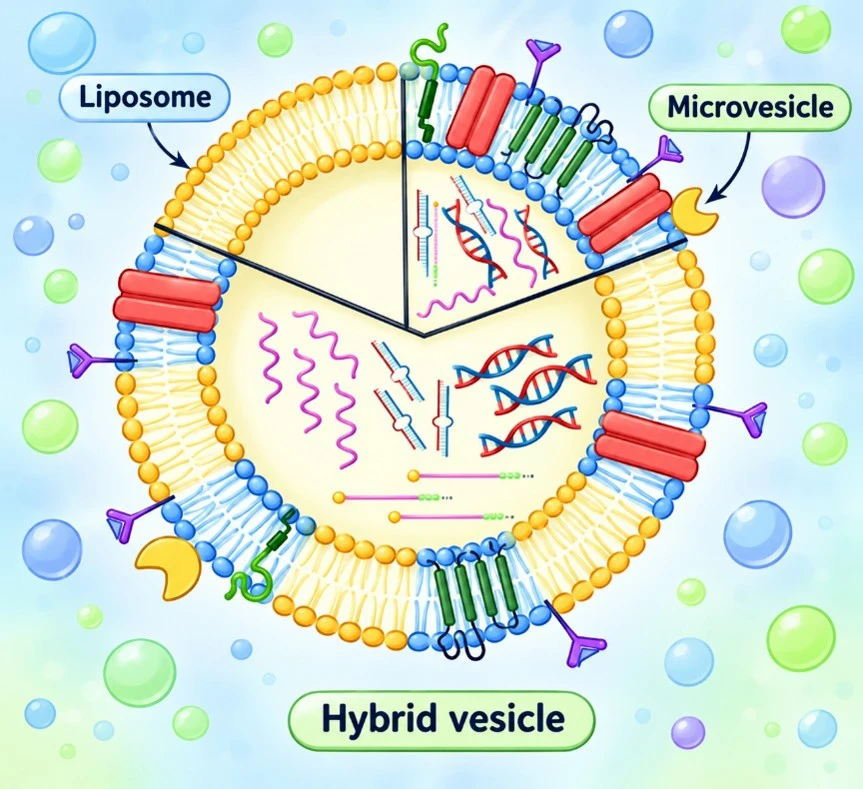
Hybrid vesicle formation through the integration of liposomes and microvesicles, highlighting their potential as platforms for molecular transport and drug delivery.
The physical properties of the membrane also matter. Lipid molecules can differ in their arrangement, influencing how tightly they pack together and how flexible or rigid a membrane becomes. In another study, the researchers compared liposomes made using cis- and trans-configured forms of DOPC, a phospholipid. The trans-configured liposomes were mechanically stiffer and delivered siRNA more efficiently in the breast cancer cell model.
The search for delivery materials has also extended to plants. EVs isolated from neem, mint and curry leaves were combined with chitosan and PEGylated graphene oxide to develop composite systems for delivering siRNA targeting estrogen receptor alpha in breast cancer cells. Among the formulations tested, the neem-based system showed the strongest performance in laboratory experiments.
Plant-derived vesicles are also being explored for applications beyond gene delivery. In separate studies, mint-derived and rose-petal-derived vesicles were incorporated into hydrogels investigated for wound care. These preclinical studies examine how plant-derived vesicles, combined with engineered materials, might support local antibacterial and wound-healing applications.
From cell membranes to chromosomes
The questions that run through this research do not stop at the cell membrane. They lead into the nucleus, where DNA is organised into chromosomes and where changes in molecular arrangement can affect the structure and behaviour of these structures.
Chromosomes are often studied through their genetic information and chemical modifications. But their organisation also has a physical dimension. Changes in DNA methylation and histone modifications can alter chromatin structure, influencing how genetic information is accessed and regulated.
Dr Rakshit and her team used infrared spectroscopy, circular dichroism, ultraviolet-visible spectroscopy and electrochemical measurements to investigate chromosomes isolated from breast cancer and normal breast epithelial cells. Their findings revealed differences in the physical and chemical characteristics of the chromosome preparations. The combination of label-free techniques could distinguish significantly hypermethylated breast cancer chromosomes from their normal-cell counterparts, offering another way to investigate cancer-associated epigenetic changes.
The team also examined how the epigenetic modifier valproic acid affects chromosome properties. Using AFM, the researchers studied metaphase chromosomes from breast cancer cell lines and found changes in chromosome elasticity and electron-transport behaviour following drug exposure. These changes were associated with the effects of valproic acid on chromatin organisation, providing a way to examine the physical consequences of epigenetic modification.
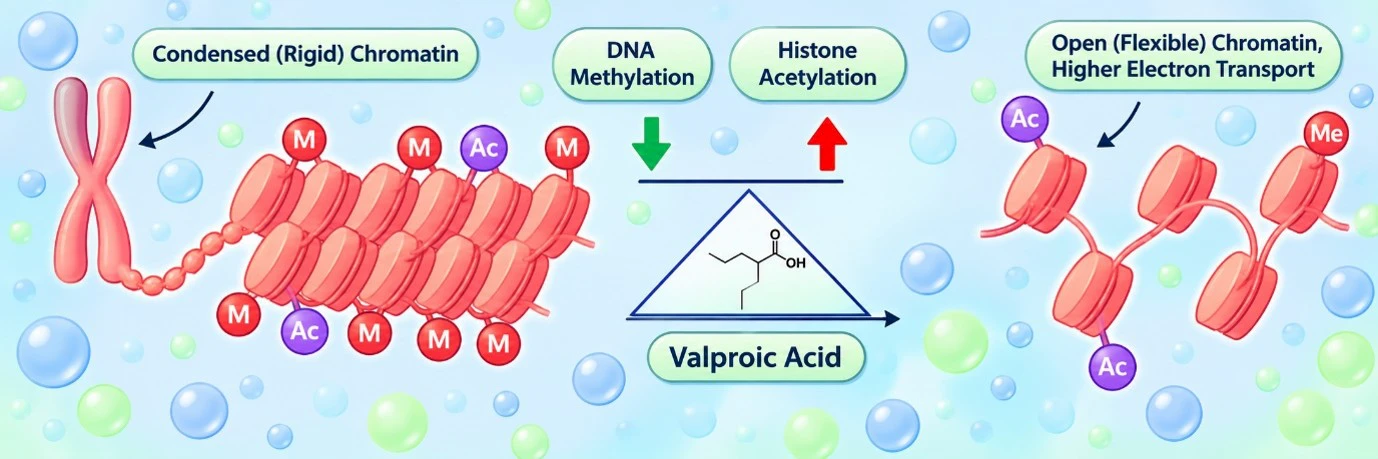
VPA-induced chromatin remodeling, highlighting histone acetylation, DNA hypomethylation, chromatin decondensation, and altered electron transport properties.
Recognition and academic engagement
In 2026, Dr Rakshit was nominated as a member of the Scientific Board of the Indian Society for Extracellular Vesicles (InSEV), invited to join the Epigenetics Society, USA, and recommended as an ACS Nanoscience Rising Star. Earlier, in 2024, she was appointed to the Early Career Editorial Board of Extracellular Vesicles and Circulating Nucleic Acids.
Despite the growing interest in EVs, several challenges remain before their potential can be translated into clinical applications. Isolating sufficiently pure and consistent vesicles, understanding which of their components are responsible for particular biological effects, and developing reliable methods for their production and delivery are all areas that require further investigation.
As Dr Rakshit observes, “The use of EVs for therapeutic purposes is still in its infancy.” Much remains to be understood before their promise can be translated into reliable clinical applications.
These investigations bring the research back to a central theme: biological structures are dynamic physical systems, and understanding their behaviour can reveal information that molecular identification alone may not capture.
Srijita Banerjee,
Academic Associate,
School of Natural Sciences.
More Blogs

The Hawthornden Literary Retreat bestowed on Dr Sambudha Sen to complete the manuscript of a novel
Professor Sambudha Sen, Head of the Department of English at Shiv Nadar Institution of Eminence, Delhi-NCR, was awarded a residency at the...
The Power of the Moving Body
Movement is an innate bodily action that humans have been exhibiting for the longest time. Long before language was invented, the body was the...

How Does A Multi-Disciplinary Approach To Education Enhance Learning And Prepare Students For A Multi-Faceted World?
In today’s world, where businesses are changing almost every day, it is the responsibility of educational institutes to provide holistic...