Ph.D. Admission 2026: Complete Guide to Eligibility, Admission Process & Entrance Exams
Blog / January 07, 2026
Pursuing a Doctor of Philosophy (Ph.D.) represents the highest level of academic achievement. It opens doors to advanced research opportunities, teaching positions, and specialized career paths across universities, research institutions, and industries worldwide. As Ph.D. admission for 2026 approaches, understanding the latest eligibility criteria, application processes, as well as entrance exam requirements is important for candidates.
This comprehensive guide covers everything you need to know about Ph.D. admission eligibility, the application process, entrance exams, important dates, and university selection strategies for the 2026 academic year. This help you plan your doctoral journey with clarity and confidence.
Ph.D. Admission Eligibility 2026
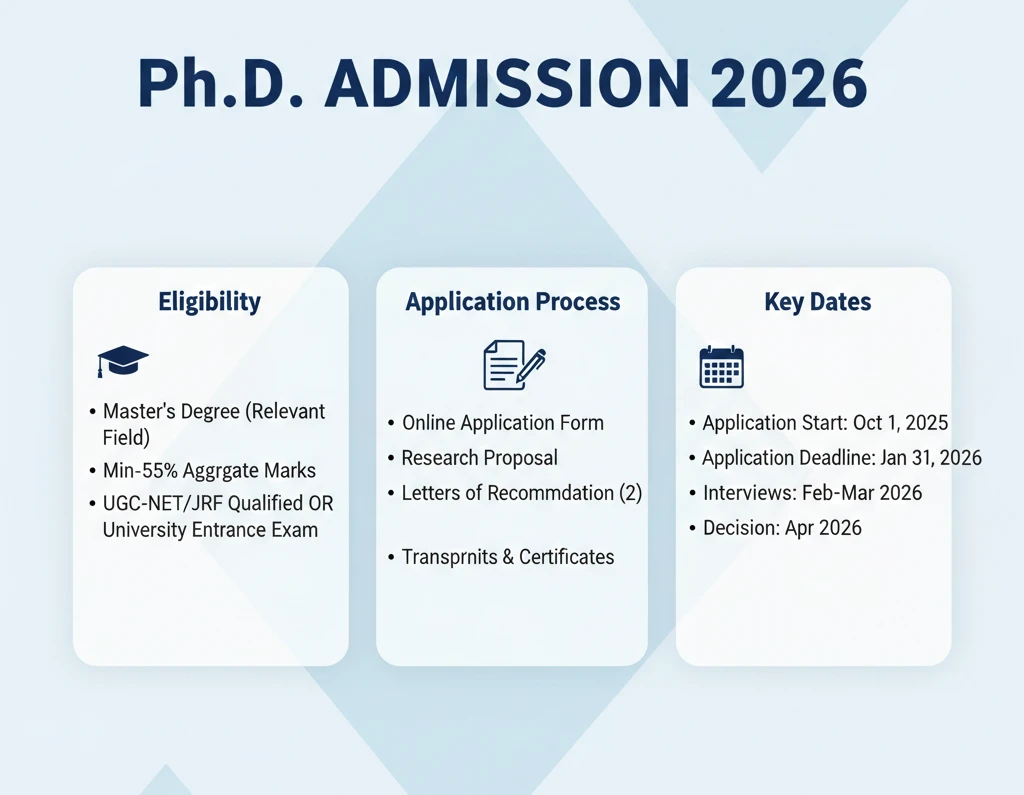
Understanding Ph.D. admission eligibility criteria is crucial before applying. While specific criteria vary across universities and disciplines, here are the general requirements:
|
Category |
Requirement |
|
Educational Qualification |
Master's degree in a relevant discipline |
|
Minimum Percentage (General) |
55% or equivalent CGPA |
|
Minimum Percentage (SC/ST/OBC) |
50% or equivalent CGPA |
|
Entrance Exam |
UGC NET/CSIR NET/GATE/University exam (varies by institution) |
|
Age Limit |
Generally, no upper age limit (some fellowships have restrictions) |
|
Research Proposal |
Required by most universities during application or interview |
Ph.D. Entrance Exams 2026
Several national and university-level entrance exams determine Ph.D. admission eligibility. Understanding which exam applies to your discipline is crucial for successful admission.
Top 5 National-Level Ph.D. Entrance Exams
|
Exam Name |
Conducting Body |
Subjects Covered |
Exam Mode |
Fellowship Eligibility |
|
UGC NET |
National Testing Agency (NTA) |
Humanities, Social Sciences, Commerce, Education (81+ subjects) |
Computer-based (CBT) |
Yes (JRF for top scorers) |
|
CSIR NET |
CSIR-HRDG |
Life Sciences, Physical Sciences, Chemical Sciences, Earth Sciences, Mathematical Sciences |
Computer-based (CBT) |
Yes (JRF for top scorers) |
|
GATE |
IIT (rotational) |
Engineering & Technology (30+ papers), Science subjects |
Computer-based (CBT) |
Yes (through institutes) |
|
ICAR AICE |
Indian Council of Agricultural Research |
Agricultural Sciences, Veterinary Sciences, Fishery Sciences |
Computer-based (CBT) |
Yes (ICAR fellowships) |
|
ICMR JRF |
Indian Council of Medical Research |
Biomedical Sciences, Life Sciences |
Computer-based (CBT) |
Yes (ICMR fellowships) |
Exemptions from Entrance Exams
Candidates may be exempt from entrance exams if they:
- Hold UGC NET (including JRF) or CSIR NET qualification
- Have qualified GATE with valid scores
- Possess M.Phil degree from a recognized university
- Are faculty members at the same institution (institutional policies vary)
Ph.D. Admission Important Dates 2026
Timing is critical for Ph.D. admission success. Here's a comprehensive list of exam dates for Ph.D. admission 2026 in India:
|
Entrance Exam |
Application Period |
Exam Date |
Result Declaration |
|
GATE 2026 |
September - October 2025 |
February 2026 |
March 2026 |
|
UGC NET (June Session) |
March - April 2026 |
May 2026 |
June 2026 |
|
CSIR NET |
March - April 2026 |
April - May 2026 |
June 2026 |
|
ICAR AICE |
February - March 2026 |
April 2026 |
May 2026 |
|
JNU Ph.D. Entrance |
December - January 2026 |
February - March 2026 |
April 2026 |
|
DU Ph.D. Entrance |
April - May 2026 |
May - June 2026 |
June 2026 |
Dates vary across universities and are subject to change. Always verify specific dates on official university websites and regularly check the Ph.D. admission 2026 portals for updates.
Ph.D. Admission Process 2026: Step-by-Step Guide
The Ph.D. admission process involves several stages that candidates must navigate successfully:
- Check Eligibility: Review the eligibility criteria for your chosen universities, including percentage requirements and entrance exam scores.
- Select Research Discipline & University: Identify your research interest and choose universities with strong programs in that area.
- Prepare for Entrance Exams: Register and study for relevant entrance exams such as UGC NET, CSIR NET, or GATE.
- Submit Your Application: Fill out the online application and attach required documents, keeping an eye on deadlines.
- Attend Interview and Present: Prepare to present your research proposal during the interview to the selection committee.
- Complete Admission and Enrollment: Accept your admission offer and finalize enrollment by submitting documents and paying fees.
Types of Ph.D. Admission
Ph.D. programs offer different modes to accommodate various candidate profiles:
|
Type of Ph.D. Admission |
Duration |
Funding/Fellowship |
Key Features |
|
Full-Time Ph.D. |
3-5 years |
University fellowships or external funding (UGC, CSIR, etc.) |
Ideal for academic careers and intensive research; requires regular on-campus engagement |
|
Part-Time Ph.D. |
Up to 7 years |
Limited or usually not available |
Flexible attendance; admission may be restricted to certain departments |
|
Sponsored/Fellowship-Based Ph.D. |
Typically 3-5 years |
Monthly stipend ₹31,000–₹35,000 plus contingency grants (UGC NET JRF, CSIR JRF, DBT JRF, etc.) |
Reduces financial burden; funding tied to fellowship conditions |
|
Direct Ph.D. After Bachelor’s Degree |
Integrated (Master’s + Ph.D.) |
Institutional or fellowship-based funding (varies) |
For exceptional bachelor’s degree holders; includes master’s-level coursework before research phase |
How to Choose the Right Ph.D. Program
Selecting the appropriate university and program significantly impacts your research experience:
- Research Alignment: Identify universities with strong research groups in your area of interest. Review faculty publications, ongoing projects, and available research facilities.
- Funding and Scholarships: Sustained financial support throughout your Ph.D. journey reduces stress and allows you to focus on research.
- University Ranking and Reputation: While not the only factor, university reputation affects future career opportunities, especially in academia.
- Infrastructure and Resources: Adequate laboratory facilities, library resources, computational tools, and access to research databases are essential for productive research.
- Location and Living Conditions: Your comfort and well-being during the multi-year Ph.D. journey matter significantly for sustained productivity.
Empowering Scholars to Lead Breakthrough Research with a Ph.D. Degree @ Shiv Nadar University (Institution of Eminence)
Shiv Nadar University is recognized as a premier institution dedicated to providing a robust Ph.D. program aimed at attracting and fostering exceptional researchers. The university's Ph.D. admissions span a variety of disciplines across its multiple schools, including the School of Engineering, School of Natural Sciences, School of Humanities and Social Sciences, and the School of Management and Entrepreneurship.
Some of the doctoral programs available through these schools include:
- Ph.D. in Chemical Engineering
- Ph.D. in English
- Ph.D. in Civil Engineering
- Ph.D. in Computer Science & Engineering
- Ph.D. in Electrical Engineering
- Ph.D. in Electronics & Communication Engineering
- Ph.D. in Life Sciences/Bioinformatics
- Ph.D. in Sociology
- Ph.D. in History and Archaeology
- Ph.D. in Economics
- Ph.D. in Chemistry and more.
Conclusion
Ph.D. admission in 2026 requires careful planning and thorough preparation. To navigate the competitive landscape, understand eligibility criteria, entrance exam requirements, and application processes. Whether driven by a passion for research or a desire for specialized expertise, a Ph.D. is a transformative journey.
Begin your preparation early by crafting a strong research proposal and studying for entrance exams. Approach the admission process systematically, and with dedication, you can secure a place in a program that aligns with your goals.
Regularly check university websites for up-to-date information on admission schedules and criteria, as these can change. Start preparing now for your doctoral journey in 2026. Apply Now!
FAQs
How do I get admission in Ph.D.?
Start by checking eligibility, choosing your research area, and clearing an entrance exam like UGC NET, CSIR NET, GATE, or a university test. Shortlisted candidates attend interviews and present a research proposal.
Who is eligible for Ph.D. exam?
Candidates with a relevant master’s degree and at least 55% marks (50% for reserved categories) are eligible. Some universities also allow candidates with valid NET, GATE, or equivalent qualifications to apply directly.
Can I do Ph.D. at the age of 40?
Absolutely! There’s usually no upper age limit for Ph.D. admission in India. Many professionals begin their Ph.D. in their 40s or later, especially through part-time or sponsored research programs.
Can I complete my Ph.D. in 2 years in India?
In most cases, no. As per UGC norms, a Ph.D. typically takes a minimum of three years. Even with prior research experience or M.Phil, completing a Ph.D. in just two years is unlikely.