Part-Time MBA vs Executive MBA: What Works Better for Working Professionals?
Blog / January 08, 2026
In the last ten years, the search for an MBA for working professionals has increased significantly, as people actually want a degree that fits into their packed schedules. Careers run longer now, and the way work patterns keep changing, people want to boost their management skills, but without putting their jobs on hold.
If you’re considering an MBA while you work, you’ll probably run into two main choices: the Part-Time MBA and the Executive MBA (EMBA). Both are popular, both target people who are already working, but they’re actually built for different points in your career and goals.
The blog will break down what each program offers, what makes them different, and which one makes sense for you - especially if you’re considering an MBA for working professionals in India.
Why Working Professionals are Choosing Flexible MBA Formats
GMAC’s latest data shows most people aiming for MBA programs that let them keep working. Makes sense, right? With higher living costs and bills to pay, quitting your job isn’t easy.
This shift is even stronger in India. For many, stepping away from a steady paycheck isn’t just an option. That’s why part-time, executive, weekend, and blended MBAs are popping up everywhere. Everyone’s trying to make education fit into real life, not the other way around.
What is a Part-Time MBA?
A part-time MBA lets you keep working while you learn the ins and outs of management. Classes usually happen on weekends or evenings, sometimes online, sometimes in person - it’s all set up to fit around your job.
In India, these part-time MBA or PGDM programs usually last two to three years. The coursework covers the basics - marketing, finance, operations, HR, and strategy - so you get a solid foundation in everything that matters in management.
Key Features of a Part-Time MBA
- Designed for early to mid-career professionals
- Flexible class schedules suited for full-time employment
- Emphasis on management fundamentals
- Lower cost compared to full-time MBA programs
- Learning spread over a longer duration for easier absorption
Who Should Opt for a Part-Time MBA?
A part-time MBA is ideal if you:
- Have 2-8 years of work experience
- Want to transition from technical or functional roles into management
- Are looking for steady career progression
- Need flexibility due to work or personal commitments
For many professionals, a part-time MBA serves as a structured way to gain managerial credibility while continuing to grow within their organization or industry.
What is an Executive MBA (EMBA) in India?
An Executive MBA is designed for experienced professionals who already hold managerial or leadership responsibilities and want to advance into senior or strategic roles.
In India, Executive MBA programs are typically targeted at professionals with 5-10+ years of work experience, depending on the institution. These programs are usually completed within one to two years and follow an intensive learning model with weekend or modular classes.
Key Features of an Executive MBA
- Aimed at mid-to-senior level professionals
- Shorter but more intensive program structure
- Strong focus on leadership, strategy, and decision-making
- Peer learning from experienced professionals
- Higher program fees compared to part-time MBA formats
Who Should Choose an Executive MBA?
An EMBA is better suited if you:
- Have significant work and people management experience
- Are already leading teams, projects, or business units
- Want to accelerate into senior leadership roles
- Value learning through peer discussions and real-world case studies
In India, many executive MBA programs are branded as PGPEX, EPGP, or PGPX and are positioned as leadership-focused programs rather than foundational management degrees.
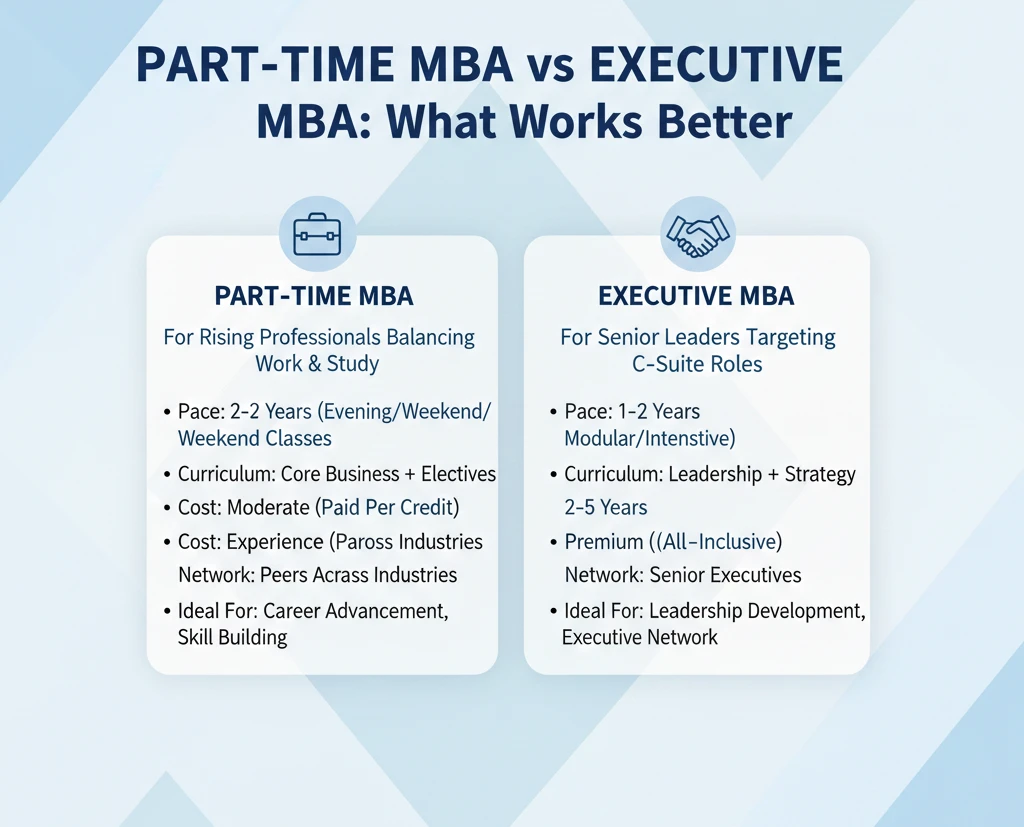
Part-Time MBA vs Executive MBA: Key Differences
1. Experience Level and Peer Group
Classroom compositions really set these programs apart. In part-time MBAs, you’ll find folks at different points in their careers - some just starting out, others with a few years under their belts. Executive MBA programs, on the other hand, pull in seasoned professionals, people who’ve already built up a lot of experience. This mix changes everything. The conversations go deeper, and the peer learning takes on a whole new level, especially in the executive track.
2. Time Commitment and Learning Intensity
Both formats let you keep working, but they move at different speeds. With a part-time MBA, you take classes over a longer stretch, which helps if you’ve got a busy job and need some breathing room. An Executive MBA crams the material into a shorter window, so things get intense fast. You really have to stay on top of your schedule and stay committed.
3. Cost Considerations and Return on Investment
Part-time MBA programs cost less and are easier to get into, so they’re a popular choice for people paying out of their own pockets. Executive MBA programs charge more, but you’re paying for a group of experienced classmates and a curriculum built around leadership.
When it comes to results, part-time MBAs help you move forward in your career step by step. EMBAs, on the other hand, really push you toward bigger leadership roles and higher positions.
4. Career Outcomes: Progression vs Acceleration
Choosing between a part-time MBA and an EMBA really depends on where you see your career going. If you want to move up steadily, expand your skill set, or step into management for the first time, a part-time MBA makes sense. But if you’re aiming for a big leap - maybe into senior leadership or a role with more strategic or enterprise-wide impact - the EMBA fits better.
Relevance of MBA for Working Professionals
India’s management education ecosystem has evolved rapidly to meet the needs of working professionals. Leading institutions now offer:
- Weekend and modular MBAs
- Blended online + campus programs
- Mid-career executive education pathways
This expansion ensures that professionals do not have to pause their careers to gain high-quality management education.
Future-Ready MBA for Working Professionals at Shiv Nadar University (Institution of Eminence)
An example of how Indian universities are adapting MBA programs for employed learners can be seen in the Online MBA offered by Shiv Nadar University. This two-year online program is structured specifically for individuals looking for an MBA for working professionals and want flexibility without compromising academic depth.
The program structure and learning design include:
- A quarter-based format spread across eight quarters, designed for working professionals
- Live online classes conducted on weekends, supported by recorded lectures for flexible learning
- An average commitment of 8-12 hours of structured learning per week, enabling a balance between work and academics
- Specialization options in Marketing, Digital Finance, Human Resources, and Data Science & Analytics
- Campus immersion opportunities that support peer interaction, applied learning, and academic engagement beyond the online format
This model reflects how Indian universities are designing MBAs that align closely with the realities of working professionals today.
Final Takeaway: Which MBA Works Better?
The choice between a Part-time MBA and an Executive MBA isn’t about which one is superior. It comes down to where you stand in your career. Both degrees are made to fit based on the needs of working professionals that are structured management training without quitting your job.
Part-Time MBAs are great if you’re still building up your management skills and want to get a broader view of business. On the other hand, Executive MBAs focus on leadership and big-picture strategy, usually for folks who already have a good chunk of experience. Universities here are catching on, too. So you can keep working and still keep learning.
With so many options out there for people with jobs, the hard part isn’t finding a program - it’s figuring out which one actually fits your career, your energy level, and where you want to end up.
FAQs
Q. Can working professionals do an MBA?
A. Yes, it is one of the most convenient ways to get promoted to senior roles or switch careers.
Q. Which MBA is best for working professionals?
A. EMBA, MBA Online and Part-time MBAs are great as they provide flexibility to balance work and studies.
Q. Can I do an MBA after 32 years of age?
A. Yes, there is no age bar set to do an MBA, just make sure to fit well within the eligibility criteria.
Q. Is it possible to balance work and study while doing MBA?
A. Yes, only if it is an online MBA, EMBA or a part-time one.