Mechanical Engineering Courses After 12th: Shaping Innovators Who Build the Future of Mobility, Energy, and Infrastructure
Blog / October 08, 2025
B. Tech. Mechanical EngineeringMech. Engg. courses after 12thWe live on the edge of an Industrial Revolution. Electric vehicles are gliding silently along smart highways, wind farms are powering homes and cities, while 3D-printed buildings are rising into the skyline. The physical world is being redesigned. The driving force behind this change is a discipline which has been around for as long as innovation: Mechanical Engineering.
For students graduating 12th grade this should mean that picking the right mechanical engineering courses after 12th grade is not just an academic exercise - it is also a commitment to being a builder of the future.
This blog will provide an overview of the exciting avenues of a B.Tech. in Mechanical Engineering and other similar courses, and will also give insight into how all of this prepares students to solve the big problems found in mobility, energy, and infrastructure.
Understanding the Core of Mechanical Engineering
At its core, mechanical engineering is the application of principles of physics, mathematics, and materials science to design, analyze, manufacture, and maintain machines and mechanical systems. Mechanical engineering encompasses the widest of all engineering disciplines, and involves anything that moves, from the tiniest micro-sensors to the largest spacecraft.
The foundational courses in mechanical engineering after 12th grade provide that core expertise, and include:
- Thermodynamics and Fluid Mechanics
- Engineering Mechanics and Strength of Materials
- Machine Design and Theory of Machines
- Manufacturing processes and metallurgy and
- Computer-Aided Design (CAD) and Computer-Aided Manufacturing (CAM)
This core foundation is not negotiable. However, just like the practice of mechanical engineering, the educational curriculum has come a long way from just studying gears and pistons - it is infused with digital technologies to prepare graduates to meet the demands of future industries.
The Premier Pathway: B.Tech Mechanical Engineering
The B.Tech in Mechanical Engineering is one of the most popular mechanical engineering courses after 12th for aspiring engineers. Typically, it takes four years and provides substantial theory as well as laboratory and industry projects. The power of a contemporary B.Tech. in Mechanical Engineering is that it incorporates applied fields of study:
- Mechatronics & Robotics: Mechanical systems aren't mechanical systems any more; mechanical engineers will take courses in Mechatronics and Robotics, and Automation that will prepare them with the knowledge and skills to design and manage the intelligent systems that operate automated factories or surgical robots or autonomous vehicles.
- Sustainable Energy Systems: As the world moves to a decarbonized future, mechanical engineers will be tasked with the design of systems for solar and wind energy systems, hydrogen generation, and innovation in battery technology and energy systems.
- Advanced Materials and Manufacturing: The infrastructure of the future requires smarter materials and processes. Current courses teach composites, smart materials and additive manufacturing (3D Printing) which are significantly changing how we build custom medical implants to architectural components.
Other Noteworthy Mechanical Engineering Courses After 12th
Although B.Tech has been positioned as the gold standard, other routes have great career options too:
- Diploma in Mechanical Engineering: A three-year polytechnic course that is very hands-on and valid for students wanting to work quickly.
- B.E. (Bachelor of Engineering) in Mechanical Engineering: Almost the same degree as the B.Tech., with a distinction of being more theoretical (B.E.) rather than application based (B.Tech.), although that difference has narrowed.
- Integrated B.Tech. + M.Tech. Program: A five-year dual degree in Mechanical Engineering for students wanting a greater foundation in research.
Shaping the Future: The Three Pillars of Innovation
The Future of Mobility:
For the first time in over a hundred years, the auto and aerospace industries are going through their biggest disruption. Mechanical engineers are leading projects that include designing battery packs and thermal management for Electric Vehicles (EVs), creating sensors and actuators for autonomous systems, and designing jet engines that are more fuel efficient and airframes for the next generation of aerospace that weigh less.
The Future of Energy:
The transition to a more sustainable energy grid is perhaps the largest undertaking for engineers in the century. Mechanical engineers are at the frontlines of this transition from establishing and maintaining large wind turbines offshore to designing concentrated solar plants and the foundation of a hydrogen economy.
The Future of Infrastructure:
From smart cities to able water systems, the built environment is undergoing a tech-enabled upgrade. Here mechanical engineers innovate by designing energy efficient "green" buildings with smart HVAC systems, create a body of innovative robotics for building construction, and develop water purification and desalination systems to overcome our failings of global water shortages.
Pursuing Excellence with Shiv Nadar University (Institution of Eminence): The Hallmarks of a Modern Mechanical Engineering Program
In choosing mechanical engineering courses after 12th, students are well-advised to find colleges which teach a combination of core principles and cutting-edge technology. The best programs heavily focus on experiential-based, active learning.
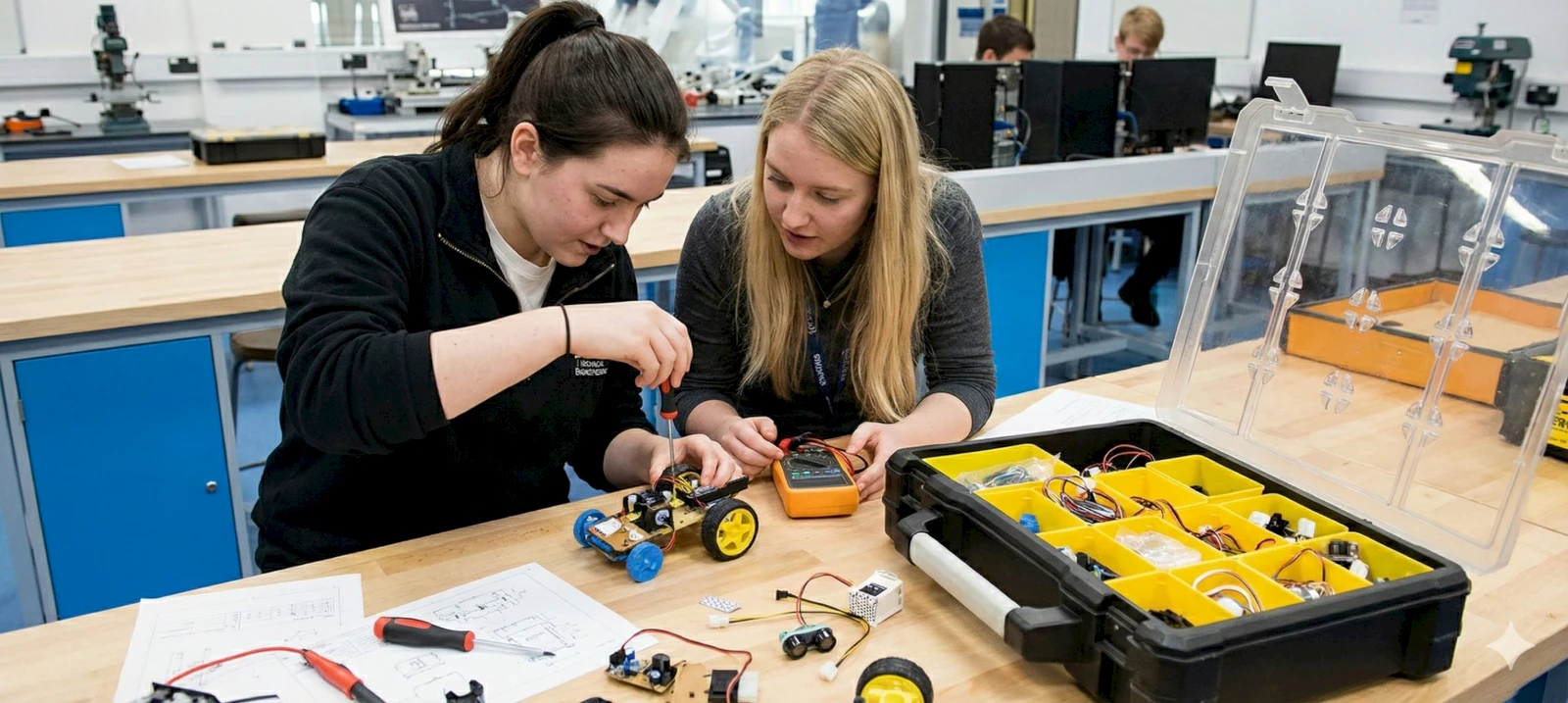
An example is the B.Tech. Mechanical Engineering program at Shiv Nadar University, which is framed within a philosophy of "Learning-by-Doing". More specifically, the curriculum emphasizes the entire product development cycle from idea to concept, design, prototyping to testing, rather than simply theory. At the School of Engineering, students have the opportunity to carry-out research in several thrust areas including:
- Advanced Manufacturing - students practice principles like precision engineering and additive manufacturing.
- Robotics and Automation - completing control design for robotic systems.
- Energy and Sustainability - research in areas of thermal sciences and sustainable energy technologies.
- Design Engineering - teaching students the latest in computer-aided engineering and finite element analysis, with the latest "state of the art" facilities.
The framework of the courses routinely features activities like capstone projects, but increasingly, students are dealing with industry-connected problem-solving and other issues related to technology and infrastructure. The overall experience of the time in all engineering courses is naturally interdisciplinary, and students regularly receive insights from other engineering-based fields.
Is This Path for You?
If you are a student who holds an inquiring mind about how everything works, enjoys solving problems that are often very complex, is good in physics and mathematics, and wants to contribute to solutions in the real world that have a social purpose, mechanical engineering may be for you.
The most important thing is to pick a program that teaches those aspects of the profession but is also situated in a program that is predictive of the digital and sustainable future. So, apply at Shiv Nadar University which has excellent industry links, modern laboratories, and a curriculum focused on interdisciplinary projects.
Conclusion
The perspective of mechanical engineering as an established field is bygone. It is, in fact, one of the most exciting and important professions in terms of defining a sustainable future. By taking the proper mechanical engineering courses after 12th grade, especially through a holistic degree like B.Tech. Mechanical Engineering, you are not only choosing a profession, but also a chance to be a person who creates and shapes the future of physical movement, energy, and physical spaces.
The key is to find a program similar to the one at a university like Shiv Nadar University, which goes beyond the pure-theory elements of a manual to building a culture of practical hands-on innovative engineers and interdisciplinary problem-solvers who will turn today's aspirational projects into tomorrow's built world.
FAQs
What are the best mechanical engineering courses available after the 12th grade?
There are a range of mechanical engineering courses after completing 12th grade including Diploma, B.E. and B.Tech., where B.Tech. is preeminent.
Can I change specialisation later or pursue higher education?
Yes, after completing B.Tech. in Mechanical Engineering, you can take specialization courses in many different areas such as thermal engineering, manufacturing, robotics, automation, aerospace. You can also do a Masters or transition into fields like data analytics for manufacturing, IoT, renewable energy systems, etc.
I missed out on JEE, how can I get admission in B.Tech. in Mechanical Engineering?
There is no need to worry as universities like SNU conduct their own entrance exam, SNUSAT, and aptitude test for admissions.