MBA Eligibility Criteria in India: Academic Requirements and Admission Process
Blog / January 06, 2026
An MBA has continued to remain one of the most desirable career paths for graduates across different streams. It can take you across different industries like consulting, finance, tech, operations. Every year, millions of candidates apply to different business schools all over the country. So, before you dive into test preparations or start picking out schools, make sure you are well aware about the MBA eligibility. It’s worth knowing the details upfront.
As many candidates remain unclear about the actual eligibility norms and admission stages, despite MBA’s huge popularity. In this blog, you’ll get to know about the complete MBA eligibility criteria in India, academic requirements, the role of entrance exams, and the standard pattern followed by various B-schools in India.
Understanding MBA Eligibility in India
In simple terms, MBA eligibility refers to the minimum educational qualifications and examination requirements a candidate must fulfill to apply for an MBA or PGDM course. While MBA programs are offered by IIMs, IITs, central universities, state universities, and private institutions, the foundational eligibility norms are largely similar across the ecosystem.
Eligibility is not restricted by undergraduate stream or professional background. Instead, business schools assess candidates based on graduation status, minimum qualifying marks, and performance in recognized management entrance examinations.
Minimum Academic Requirements for MBA Programs
Bachelor’s degree from a recognized university
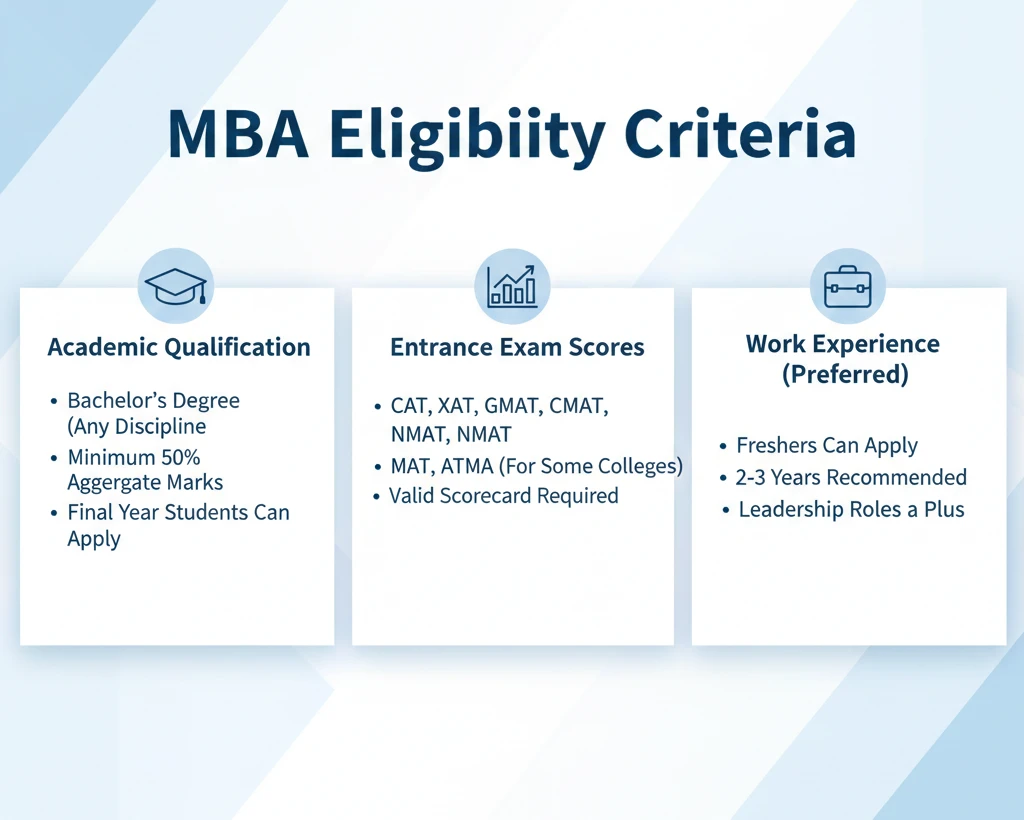
The MBA eligibility criteria in India is quite flexible. One must acquire a bachelor's degree which is at least three years long from an accredited institution. Those with degrees in any field, including art, commerce, science, engineering, law, and medicine, can apply to the vast majority of institutions in India. In addition, many institutions will accept applications from final-year students so long as they provide proof of their degrees before the deadline for enrollment comes due.
Minimum graduation marks
The standard academic benchmark followed by most MBA colleges in India is:
- 50% aggregate marks (or equivalent CGPA) in graduation for General category candidates
- 45% aggregate marks (or equivalent) for SC/ST/PwD candidates
IIMs, central universities, and a lot of private or autonomous colleges go by this eligibility rule. However, some private universities ask for higher marks, usually between 55% and 60%. Hitting the minimum score just means you’re eligible. It doesn’t mean you’ll get in, since MBA admissions are seriously competitive.
Role of MBA Entrance Exams in Eligibility
Academic qualification alone does not complete MBA eligibility in India. A valid score in a recognized management entrance examination is a critical component of the admission process.
Major MBA entrance exams in India
- CAT (Common Admission Test) - Accepted by all IIMs and over 1,000 business schools
- XAT (Xavier Aptitude Test) - Accepted by XLRI and several leading private institutes
- CMAT (Common Management Admission Test) - Widely accepted by AICTE-approved colleges
- MAT / ATMA - Accepted by many private and regional institutions
- GMAT - Accepted by select Indian MBA programs with global or executive orientation
CAT alone brings in more than 2.5 - 3 lacs candidates every year. The number of candidates that CAT attracts indicates how competitive MBA Admissions are in India. Students who meet the eligibility criteria can apply, but only by performing better than other candidates can get admission.
MBA Admission Process in India: Step-by-Step
Once candidates meet the MBA eligibility criteria in India, the admission process generally follows a structured multi-stage framework.
Step 1: Appear for an entrance exam
Candidates need to register for and take one or more MBA entrance examinations that are accepted by the institutions they wish to attend. The scores/percentiles received will generally be the primary consideration for shortlisting purposes.
Step 2: Apply to MBA colleges
Candidates can apply to a university either directly or through a centralized processing center. In both cases, students need to provide their academic information, entrance exam scores, work experience (if any), and other documents related to their eligibility.
Step 3: Shortlisting of candidates
Institutes then review everything. They pick candidates mostly by looking at test scores and how steady your grades have been. Some schools also care about things like where you’re from or your work background - it just depends on their rules.
Step 4: Selection rounds
Shortlisted candidates participate in evaluation rounds that may include:
- Personal Interview (PI)
- Written Ability Test (WAT) or essay
- Group Discussion (GD), used by some institutes
These rounds assess communication skills, analytical thinking, leadership potential, and overall suitability for management education.
Step 5: Final selection and admission offer
Final offers of admission are made based on an overall assessment of each applicant which may take into account successful results from entrance examinations, participation and performance in stages of the selection process, educational background and previous work experience. Selected candidates then continue with documentation verification and payment of tuition to secure admission.
MBA (Global) at Shiv Nadar University (Institution of Eminence): What the Program Offers and Who Can Apply
The MBA (Global) Program at Shiv Nadar University equips graduates to thrive within the global economy and changing digital environment by providing them with an experience-rich curriculum focused on data analysis, development of key leadership skills, and exposure to international business practices. They will have opportunities to learn about, through experiential learning, how to be effective managers/ leaders at the global level.
One major distinguishing feature of the MBA (Global) program is its focus on preparing students to work in multinational organisations or global business environments through the inclusion of international experiences (e.g., travel abroad), connections to industry and utilising present-day management theories and practices. The ultimate objective of this program is to provide students with the applicable knowledge they need to succeed as managers and leaders in an increasingly globalised workplace.
Eligibility Requirements
As per the official program guidelines, candidates applying to the MBA (Global) program at Shiv Nadar University must fulfill the following criteria:
- A bachelor’s degree from a recognized university with a minimum of 50% aggregate marks or equivalent CGPA.
- Final-year undergraduate students are eligible to apply and may be considered for provisional admission, subject to completion of degree requirements within the stipulated timeline.
- Submission of a valid score from any one of the accepted examinations, including CAT, XAT, GMAT, GRE, NMAT, or GATE, in accordance with the score validity norms specified by the university.
These criteria are aligned with standard MBA eligibility criteria in India, while offering flexibility through multiple accepted entrance exams and a globally aligned academic structure.
Conclusion
If you’re thinking about studying management in India, it becomes important to know every little detail about its eligibility. The MBA eligibility criteria in India is set up in a way where anyone with a degree, doesn’t matter what field, can throw their hat in the ring, as long as they meet the basic requirements and pass the entrance exams.
What further matters is your entrance exam score, the colleges you pick, and how well you prepare for interviews; all of that matters just as much. When you understand the eligibility and the way admissions work right from the start, you can plan smarter and boost your odds of getting in.
FAQS
- Can I do an MBA without CAT exam?
A. Yes, you can pursue an MBA without CAT through other entrance exams like NMAT, GRE, XAT, MAT, etc.
Q. Is direct admission possible in MBA?
A. Yes, direct MBA admission is possible in some private colleges and universities based on merit or management quota.
Q. Which MBA is highest in demand?
A. MBA in Marketing, Finance, Business Analytics, and Human Resources are currently among the highest in demand.
Q. Can we do an MBA after 12th?
A. No, you cannot do a regular MBA after 12th, but you can pursue integrated MBA programs that combine undergraduate and postgraduate studies.