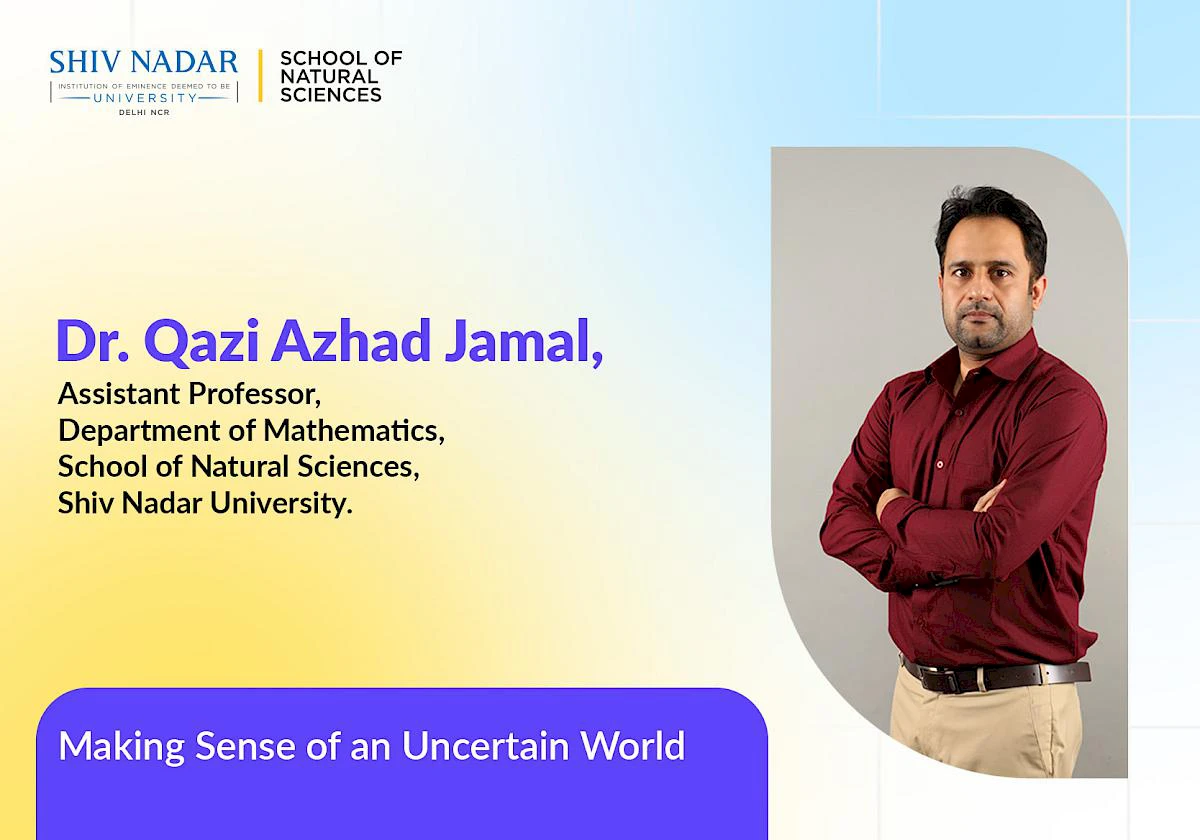
Making Sense of an Uncertain World: In Conversation with Dr Qazi Azhad Jamal
Editorial / September 04, 2026
Interview and Story by Srijita Banerjee
Mathematics is often presented as a world of certainty, where problems have precise answers. But when mathematics meets the real world, data are rarely complete, systems do not always behave as expected, and extreme events can be difficult to predict. In this conversation, Dr Qazi Azhad Jamal, Assistant Professor in the Department of Mathematics, discusses how statistical and computational methods can help us make sense of such uncertainty.
His research spans estimation theory, data-driven modelling, copula modelling and ordered data. We spoke to him about how these mathematical tools can help us make better decisions—from designing reliable products and understanding disease risk to planning infrastructure and evaluating sustainable development policies.
Q: Mathematics is often taught in terms of certainty, while real-world data are anything but neat. Why is this distinction important?
Dr. Jamal: Real-world data are more like a busy restaurant during dinner service. Ingredients may be missing, processes may stop midway, and unexpected things happen. In an organised kitchen, by contrast, you have exact ingredients and measurements, and the recipe works every time.
Traditional statistical methods often rely on assumptions such as complete data or well-behaved systems. But in practice, that is rarely the case. Tests may end early, machines may fail, and observations may go missing. Data can be messy and incomplete. If our mathematical methods cannot handle missing information, its usefulness is limited.
My work focuses on developing mathematical and statistical tools that can still provide reliable estimates when the available information is imperfect.
Q: Your work on Generalized Order Statistics and reliability estimation addresses situations where different products or systems have different failure patterns but need a common measure of reliability. How does this help?
Dr. Jamal: Think about a car company producing diesel, petrol and electric engines. Each type may have a very different failure pattern, yet the company needs to assess reliability and make decisions about safety, maintenance or warranties. The challenge becomes even greater when testing data are incomplete or collected under different conditions.
Generalized Order Statistics give us a flexible framework for analysing different types of data, including extreme observations and censored data. We can then use methods such as maximum likelihood estimation, Bayesian estimation and improved estimation to obtain reliable estimates with minimal error.
These approaches can help manufacturers and other decision-makers assess the reliability of products and systems more accurately, potentially reducing unnecessary costs while improving safety and performance.
Q: You also work with “mixed marginals” using copula models. Why does this matter, particularly in medicine?
Dr. Jamal: Suppose we want to study two medical variables together—for example, the duration of diabetes and the progression of kidney disease. The statistical distributions describing these two processes may be very different; this is where the idea of mixed marginals becomes relevant.
Copulas provide a way to model these variables jointly while allowing each to retain its own statistical characteristics. In simple terms, they act as a bridge that helps us understand how different variables are related without forcing them into the same distribution.
This can give us a more realistic picture of how different biological processes interact and can improve risk assessment. The same approach can also be applied in areas such as finance, economics, manufacturing and sustainability, wherever different kinds of variables need to be studied together.
Q: Your research also considers reliability in systems made up of different components and exposed to extreme conditions. How can this help engineers facing a changing climate?
Dr. Jamal: Modern systems are made up of components with very different characteristics. A power plant, for example, contains pumps, heaters and turbines, each of which can fail in different ways.
Historically, systems were often designed around the worst conditions observed in the past. But climate change is making that approach increasingly challenging. We cannot build a power plant and wait for decades to see how it responds to unprecedented heatwaves or other extreme conditions. Instead, we need mathematical and computational models that allow us to explore such scenarios.
Using Bayesian methods, Markov Chain Monte Carlo and other metaheuristic approaches, we can simulate different possible lifecycles and study competing risks—the possibility that a system may fail for different reasons. This helps us identify vulnerable components and understand how complex systems might behave under extreme stress.
We are currently exploring competing-risks analysis for EV batteries, with the aim of understanding the different possible causes of battery failure. Such analysis could eventually contribute to efforts to make EV systems more reliable and resilient under changing environmental conditions.
Q: Your ANRF-funded project examines the interlinkages among the UN Sustainable Development Goals and their indicators. How can mathematical models help policymakers understand these connections?
Dr. Jamal: Policymakers sometimes approach the 17 UN Sustainable Development Goals as a set of separate targets. But in reality, they are deeply interconnected. Progress on one goal can support another, but it can also create a trade-off. For example, promoting industrialisation may generate employment and economic growth while simultaneously increasing pressure on water and other natural resources.
My project looks beyond the broad goals to the specific indicators that underpin them. Using data-driven methods, including copulas and stochastic systems—systems that incorporate randomness—we study how these indicators interact.
Importantly, these relationships may not be the same everywhere. A policy that creates a trade-off in one country may produce a synergy in another because the underlying economic, social and environmental conditions are different.
By identifying these interconnections, mathematical models can help policymakers look beyond individual targets and consider the wider consequences of their decisions.
Q: As artificial intelligence becomes increasingly influential in science and policymaking, what role do you see rigorous statistical methods playing in the AI landscape?
Dr. Jamal: AI is highly effective at finding patterns and making predictions, but we also need to understand how confident we can be in those predictions and, where possible, why a particular prediction was made. Many AI systems are still difficult to interpret.
Rigorous statistical inference provides a framework for quantifying uncertainty and making models more interpretable. I see a significant opportunity to bring these ideas into AI systems so that future models do not simply make predictions but can also communicate their uncertainty and provide explanations that doctors, engineers and policymakers can trust.
We are interested in developing mathematical and statistical concepts that can contribute to AI itself. We already use AI in some aspects of our work, but it is equally important to explore how new mathematical ideas can improve existing AI methods. That is an area we are currently exploring at an early stage.
Whether modelling the failure of a machine, the progression of a disease or the complex relationships between development goals, Dr. Jamal’s work begins with the same reality: the world rarely follows a perfect mathematical script. His research seeks to develop statistical tools that can work with incomplete information, diverse systems and uncertain conditions, bringing mathematical models closer to the complexity of the world they are designed to describe.
More Blogs

The Hawthornden Literary Retreat bestowed on Dr Sambudha Sen to complete the manuscript of a novel
Professor Sambudha Sen, Head of the Department of English at Shiv Nadar Institution of Eminence, Delhi-NCR, was awarded a residency at the...
The Power of the Moving Body
Movement is an innate bodily action that humans have been exhibiting for the longest time. Long before language was invented, the body was the...

How Does A Multi-Disciplinary Approach To Education Enhance Learning And Prepare Students For A Multi-Faceted World?
In today’s world, where businesses are changing almost every day, it is the responsibility of educational institutes to provide holistic...