In the Age of Chatbots, Why Study Chaucer? Studying MA English in the AI Era

Blog / September 10, 2025
M.A. in English Course DetailsCareers after an M.A. EnglishWhen a chatbot can break down Chaucer faster than you can open the book, this is what makes you pause and ask, “What is the value of studying English today?”
It is a question that many students quietly wonder as artificial intelligence can easily write essays, summarize long articles as well as mimic literary styles. Let’s better understand by taking a real example.
ChatGPT, we all know, so just open it on your laptop and type “Explain The Canterbury Tales in 500 Words” and in only seconds, you will have a neat summary. If this platform can do so much, what is the point of pursuing a postgraduate degree like an MA in English?
But the answer lies in what machines cannot do.
An AI platform can write or generate words, but it never understands the culture, history or human condition. This is where it lacks empathy to connect stories across centuries or a viewpoint to interpret why a tale written in Middle English provides meaning in today’s world.
Here in this blog, we will explore why an MA in English is more than a degree in the age of chatbots!
Timeless Value of Literature
When Johannes Gutenberg started the printing press, many feared memory and storytelling would perish. Centuries later, the digital revolution brought back similar concerns over short attention spans and deep reading.
Every change in technology has changed our consumption of words, but it cannot replace the value of literature. A study of Chaucer is not about learning old words. It entails:
- How language and communication have changed over centuries.
- Why stories still speak to themes like love, power, morality, and justice.
- The ways literature influences culture and how we see ourselves.
AI may string words together, but it cannot do what a human can. That’s why individuals who are studying literature hold an edge today.
Inside the Degree - What an MA in English Really Offers
An MA in English is a postgraduate degree that helps students to balance tradition and modernity. What will you actually study during the course? Basically, it widens your intellectual horizons by learning Chaucer, Shakespeare, nineteenth-century poetry, postcolonial theory, and many more.
Skills You Will Develop During Your Course:
- Research and Critical Inquiry - The ability to dig deep into texts and contexts
- Advanced Writing - Academic, professional, and creative forms
- Interpretation - Making sense of complex cultural narratives and
- Digital Communication - Linking classical learning with contemporary media
This will make sure you develop the ability to interpret, which becomes your competitive advantage.
Who Gets a Seat at the Table? MA English Eligibility
Now, let’s understand the MA English eligibility criteria in simple terms. Many universities welcome students who have a background in humanities and social studies with a decent academic record.
Here is a quick look:
|
Background |
Requirement |
|
Humanities & Social Sciences |
Minimum 50% aggregate in undergraduate studies |
|
Non-Humanities Disciplines |
Higher requirement, usually 60–65% aggregate |
|
Final-Year Students |
Can apply provisionally, must graduate before program starts |
Some universities conduct entrance exams, while others admit based on merit.
Career Pathways - Where an MA in English Leads
One of the most asked questions by students - “What career opportunities and salaries can I expect after an MA in English?”
There are several high-paying jobs after the MA English program if you combine your literary training with digital skills.
|
Roles |
Responsibilities |
Salary Range |
|
UX Writer / Content Strategist |
Designing the language users interact with in apps, websites, and devices |
₹8-15 LPA |
|
Corporate Communication Specialist |
Managing internal and external communication for brands |
₹6-12 LPA |
|
Policy Analyst / Researcher |
Working with think tanks, NGOs, or government bodies |
Starting from ₹7 LPA |
|
Publishing Editor / Literary Agent |
Curating manuscripts and shaping publishing trends |
₹4-9 LPA |
|
Content Managers/ Writers |
Creating, editing, and managing content across platforms |
₹5–10 LPA |
|
Copywriter / Creative Writer |
Writing persuasive, engaging, and brand-specific copy for ads, campaigns, websites, and marketing materials |
₹4–8 LPA |
|
Linguistics Consultant |
Analyzing language patterns, advising on communication strategies |
₹6–12 LPA |
Why Choose MA English at Shiv Nadar University (Institution of Eminence) in the Age of Chatbots?
Shiv Nadar University provides an MA in English program that goes beyond traditional study. The university amalgamates classical literature and contemporary perspectives to thrive in the age of chatbots. The School of Humanities and Social Sciences at Shiv Nadar University emphasizes the skills which machines can’t replicate - interpretation, creativity, cultural insight, and critical analysis.
What makes this course stand out?
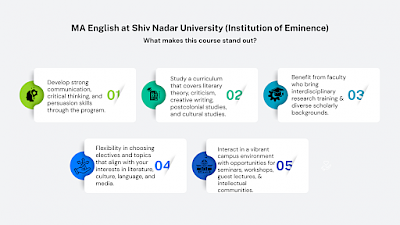
At Shiv Nadar University, the MA in English provides you with a transformative journey to sharpen your interpretive edge and prepare for careers in a world where human insight still leads.
Conclusion - Why Chaucer Still Speaks in the Age of Chatbots
So, now it’s clear why pursuing an MA in English is valuable in the AI world. The program teaches you what machines can’t - meaning. This helps you to build timeless interpretive skills that will foster your future success. So, if you want to future-proof your career, while maintaining human interpretive, empathizing, and creating capabilities, then let's explore.
Start your adventure today with Shiv Nadar University on a path to a rewarding, high-salaried career!
FAQs
What skills will I get after MA in English?
The program helps you develop essential skills- Research and Critical Inquiry, Advanced Writing, Interpretation, and Digital Communication.
Who is eligible for MA in English?
An applicant required a bachelor’s degree with a minimum of 50% marks.
What are the popular career pathways after MA in English?
Some high-paying career roles after MA in English are UX Writer, Content Strategist, Corporate Communication Specialist, Policy Analyst, Publishing Editor, Content Manager, Copywriter, Linguistics Consultant, and many more.