How B.Sc. Mathematics Prepares You for Data Science, Finance, and Research
Blog / March 10, 2026
The modern era of professional and industrial landscapes is driven by big data and artificial intelligence. As a result, the demand for individuals who can decode complex information has been at its very peak. While many students might seem to pick specialized degrees, those who choose a B.Sc. Mathematics hold a unique advantage. But what makes Mathematics so indispensable? In a nutshell, it is the universal language of logic and forms a solid base upon which modern innovations like financial algorithms and machine learning models are built.
Now, you might be wondering about how a traditional degree like B.Sc. Mathematics can still be this relevant in a world driven by technological advancements. One prime reason is that apart from teaching equations, it nurtures a rigorous and analytical mindset, which is vital across high-growth career paths.
Why Mathematics is the Foundation of Modern Industry
Mathematics is not just about solving problems on a whiteboard; it is about recognizing patterns, modeling reality, and making decisions under uncertainty.
1. Data Science: The Mathematics of Intelligence
Data Science is essentially applied mathematics. If you’re building a recommendation engine or training a neural network, math is at the centre of it all. Linear algebra runs the show in deep learning, and calculus drives the optimization that makes these models work. When you really understand these concepts, you move beyond just using someone else’s tools; you start shaping intelligence yourself.
2. Finance: Quantitative Precision
The financial sector has moved far beyond simple accounting. Quantitative analysts use stochastic calculus and probability theory to predict market trends and price derivatives. A background in B.Sc. Mathematics prepares you to handle the complex mathematical models that drive high-frequency trading and risk management.
3. Research: The Logic of Discovery
In research, whether you’re in academia, defense, or some niche R&D lab - you have to turn the chaos of real life into something math can actually handle. That’s where math graduates shine. They’re trained to be precise, to cut through the noise, and to make sure every scientific breakthrough stands on solid, logical ground.
Unpacking the B.Sc. Mathematics Syllabus
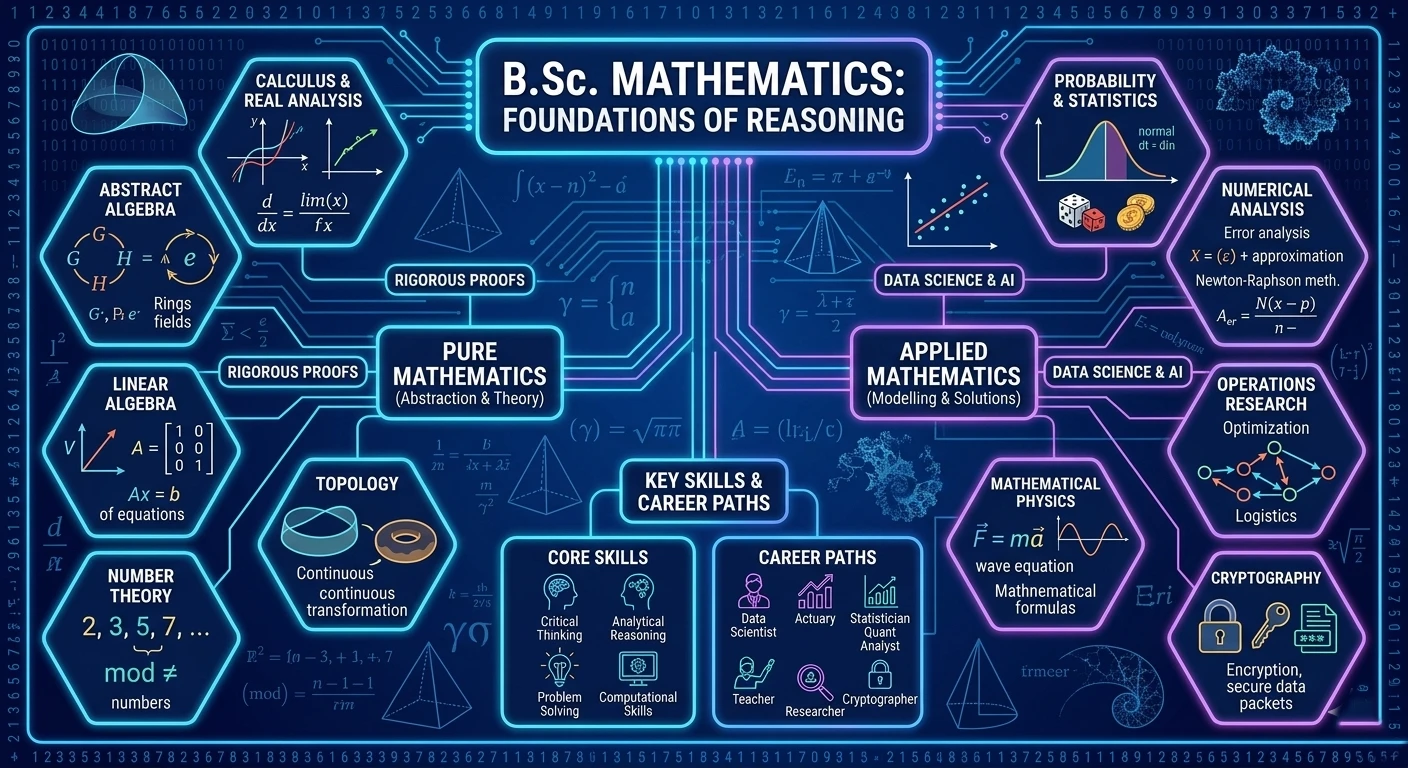
Understanding the B.Sc. Mathematics syllabus is crucial because it reveals exactly how the curriculum maps to professional skills. While specific modules vary by university, the core pillars generally include-
- Calculus & Differential Equations- These are essential for understanding the "change". In Data Science, this relates to optimization. In Finance, this is used to model interest rates and continuous growth.
- Linear Algebra- This is the language of data. Almost every data structure, from a digital image to a massive user database, is manipulated as a matrix or vector.
- Probability & Statistics- Perhaps the most "employable" skill in the syllabus. It provides the tools to draw meaningful conclusions from raw, noisy data, a core requirement for any data analyst or risk manager.
- Numerical Methods & Computational Math- It gives you what you need to pull real insights from messy data, something every data analyst or risk manager relies on. Numerical Methods and Computational Math connect theory to real-world problem-solving. You learn how to take tough problems that you can't solve by hand and tackle them using software like Python or R.
Market Demand: The Data Doesn't Lie
The career outlook for mathematics graduates is exceptionally strong, driven by the massive talent gap in analytical roles.
- Growth in Data Science- Research indicates that the demand for high-level data experts has been growing steadily, with some projections showing a massive talent gap of nearly 1 million AI and data-science professionals in India by 2026.
- High-Value Roles- Roles like Data Scientist, Quantitative Analyst, and Actuarial Analyst often rank among the highest-paying in the tech and finance sectors. For instance, in India, experienced data scientists can command significant packages, often starting from ₹14 LPA and scaling up rapidly with expertise.
- Versatility- A B.Sc. Mathematics degree is remarkably versatile. Unlike some specialized degrees that lock you into a single industry, a math degree allows you to pivot between sectors, from tech to banking to public policy research.
Building Your Career Strategy
If you are currently enrolled or planning to enroll in a B.Sc. Mathematics, you should concentrate on the following three focal points to help increase your opportunities for employment-
- Take Advantage of Programming - While mathematical theory can be a powerful tool, learning the ways to implement that theory will be critical. Select one of the two most common programming languages, Python or R, and begin learning them as soon as possible. This will enable you to use your statistical knowledge in conjunction with real data.
- Pick Related Electives - Seek out elective courses such as Mathematical Modelling, Financial Mathematics, or Optimization. The courses offer an outstanding return on investment and will be valuable assets when you enter the job market.
- Getting Practical Experience through Project-Based Learning - Don't just study to pass examinations. Explore opportunities to utilize your skills through data science hackathons, finance modelling competitions and/or research projects. Having relevant experience demonstrates the ability to work with "messy" real-world applications of your theoretical knowledge.
Academic Excellence in Action: B.Sc. ( Research ) in Mathematics at Shiv Nadar University (Institution of Eminence)
If you want to understand how a modern curriculum bridges the gap between theory and industry practice, the B.Sc. (Research) in Mathematics at Shiv Nadar University deserves a look. Apart from academic mastery, the program is designed to offer the flexibility required for interdisciplinary careers.
The unique structure of the program stands out as it allows students to tailor their academic path to align with their career goals. Its key features include-
- Tailored Specializations- The program lets you dive into special tracks like Mathematical Finance, where you actually learn the math that powers risk management and investment strategies in the real world. If that’s not your thing, there’s Applied Algebra. It’s not just theory; you’ll see how algebra protects online payments and helps design tricky statistical experiments.
- Interdisciplinary Flexibility- What really stands out here is the flexibility. You don’t have to follow a strict sequence of core classes, which means you can fit in a Minor from another field. Lots of students mix math with Computer Science, Economics, or Management. Employers really like that blend and it's a big deal in today’s job market where data runs the show.
- Career Pathways- When it comes to life after graduation, students from this program have landed jobs in data analytics, economics, and research. Some have even gone on to top universities around the world.
By allowing students to specialize early and integrate other disciplines, programs like this ensure that mathematics graduates are not just "academics," but versatile professionals ready for the modern workforce.
Conclusion
The idea of obtaining a B.Sc. Mathematics degree is one that can positively influence your thought processes. Mathematics teaches individuals how to deal with uncertainty, how to resolve complex issues into small pieces, and generate an uncomplicated answer when many complicated items are present.
At present, we are faced with many challenges due to complexity; this ability to think mathematically gives individuals a competitive edge across all career fields. Whether you wish to be part of the new generation of Artificial Intelligence or have a high-powered career in international finance, it will start with a solid foundation in Mathematics.
FAQs
Q. What is the scope of B.Sc. Maths?
A. B.Sc. Mathematics offers a wide range of career opportunities in data science, finance, research, teaching, actuarial science, banking, and technology-driven industries.
Q. Is B.Sc. Maths easy or tough?
A. B.Sc. Mathematics can be challenging due to its logical and analytical depth, but it becomes manageable and rewarding with consistent practice and conceptual clarity.
Q. Which career is best for a maths student?
A. Some of the best careers for mathematics students include Data Scientist, Quantitative Analyst, Actuary, Researcher, Statistician, and Financial Analyst.