From Semester One to Final Year: How a B.Tech. in Electrical and Computer Engineering Actually Unfolds
Blog / June 08, 2026
You picked the branch. But do you know what the next four years are actually going to ask of you?
A B.Tech. in Electrical and Computer Engineering is not a renamed version of ECE. Where traditional ECE leans on electronics and communication, this branch integrates electrical systems with computing architecture — designed for industries where the two are inseparable. Electric vehicles. AI chips. Embedded systems. Wireless infrastructure.
If you have already chosen this branch, the harder decision is behind you. What most students are not prepared for is what the next four years actually demand.
Most Students Pick This Branch for the Wrong Reasons — Here Is What It Actually Demands
The honest reason many students land here is that it sounds safely broad. This field isn't strictly computer science or electrical engineering either. It falls somewhere in between, and that middle ground feels uncertain. The breadth is real. But it is not a way around depth; it is in addition to it.
From Semester 1, you are working through calculus, physics, and programming at the same time. By Year 2, you are inside circuit design, signal processing, and machine drives simultaneously. Students who come in expecting a lighter CS or a trendier EE both find Year 2 genuinely difficult. Knowing that upfront is an advantage.
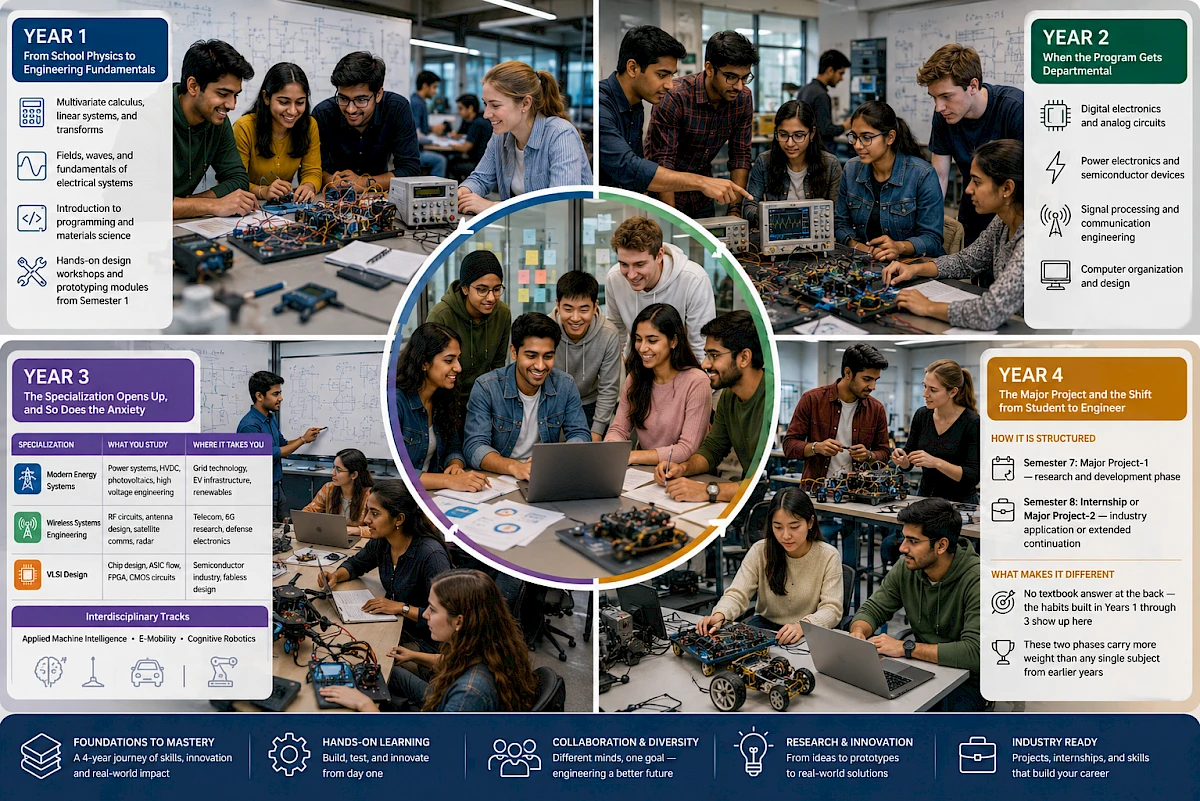
Year 1: From School Physics to Engineering Fundamentals
The first year acts as a starter. Engineering is different from what you study in school, and everyone is learning it from scratch.
What you cover-
- Multivariate calculus, linear systems, and transforms
- Fields, waves, and fundamentals of electrical systems
- Introduction to programming and materials science
- Hands-on design workshops and prototyping modules from Semester 1
What to know going in-
- Experiential learning starts from Day 1 — treat it as a signal of how the degree is built, not as filler
- The foundations you build here feed directly into the subject load of Year 2
Year 2: When the Program Gets Departmental
Semesters 3 and 4 are where the branch earns its reputation. The subject load is wide, and everything is interconnected.
What you cover-
- Digital electronics and analog circuits
- Power electronics and semiconductor devices
- Signal processing and communication engineering
- Computer organization and design
What to watch out for-
- Semiconductor knowledge feeds analog circuits; signal processing feeds communication engineering — let one slip, and it shows up in the next subject.
- This is the year most students find genuinely difficult — consistent habits here are what make Year 3 manageable.
Year 3: The Specialization Opens Up, and So Does the Anxiety
After two years of a fixed curriculum, Year 3 hands control back to you. Three within-department specialization tracks open up, along with four interdisciplinary options. Nobody tells you which direction to take. That is the point.
Specialization | What You Study | Where It Takes You |
Modern Energy Systems | Power systems, HVDC, photovoltaics, high voltage engineering | Grid technology, EV infrastructure, renewables |
Wireless Systems Engineering | RF circuits, antenna design, satellite comms, radar | Telecom, 6G research, defense electronics |
VLSI Design | Chip design, ASIC flow, FPGA, CMOS circuits | Semiconductor industry, fabless design |
Beyond these, interdisciplinary tracks — Applied Machine Intelligence, E-Mobility, Cognitive Robotics, and Real-Time Embedded Systems — combine courses from electrical engineering, CS, and mechanical engineering.
How to choose-
- Pick the track whose problem set you want to spend your career solving — not which sounds most impressive right now
- The Applied Machine Intelligence track gives you the hardware foundation that pure CS graduates do not have
- Going in without a direction is the most common Year 3 mistake
Year 4: The Major Project and the Shift from Student to Engineer
The final year is when the degree stops being about what you know and starts being about what you can produce.
How it is structured-
- Semester 7: Major Project-1 — research and development phase
- Semester 8: Internship or Major Project-2 — industry application or extended continuation
What makes it different-
- No textbook answer at the back — the habits built in Years 1 through 3 show up here
- These two phases carry more weight than any single subject from earlier years
Career Scope for B.Tech. ECE Graduates in 2026
The honest answer - the scope is wide. The branch keeps core engineering roles in power companies, defense PSUs, and semiconductor firms accessible alongside tech roles — something pure CS graduates simply cannot say.
- VLSI and chip design engineer
- Embedded systems engineer
- Wireless and 6G network engineer
- EV powertrain and charging systems engineer
- AI hardware engineer
- Power systems engineer
B.Tech. in Electrical and Computer Engineering at Shiv Nadar University
Shiv Nadar University is a multidisciplinary research university recognized by the Government of India as an Institution of Eminence. The School of Engineering houses five departments spanning civil, mechanical, chemical, computer science, and electrical engineering — creating an environment where interdisciplinary work is built into the academic structure, not bolted on as an afterthought.
The B.Tech. in Electrical and Computer Engineering is offered by the Department of Electrical Engineering. The program combines a strong core in electrical and computing fundamentals with deliberate depth through specialization. The design reflects where the industry actually is: graduates come out with both hardware fluency and computational grounding, not a compromise between the two.
Here is what sets the program apart-
- Trending specializations- Modern Energy Systems, Embedded Systems and Computer Engineering, Analog/R.F. and Communication Systems, and Sensors and Nanoelectronics; minimum CGPA of 5.0 required
- Four interdisciplinary specialization tracks- Applied Machine Intelligence, E-Mobility, Cognitive Robotics, and Real-Time Embedded Systems, drawing from electrical engineering, CS, and mechanical engineering
- Experiential learning built in from Semester 1- Three hands-on courses: Introduction to Engineering: Ideas to Impact (Semester 1), Design to Reality: CAD and 3D Printing (Semester 2), and Embedded Systems Hardware (Semester 5)
- Option to pursue a minor in any other stream- Students can complement their ECE degree with coursework from another department
- Two-phase Major Project- Major Project-1 in Semester 7 and Internship or Major Project-2 in Semester 8
The 2026-27 admissions cycle is currently open. Full program structure, specialization lists, and application details are available on the B.Tech. in Electrical and Computer Engineering page.
Conclusion
A B.Tech. in Electrical and Computer Engineering rewards students who stay engaged across disciplines and make deliberate choices in Year 3. The breadth is genuine — but so is the depth, and graduates who navigate it well come out with a skill set that is genuinely scarce in the market.
Pick a specialization you can go deep in. Find a program whose curriculum reflects where the industry actually is. And if 2026-27 is your cycle, do not let the application process be the last thing you get around to.
Frequently Asked Questions
Q. What is an electrical and computer engineer?
Ans. An electrical and computer engineer works at the intersection of electrical systems and computing architecture. Unlike traditional ECE, this branch trains graduates for roles where both hardware depth and computing fluency are required — AI hardware, EV systems, embedded design, and wireless infrastructure.
Q. Is Electrical and Computer Engineering a good career in 2026?
Ans. Yes, particularly for students who specialize with intent. The branch feeds into VLSI, 6G, EV powertrain, and AI hardware, while keeping core engineering roles in power and defense accessible. That dual access is the main career advantage over narrower branches.
Q. Which is better — ECE or Electrical and Computer Engineering?
Ans. They serve different outcomes. Traditional ECE is stronger for communication and signal processing roles. Electrical and Computer Engineering suits roles needing both hardware depth and computing fluency — chip design, embedded AI, autonomous systems, and EV technology.
Q. What subjects are covered in the first year of B.Tech. ECE?
Ans. Typically: multivariate calculus, linear systems and transforms, fields and waves, introductory programming, fundamentals of electrical systems, materials science, and environmental studies. Most programs include hands-on experiential modules from Semester 1.