From Quantum Algorithms to Ethical AI - PhD Topics in Computer Science That Redefine the Future

Blog / September 18, 2025
Ph.D. Topics in Computer SciencePh.D. Research Topics in CSMany students entering a Ph.D. in Computer Science today share a common question: Which research area will be relevant from a future perspective?
As we can see, artificial intelligence is reshaping economies, data systems are powering public health, and cybersecurity is becoming a matter of concern; the Ph.D. in computer science is not about simply writing a thesis anymore. It’s about anchoring your work to real problems - problems that institutions, industries, and societies are racing to solve.
But what does that mean for you as a researcher?
It means your Ph.D. must be strategic, not just scholarly. It must answer questions that are being asked and those that aren’t yet visible. And it must position you to contribute meaningfully, whether in academia, policy, or industry.
In this blog, we explore high-impact Ph.D. topics in Computer Science 2025 that are not only timely but technically deep, globally relevant, and career-aligned. We break down the major research areas, from algorithms and complexity to machine learning and secure systems, and explain what makes each of them worth your time, your thesis, and your future.
Why the Right Ph.D. Topic Shapes More Than Just a Thesis
A Ph.D. is more than a degree.
It’s a research commitment that often defines where you’ll work, who you’ll work with, and what you’ll become known for.
Choosing a topic is not a side step. It’s the first real move in shaping your identity as a researcher. Top Ph.D. topics in Computer Science are not just trendy; they’re transformative.
They open doors in:
- Global research labs (public and private)
- Policy think tanks
- AI, data, and cybersecurity startups
- University faculty positions and
- Consulting and advisory boards
Let’s say you explore Explainable AI or Federated Learning. You won’t just publish; you’ll likely end up contributing to standards, frameworks, or even national strategies.
With the right topic, your research gets cited in journals, used in systems, and referenced in boardrooms, and gets the recognition that you deserve.
Algorithms and Computational Complexity: Making Efficient and Ethical Decision Systems
You may not see them, but algorithms are everywhere - from ambulance dispatch systems to stock predictions.
In 2025, algorithms aren’t just about speed. They’re about scalability, ethics, and fairness.
Trending Research Questions:
- How do you optimize task scheduling in cloud-edge hybrid systems?
- Can you make genetic algorithms more energy-aware?
- How can game theory reduce server conflict in distributed setups?
- Best way to model and simplify NP-hard problems in real-world routing.
Key Areas to Work:
- Time complexity in parallel systems
- Randomized and approximation algorithms for resource allocation
- Graph theory in cybersecurity and communications
Data Science and Engineering: Creating Meaningful Impact from Unstructured and Distributed Data
Data isn’t the new oil. It’s the new infrastructure. Yet, messy, unlabelled, biased, or incomplete data still floods systems faster than they can be handled.
Your Ph.D. can focus on making data trustworthy, useful, and explainable.
Focus Areas for 2025:
- Scalable architectures using Apache Spark and Hadoop
- Mitigating data skew in massive parallel pipelines
- Federated analytics for decentralized systems
- Energy-efficient data workflows and
- Bias detection and correction in data processing
Technical Tools You'll Use:
- Python, R, MATLAB for modeling
- MongoDB, PostgreSQL for structured and NoSQL data
- CloudSim, GridSim for simulating distributed workloads
When you design data systems that self-heal, adapt, or explain decisions, your work helps industries cut waste, speed decisions, and avoid risk.
Human-Centric and Transparent AI-ML for the Next Decade
Everyone’s doing AI. But not everyone’s doing it well.
Your Ph.D. in AI needs to go beyond datasets and models. It must focus on safety, scalability, and sense-making.
Trending Ph.D. Topics in Computer Science 2025:
- Explainable AI for high-stakes decisions
- AutoML and Neural Architecture Search to make models self-optimizing
- AI in smart cities and real-time governance
- Federated Learning for privacy-first model training and
- Digital Twin modeling using AI for predictive planning
Research Challenges You Can Solve:
- Can your model scale across cities without re-training?
- Is your model transparent enough for policy use?
- How do you secure AI systems in edge environments?
Security and Privacy: Safeguarding Trust in a Digital, Decentralized, and AI-Driven World
When people don’t trust systems, they don’t use them.
As systems become more distributed, as data flows through cloud and edge layers, and as AI starts making sensitive decisions, Ph.D. research must anchor itself in real trust-building technologies.
Top Areas to Work:
- Post-quantum cryptography: Cryptosystems that survive quantum computing threats
- Blockchain-based identity and access: More than Bitcoin—this is about citizen services and medical records
- Homomorphic encryption: Secure computation without decrypting sensitive data
- Zero-trust architectures: No device or node gets default access
- Deepfake detection systems: Protecting media integrity and public trust
- Anomaly detection using AI: Smart systems that flag what humans can’t catch
Cyber-attacks now target infrastructure, education, health, and banking. Governments and companies are raising budgets for research-driven solutions in multi-cloud security, privacy-aware AI, and decentralized systems.
Your Ph.D. could directly support these transitions.
Wireless, Mobile Computing, and Networking: Building the Future’s Invisible Infrastructure
From delivery drones to connected ambulances, from smart streetlights to agricultural sensors, the real computing power of the future will live in networks.
If you want to work at this intersection, the Ph.D. topics in Computer Science 2025 under this domain offer deep relevance.
Research Focus Areas:
- 6G wireless systems
- Mobile ad hoc networks (MANETs) and vehicular networks (VANETs) for dynamic environments
- Energy-efficient routing in sensor networks
- Network slicing for IoT platforms and
- Real-time communication in smart infrastructure
Networking research is no longer limited to telecom. It fuels everything from urban planning to space exploration.
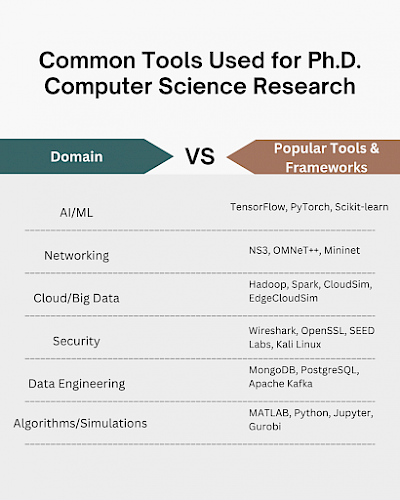
Tools for Ph.D. Computer Science Research
The right tool speeds your experiments, sharpens your models, and keeps your work relevant. When selecting your Ph.D. topics in Computer Science, align your research with tools that scale and simulate well.
Use tools that support:
- Scalable computation
- Reproducible results
- Industry-aligned outputs
Here’s a table with common tools used across key research domains:
How to Strategically Choose Ph.D. Topics in Computer Science 2025
You don’t need a thousand topic ideas. You need one that’s right.
Start with three filters:
- Problem First
Don’t chase trends. Start by asking:
- Who benefits from this research?
- What happens if this problem is left unsolved?
- Skill Match
Choose a topic where you can grow, not drown.
- If you enjoy math and theory, explore algorithms.
- If you prefer building systems, go for networking or data engineering.
- Future Proofing
Ask these:
- Will this topic matter in 2040?
- Does it align with national or global research priorities?
Checklist to Evaluate a Topic:
- Is there enough existing literature to explore gaps?
- Can you get access to data or simulation environments?
- Does the topic offer real-world impact and career pathways?
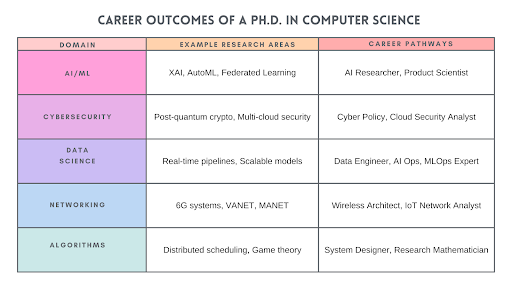
Career Outcomes of a Ph.D. in Computer Science
Begin Your Ph.D. in Computer Science Journey with Shiv Nadar University (Institution of Eminence)
It is very clear that Ph.D. topics in Computer Science 2025 are evolving toward impact, scale, and global relevance. But choosing just the topics is not everything, you need a place that provides you with all the necessary things to do research about the topic.
You don’t just need a university with infrastructure; you need one with intellectual depth, interdisciplinary openness, and a commitment to research that matters.
At Shiv Nadar University, recognized as the Institution of Eminence by the Government of India, the Ph.D. in Computer Science and Engineering program is built around exactly that kind of purpose.
The School of Engineering offers a holistic environment where your questions are encouraged, your ideas are tested, and your curiosity is fostered by leaders from both the academic world and industries.
Key Research Areas:
- Algorithms and Complexity
- Data Science and Engineering
- Artificial Intelligence and Machine Learning
- Security and Privacy
- Wireless, Mobile Computing, and Networking
If you are interested in discovering the intricacies of algorithms or building systems that reach millions, the Ph.D. program at Shiv Nadar University provides you with the ecosystem to explore deeper and the support to go farther.
Synopsis
Picking Ph.D. topics in Computer Science 2025 is not about just writing a thesis and finishing a degree; they are about starting conversations that the world hasn’t had yet.
Whether it’s AI, security, networks, or data, every domain you explore opens up:
- Opportunities to build systems that last
- Positions that influence what technologies get built
- Impact that helps communities grow
Choose your topic with care, build it with purpose, and work on it with clarity.
If you are someone who does not want to do a Ph.D. just for earning a title, but you want to be a person who shapes how technology serves society, then Shiv Nadar University is the place where your journey begins. Admissions are open for the Ph.D. in Computer Science program. Gear up and apply now!
FAQs
What are the trending domains for a Ph.D. in Computer Science in 2025?
AI, ML, cybersecurity, data science, etc, are the top picks for Ph.D. topics in Computer Science.
What are the subjects in Ph.D. Computer Science?
A Ph.D. in Computer Science involves advanced study and original research in core and specialized areas, typically including AI, ML, Data Science, Cybersecurity, Algorithms, Database Systems, Software Engineering, Computer Networks, Web Technologies, Cloud Computing, etc.
What are the top career paths after a Ph.D. Computer Science?
After a Ph.D. in Computer Science, you can pursue careers in academia as a professor or researcher, or in industry as a research scientist, AI specialist, data scientist, or software engineer in roles such as Senior Developer and Architect.