From Equations on Paper to Solutions in Life - How B.Sc. Mathematics Subjects Shape Thinkers

Blog / September 16, 2025
B.Sc. Mathematics SubjectsB.Sc. Maths Career PathwaysMath isn’t just about scribbling equations on a board or working through endless formulas in silence.
It is more than numbers!
Have you ever wondered why some people can cut through confusion, some patterns others miss, and come up with solutions that actually work? That is where the mind thinks mathematically.
Whether it's designing algorithms for social media, predicting climate patterns, or analyzing stock markets, maths quietly drives solutions. It actually builds a mindset that turns problems into possibilities. This is exactly what a B.Sc. Mathematics offers.
When you start studying B.Sc. Mathematics Subjects, you will actually move beyond the formulas and step into a world where logic, reasoning, as well as creativity work together. The program allows you to think in ways that can reshape industries and everyday life.
Here, we will explore the journey year by year - from the basics to advanced topics that shape you into a critical thinker!
Equations with Purpose - Why Studying Math Feels Different Here
At school, studying maths means solving equations to pass the exam. But, a B.Sc. in Mathematics completely changes the game!
The program allows you to explore the “why” behind the formulas instead of memorizing steps. The best part is that you will deliver theories, practice proving results, as well as link abstract concepts to real-world applications. The focus is now moving toward:
- Depth-Rigorous Proofs
- Problem-Solving Strategies and
- Mathematical Modeling
By working through these concepts, you’ll find it easier to shift between domains - whether it’s solving equations in economics, writing algorithms in computer science, or interpreting data in finance.
Here’s Why Students Choose This Course
- Theories and proofs that help you know how to solve and why solutions work
- Maths applications to tackle modern challenges and
- Adaptability by gaining essential skills that are transferable to almost any career path
When you pursue B.Sc. Mathematics, you start tackling problems the way real thinkers do.
B.Sc. Mathematics Subjects Year-Wise Breakdown
Here is the breakdown of B.Sc. Mathematics subjects year-wise.
1st Year B.Sc. Mathematics Subjects
In the first year, you will develop foundational knowledge. You will learn core concepts that are taught at a much deeper and more rigorous level. The first year usually includes:
- Calculus
- Algebra
- Geometry and Vector Analysis
- Probability and Statistics
- Differential Equations and
- Mathematical Logic and Set Theory
They give you a strong base in reasoning, improve the way you handle computations, and get you ready for the tougher concepts that come later in the course.
B.Sc. Mathematics Subjects List for Later Years (2nd and 3rd Year)
|
Year |
Subjects |
Focus Area |
|
2nd Year |
Abstract Algebra |
Explore algebraic structures, understand rigorous proofs, and link math with physical systems |
|
Real Analysis |
||
|
Vector Calculus |
||
|
Mechanics |
||
|
3rd Year |
Complex Analysis |
Learn higher-level problem solving, discover how abstract math shapes modern science, and practice computational methods |
|
Linear Algebra |
||
|
Topology |
||
|
Numerical Methods |
||
|
Mathematical Modeling |
By the end of the course, you will notice how first-year basics turn into effective tools that help you interpret the complexity in any field.
From Equations to Expertise - Skills Gained Via B.Sc. Mathematics Subjects
A mathematics course is not just about mastering formulas; it helps you build valuable skills.
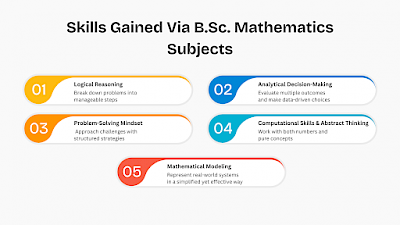
These skills provide an advantage to maths graduates in any professional environment.
Career Pathways Shaped by B.Sc. Mathematics Subjects
Here are some popular career opportunities you will explore after completing a B.Sc. Mathematics program:
|
Job Profile |
Job Description |
Average Salary Range |
|
Teacher/Professor |
Teach at high school or even college level, depending on your interests |
₹3 LPA – 36 LPA |
|
Data Analyst |
Work with management teams to know business needs and develop data-driven solutions |
₹3.5 LPA – 27 LPA |
|
Retail Banker |
Manage customer accounts, provide financial advice, and sell banking products |
₹4 LPA – 18 LPA |
|
Data Scientist |
Develop algorithms, build predictive models, and extract insights from data |
₹5 LPA – 36 LPA |
|
Research Assistant |
Work in academic or industrial settings, assisting in the planning and execution of research projects |
₹3 LPA – 8 LPA |
|
Subject Matter Expert |
Work in consulting firms, educational institutions, or corporate settings, offering expert advice and insights |
₹2.5 LPA – 7 LPA |
|
Actuarial Analyst |
Analyzing data to predict future events, such as mortality rates or economic trends, and developing strategies to minimize risk |
₹4 LPA – 17 LPA |
|
Policy Analyst |
Research and evaluate the effectiveness of policies and programs |
₹4 LPA – ₹12 LPA |
|
Financial Analyst |
Evaluate investment opportunities, analyze financial data, and provide recommendations to businesses and individuals |
₹3.5 LPA – 15 LPA |
|
Statistician |
Collect data by designing surveys, experiments, and opinion polls |
₹4 LPA – 16 LPA |
|
Business Analyst |
Professionals bridge the gap between IT and business teams, ensuring that business needs are translated into technical solutions |
₹3 LPA – 25 LPA |
|
Operational Researcher |
Use mathematical methods to solve complex organizational problems |
₹3 LPA – 12 LPA |
Why do Industries Require Math Thinkers?
Every industry today runs on tech, data, and models in one form or another. That’s why math skills matter, whether you’re tracking climate patterns or coding AI tools.
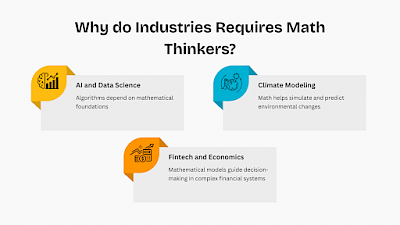
Today’s world showcases how math thinkers are builders, innovators, as well as problem-solvers across industries.
Where Curiosity Turns into Clarity - B.Sc. (Research) in Mathematics at Shiv Nadar University (Institution of Eminence)
If numbers excite you, Shiv Nadar University’s B.Sc. (Research) in Mathematics is for students who want to turn their passion into a rewarding career. The curriculum prepared by the School of Natural Sciences combines rigorous academics with research exposure from the very first year.
Why Shiv Nadar University is the first choice for B.Sc. (Research) in Mathematics?
- Globally trained faculty who bring cutting-edge expertise in areas
- Students gain hands-on experience through undergraduate research opportunities (OUR)
- Collaborations with international universities
- Access to advanced labs and computational resources
- Rigorous learning and research in fundamental areas of mathematics and emerging technologies
- Seminars delivered by distinguished mathematical scientists
- Advanced research laboratory with high-end computational facilities
B.Sc. (Research) in Mathematics at Shiv Nadar University builds graduates who are problem-solvers ready for careers in data science, finance, research, and beyond.
Synopsis
Studying mathematics is more than about math- it helps prepare you to tackle the toughest questions in life. In B.Sc. Mathematics course, you will not only study equations - you will develop and acquire the logical reasoning, creativity, and problem-solving ability that will support you in any career path you may take, from research to finance, technology, data science, and more.
If you have an interest in numbers and logical reasoning, you should absolutely select Shiv Nadar University, which brings contemporary and best practice knowledge in all areas, and hands-on experience. While equations may be forgotten, the way you will learn to think will last a lifetime!
FAQs
Who is eligible for B.Sc. Mathematics course?
You should be a student who has passed 10+2 from any recognized board or equivalent with at least an aggregate of 65% in four subjects.
What are top B.Sc. Mathematics Subjects List?
You will study core subjects during B.Sc. Mathematics course- Calculus, Algebra, Geometry, Vector Analysis, Probability, Statistics, Differential Equations, and many more.
How many subjects are included in B.Sc. Mathematics course?
The program covers a wide range of core subjects over three years- Calculus, Algebra, Geometry, Real and Complex Analysis, Differential Equations, Linear Algebra, Probability and Statistics, etc.