Economics Courses After 12th in India: Power Move or Risky Choice?
Blog / January 12, 2026
Choosing the right undergraduate course after Class 12 is an important decision for students in India. Among the sea of options, economics courses have steadily gained prominence due to their applicability across business, government, finance, and data-driven roles. Economics equips students with the ability to understand how markets function, how policies are designed, and how data is used to guide decisions, skills that are increasingly valuable in today’s economy.
For students from commerce backgrounds especially, economics courses after 12th commerce offer a natural academic progression into careers that combine analytical thinking with real-world applications. This blog provides an overview of economics as a discipline, the main undergraduate course options, eligibility criteria, a university-specific example, and career prospects.
Why Economics Is a Strong Subject Choice After Class 12
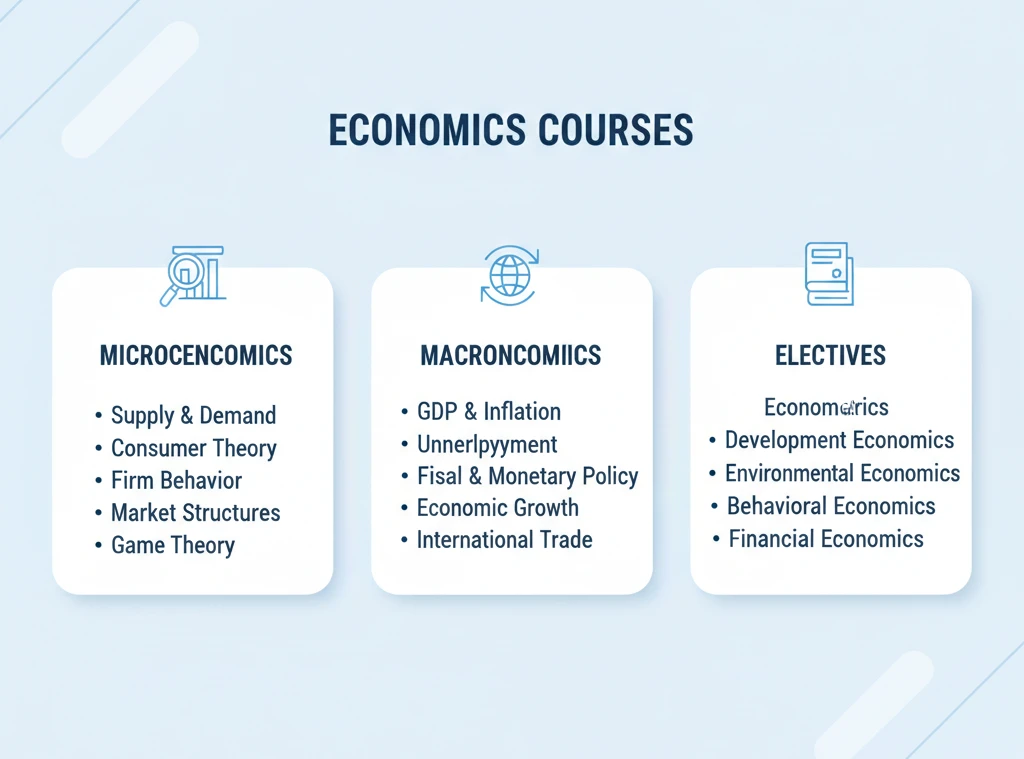
Economics is a social science grounded in logic, analysis, and evidence-based reasoning. It helps students examine issues such as inflation, unemployment, economic growth, income distribution, and global trade, topics that directly influence businesses and public policy.
According to the All India Survey on Higher Education (AISHE) 2021-22, India had over 4.33 crore students enrolled in higher education, with a Gross Enrolment Ratio (GER) of 28.4% in the 18-23 age group. Social science programs, including economics, continue to attract strong enrollments due to their flexibility and broad career relevance.
In recent years, economics has also become more quantitative. Many universities now integrate statistics, econometrics, and data analysis into their curricula, aligning economics education with evolving industry requirements.
Major Economics Courses After 12th in India
Students can choose from multiple undergraduate economics courses immediately after completing Class 12. Each course differs slightly in focus and academic orientation.
1. BA Economics / BA (Hons) Economics
Overview:
BA Economics focuses on economic theory and its application to real-world problems. Core subjects typically include microeconomics, macroeconomics, Indian economy, public finance, and development economics.
Duration:
3 years (with 4-year honours options under NEP 2020)
Best suited for:
Students interested in public policy, civil services preparation, research, academia, and general business roles.
2. B.Sc. Economics / B.Sc. (Hons) Economics
Overview: B.Sc. Economics places greater emphasis on mathematics, statistics, and econometrics along with core economic theory. Many programs also introduce data analysis tools.
Duration:
3-4 years depending on the university
Best suited for:
Students inclined towards analytics, finance, research, quantitative economics, and technical roles.
3. Economics with Data Science or Statistics (Interdisciplinary Programs)
Overview - Under the National Education Policy (NEP), several universities now offer economics degrees combined with minors or specialisations in data science, statistics, or mathematics.
Duration - Usually 4 years (honours with research)
Best suited for - Students aiming for careers in data analytics, consulting, economic research, and tech-enabled business roles.
4. BCom with Economics (Major/Minor or Core Papers)
Overview - Some institutions offer economics as a major or minor within a Bachelor of Commerce program, combining business fundamentals with economic analysis.
Duration - 3 years
Best suited for - Students specifically exploring economics courses after 12th commerce who want exposure to accounting, finance, and economics together.
Eligibility for Economics Courses After 12th Commerce
Eligibility criteria vary across universities, but common requirements include:
- Completion of Class 12 from a recognized board
- Minimum percentage cut-offs as specified by the institution
Many universities prefer or require Mathematics in Class 12, particularly for B.Sc. Economics and research-oriented courses. However, several BA Economics programs remain accessible to commerce students without mathematics. Applicants should always check subject prerequisites before applying.
Career Opportunities After Completing Economics Courses
Graduates of economics programs work across a wide range of sectors. Common entry-level roles include:
- Economic or policy research assistant
- Business or market analyst
- Data analyst (with statistical and programming skills)
- Credit or risk analyst in banks and financial institutions
- Consulting and strategy roles
- Positions in think tanks, NGOs, and development organizations
Labour market data consistently shows that graduates are more likely to secure salaried employment compared to non-graduates. Economics graduates who supplement their degree with internships, data tools, and communication skills tend to achieve stronger career outcomes.
Skills That Enhance the Value of an Economics Degree
To maximize the benefits of economics education, students should build complementary skills such as:
- Spreadsheet analysis (Excel)
- Statistics and basic econometrics
- Data tools like Python, R, or Stata
- Research and report writing
- Presentation and analytical communication
These skills help translate academic economics into practical workplace applications.
Why Shiv Nadar University (Institution of Eminence) Is a Strong Choice for Studying Economics After 12th
A good example of a research-focused undergraduate economics program in India is the B.Sc. (Research) in Economics offered by Shiv Nadar University. It is designed for students who want rigorous training in economics with a strong quantitative and research foundation.
What students gain from the program:
- Strong Core Foundation - The curriculum includes microeconomics, macroeconomics, mathematics for economists, statistics, and econometrics, ensuring conceptual and quantitative depth
- Research Exposure - Students undertake an undergraduate research project or thesis in the final year, developing skills in independent research and academic writing.
- Interdisciplinary Flexibility - The program allows students to take electives across disciplines, and Shiv Nadar University also offers a combined B.Sc. (Research) in Economics and Finance for those interested in financial economics.
- Clear Academic Orientation - Admission is through standardized tests such as SNUSAT, SAT, or ACT, with Mathematics in Class 12 generally required, reflecting the program’s quantitative focus.
Such programs are well-suited for students considering postgraduate studies in economics, finance, public policy, or careers in analytics and research-driven roles.
Conclusion
Economics courses after 12th offer a balanced combination of analytical reasoning, data interpretation, and real-world relevance. Whether pursued through a B.A., B.Sc., interdisciplinary program, or a commerce-integrated structure, economics provides a flexible academic foundation that aligns well with careers in business, finance, data analytics, public policy, and research.
For commerce students in particular, economics courses after 12th commerce allow a smooth transition into fields that value both quantitative understanding and economic insight. With informed course selection, awareness of eligibility requirements, and consistent skill development, economics remains a strategically sound and future-oriented undergraduate choice.
FAQs
Q. Which course is best 12th economics?
A. The best is something that aligns with career goals. Top choices include B.Sc. (Hons) Economics, BA(Hons) Economics, and specialized options like Economics + Data Science.
Q. Is economics B.Sc. or BA better?
A. Both are better. B.Sc. focuses on mathematics and statistics, while BA focuses on politics, philosophy, sociology.
Q. What is BA Economics salary?
A. The starting package typically falls between INR 3-6 lakhs depending on roles you choose.
Q. What are the highest paying career options after an economics course?
A. The highest paying career options include Finance (Investment Banking, Portfolio Management), Consulting, Data Analytics, and specialized government roles.