Decoding B.Sc. Biotechnology Course Details: How It Shapes Innovators Who Engineer Life for a Healthier, Sustainable Future
Blog / October 12, 2025
B.Sc. Biotechnology course detailsScope of B.Sc. BiotechnologyIt often starts with a bunch of questions. In the beginning, they might seem pointless, like how do plants grow so tall so quickly? How do medicines heal people so quickly? Or what part does science play in solving the problems that we face in the world? For most, these questions stay just a curiosity, while the remaining turn them into a vision of creating a healthier and more sustainable future.
If you are one of those curious minds who want to turn a vision into a real impact, then a structured approach to learning about life and its processes can be the path you choose. This is where a B.Sc. Biotechnology program comes into the picture. The course is curated for you so that you can build a strong foundation in biology by introducing modern techniques used to address challenges in medicine, agriculture, and the environment.
In this blog, we will go deeper into the B.Sc. Biotechnology course details, its subjects, the practical exposure it offers, and the scope for students who want to shape the future through science.
What is B.Sc. Biotechnology Program?
Before we start getting into the modules and scope, let’s clarify what this degree is all about. A Bachelor of Science in Biotechnology is an undergraduate program and also your path into learning biology, chemistry, and technology in detail. You learn how living systems work at the microscopic level and how to use that knowledge in a real environment.
In India, the course spans 3 years, divided into 6 semesters. But some institutions have started to offer a 4 year research tracks or honors versions to give students extra research exposure.
You will usually do both theory and lab work. In the first years, you'll learn basic courses. Later, you'll choose special subjects, work on projects, do internships, and pick electives.
Key Course Details You Should Know
Let's take a look at some of the important B.Sc. Biotechnology course details that you should know before applying:
|
Serial Number |
Parameter |
Details |
|
1. |
Course |
Bachelor of Science in Biotechnology |
|
2. |
Level |
Undergraduate |
|
3. |
Duration |
3 years or 6 semesters; some universities offer 4 year Honours or Research in addition |
|
4. |
Eligibility |
+2 or equivalent with Physics, Chemistry, and Biology, however some accept Mathematics instead of Biology |
|
5. |
Minimum Marks Required |
Generally 50-60% aggregate in qualifying exams |
|
6. |
Admission Process |
Merit based or entrance exam |
|
7. |
Core Subjects |
Cell Biology Microbiology Genetics Molecular Biology Biochemistry Immunology Bioinformatics |
|
8. |
Electives |
Plant, Animal, Environmental, Industrial and Nanobiotechnology |
Why Choose This Course?
- It gives you a solid grounding in life sciences along with technological tools.
- The skills you gain during the course are highly valued.
- You gain flexibility from pure science roles to applied industry roles.
- It combines innovation and problem solving together, such as in medicine, environment, agriculture sectors.
B.Sc. Biotechnology: Duration
- Standard duration is 3 years or 6 semesters.
- Some universities or colleges also offer 4 year research options.
- Each semester includes everything from theory classes, labs and tutorials to seminars and project work.
B.Sc. Biotechnology: Fees
The fees depend heavily on the type of institution. In India, the public universities may charge relatively low annual fees, as compared to private institutions that charge significantly more.
B.Sc. Biotechnology: Eligibility Criteria
- You basically need to have completed your +2 or equivalent with subjects like Physics, Chemistry, Biology (PCB). Some institutes might entertain Mathematics in place of Biology, totally depending on their criteria.
- Minimum marks vary, often ranging from 50 to 65% in the qualifying exams.
- Admission can be merit based or through entrance exams, depending on the university.
Admission in B.Sc. Biotechnology Course
A B.Sc. in Biotechnology is usually simple but is competitive at top colleges. Applications open soon after +2 results are out. Students are chosen based on grades or entrance exams, depending on the university.
Most institutions prefer students who studied Physics, Chemistry, and Biology in their +2 and have at least 65% marks. Some private colleges may also hold interviews or small tests to check your interest in the subject.
Look at how the admission process basically works:
- Check Eligibility
Ensure you meet the subject and marks criteria for your preferred colleges.
- Application Form
Fill out the university’s online or offline form as per the deadline.
- Merit List or Exam
Admission is either through direct merit or through an entrance test score.
- Counseling and Seat Allocation
Shortlisted students attend counseling sessions or interviews before final selection.
B.Sc. Biotechnology: Entrance Exams
Many universities admit students based on their grades, while others require entrance exams. These exams test your knowledge and thinking skills.
Some of the popular B.Sc. Biotechnology entrance exams in India are:
|
Exam |
Purpose |
|
CUET |
A national exam conducted by NTA. Universities rely on CUET scores for the admission processes. |
|
ICAR AIEEA-UG |
A national exam for agriculture and allied science courses, sometimes accepted for biotechnology and related streams. |
|
State-Level Common Entrance Tests |
Various state governments conduct CETs for admission to undergraduate science courses, which may include biotech. |
|
University’s Own Exam & Aptitude Test |
Some universities such as Shiv Nadar University conduct their own exam or aptitude test like the “SNUSAT + Interview” or accept national exam scores plus an interview. |
|
National Exams + Interview / Aptitude |
In certain cases, a combination of class 12 board results or national exam scores plus a personal interview or an aptitude test is used as a route. |
B.Sc. Biotechnology: Core Subjects and Electives
You get to study multiple topics of a wide range. These typically include:
- Cell Biology
- Genetics
- Microbiology
- Biochemistry
- Molecular Biology
- Immunology
- Bioinformatics
- Environmental Biotechnology and
- Industrial Biotechnology
Elective Topics
- Plant Biotechnology
- Animal Biotechnology
- Nanobiotechnology and
- Stem Cell Biology
You can select any elective in the final semester based on where your interests lie.
B.Sc. Biotechnology Scope: What You Can Do After Graduation
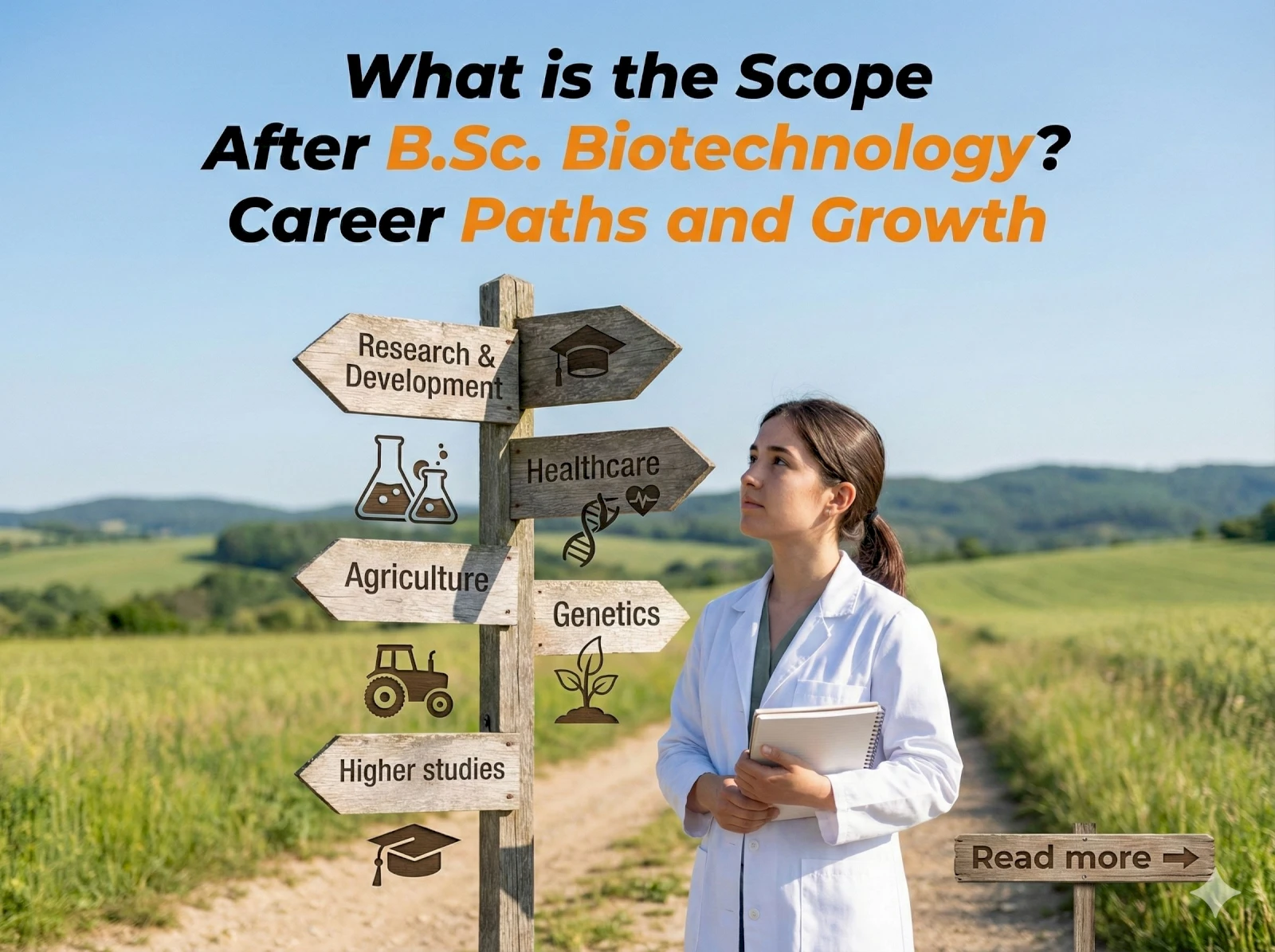
Knowing the B.Sc. Biotechnology scope helps you see the returns you get after investing time and effort in this course. Take a detailed look at all the pathways, sectors, and opportunities you get to explore.
- Higher Studies and Specializations
- Research and Development
- Pharmaceutical and Healthcare Industry
- Agriculture and Food Biotechnology
- Environmental and Industrial Biotechnology
- Bioinformatics and Computational Biology
- Teaching and Academia
- Entrepreneurship and Startups
- Government / Public Sector and Regulatory Roles
Salary and Industry Outlook
|
Job Role |
Approx. Annual Salary |
|
Research Associate |
₹3,50,000 - ₹5,50,000 |
|
Clinical Research Associate |
₹3,40,000 - ₹7,00,000 |
|
Biotechnologist |
₹2,00,000 - ₹6,50,000 |
|
Senior Research Associate |
Around ₹8,00,000 - ₹10,00,000 or more depending on specialization and company |
|
Lab Technician |
₹1,80,000 - ₹3,60,000 |
Why Choose Shiv Nadar University for Your B.Sc. (Research) in Biotechnology
If you’re looking for a program that not only teaches the biotechnology subject but also immerses you in an environment filled with research from an early stage, Shiv Nadar University stands out. The B.Sc. (Research) in Biotechnology is built to combine classroom learning with advanced discovery in this field.
Have a look at some of the highlights that are the reason for making Shiv Nadar University a compelling choice:
- The program follows a “3 + 1” model under NEP, dedicating the final year to a full research project, giving you a solid research experience before you graduate.
- You can combine majors and minors and select electives aligned with your interests. The curriculum allows you to explore biotechnology even if your major is another discipline.
- After your 2nd or 3rd year, you can join faculty research groups via the Opportunity for Undergraduate Research (OUR) program.
- For the final year or a semester, students may choose to conduct research at another university or within industry, subject to credit norms.
- A fully residential campus in NCR, with a diverse student body, thriving student clubs, sporting facilities, and an atmosphere for intellectual growth.
Choosing Shiv Nadar University for your B.Sc. (Research) in Biotechnology means you will be joining a community that values your research curiosity, interdisciplinary thinking, and academic freedom. If you’re actually interested and want to take your curiosity further to explore more, and build real skills before graduation, visit the program page, download the prospectus, and apply now to join the next batch of innovators at Shiv Nadar University.
To Conclude
Turn your curiosity into real impact by finding answers to the questions you have in mind. And that is exactly why this degree is built for some of the unique and inquisitive minds. Know in detail about the course details and scope that will help you in making better decisions that match your career goals. Step into the future of science with the B.Sc. (Research) in Biotechnology course and get access to the pedestal that can push you toward a successful career ahead.
FAQs
Is B.Sc. Biotechnology a safe choice after +2?
Yes. If you enjoy biology, lab work, innovation, and solving real problems. It offers diverse opportunities across fields.
How long does the B.Sc. Biotechnology course span for?
Well, it takes 3 years or 6 semesters. But some institutions offer 4 year honors or research versions.
What core subjects are there in this course?
You get to study subjects like cell biology, genetics, microbiology, biochemistry, bioinformatics, environmental biotechnology, and many more.
Can I go for a job immediately after B.Sc. Biotechnology?
Yes. You become eligible for research, pharma, diagnostics, environmental firms, and quality control roles. Higher qualifications improve chances for advanced roles.