Clear NET First or Pursue an M.A. in English? The Route That Actually Works
Blog / February 20, 2026
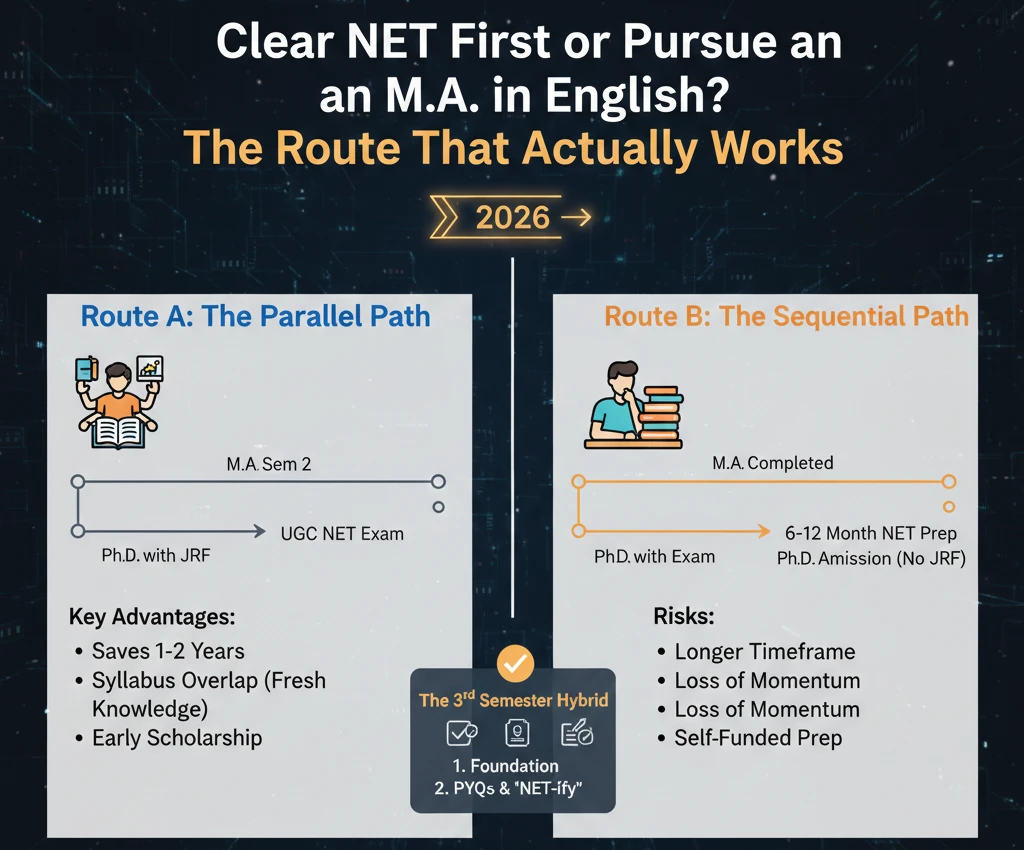
Every year, thousands of English graduates search for "M.A. in English eligibility" alongside "how to prepare for NET", often in the same week. It's a question that reveals deep confusion- Should you prove yourself through UGC-NET before applying to a master's program, or does the M.A. itself prepare you for competitive exams?
The truth is simpler than most coaching centers will tell you. This blog clarifies which path aligns with your actual goals, when each exam matters, and why the sequence you choose changes everything about your academic timeline and career readiness.
What an M.A. in English Actually Prepares You For
An M.A. in English is a postgraduate degree focused on literary analysis, critical theory, language studies, and research methodology. It's designed to deepen your understanding of literature across periods, genres, and cultural contexts.
|
Core Focus Areas |
What You Gain |
|
Literary theory and criticism |
Analytical frameworks for interpreting texts |
|
Research methodology |
Skills for academic writing and thesis preparation |
|
Specialized paper options |
Expertise in drama, poetry, postcolonial studies, etc. |
|
Dissertation work |
Original research experience |
The program is essential if you're aiming for academic careers, research positions, or roles requiring advanced literary expertise. It's not a coaching program for NET; it's a degree that builds scholarly depth.
What UGC-NET Actually Tests (And When It Matters)
UGC-NET (National Eligibility Test) is a qualifying exam for two purposes: eligibility for assistant professor positions and Junior Research Fellowship (JRF). It tests general teaching aptitude and subject-specific knowledge.
When NET becomes essential:
- You want to teach in colleges or universities
- You're applying for JRF to pursue PhD with financial support
- You need national-level qualification for academic positions
When NET is optional:
- You're pursuing corporate communication, publishing, or content roles
- Your career interest is in creative writing or media
- You plan to work in editing, journalism, or digital content
NET is career-specific, not universally mandatory. Your professional goal determines its importance.
The Logical Sequence: M.A. First, Then NET
Here's why pursuing an M.A. in English before attempting NET makes practical sense:
Stronger Subject Foundation
M.A. coursework covers the exact literary periods, theories, and texts that appear in NET Paper II. You'll study Renaissance drama, Romantic poetry, and postcolonial literature in depth, giving you conceptual clarity rather than surface-level memorization.
Research Training Helps With Paper I
M.A. programs include research methodology modules. These directly support NET Paper I, which tests skills you develop through dissertation work and seminar presentations, like teaching aptitude, research awareness, and comprehension.
Eligibility Advantage
Candidates with a master's degree score higher percentile ranges in NET. The academic maturity gained through two years of focused study translates into better exam performance.
|
Approach |
Timeline |
Success Likelihood |
|
Attempt NET after BA |
Immediate but often requires multiple attempts |
Lower. Limited subject depth |
|
Pursue M.A., then NET |
2 years + exam attempt |
Higher. Stronger conceptual base |
|
Attempt NET during M.A. |
Parallel preparation |
Moderate. Depends on program intensity |
NET Doesn't Replace a Degree
Clearing NET without a master's degree qualifies you for certain positions, but most academic institutions prefer or require M.A. for teaching roles. The exam alone won't substitute for the credential an M.A. provides.
M.A. in English Subjects: What You'll Study
Understanding M.A. in English subjects helps you see how they align with competitive exam syllabi:
|
Subject Area |
Typical Topics Covered |
|
British Literature |
Chaucer to contemporary; Shakespeare, Milton, Romantics, Modernism |
|
American Literature |
Transcendentalism, Harlem Renaissance, postmodern fiction |
|
Indian Writing in English |
Colonial to contemporary; Tagore, R.K. Narayan, Arundhati Roy |
|
Literary Theory |
Structuralism, feminism, postcolonialism, psychoanalysis |
|
Language and Linguistics |
Phonetics, syntax, semantics, discourse analysis |
These subjects directly map to NET Paper II sections. Studying them through an M.A. gives you interpretive skills rather than just factual recall.
Also read: M.A. in English: Unleash Your Literary Superpowers
Career Paths Where NET Isn't Required
If you're pursuing an M.A. in English but not aiming for academia, NET may not be on your radar—and that's perfectly valid.
Non-teaching career options with an M.A.:
- Content strategy and UX writing
- Publishing (editing, literary agencies, manuscript evaluation)
- Corporate communication and PR
- Media and journalism
- Scriptwriting for film and OTT platforms
- Technical writing and documentation
For these roles, your M.A. credential, writing portfolio, and specialized skills matter more than a qualifying exam.
When You Should Consider NET Before M.A.
There's one scenario where attempting NET early makes sense: if you're confident about teaching as a career and want to secure JRF funding for your PhD. Clearing NET with JRF before your M.A. means:
- You can pursue a funded research path immediately after your master's
- You have financial support during your PhD
- You meet assistant professor eligibility requirements early
However, this path requires exceptional self-study discipline and access to quality coaching or resources, since you won't have the M.A. foundation yet.
Making the Decision That Fits Your Goals
The choice between clearing NET first or pursuing an M.A. depends entirely on your career destination, not on which one seems "easier" or faster.
|
Your Goal |
Recommended Path |
|
Teaching in colleges/universities |
M.A. first, then NET (or attempt NET during M.A. final year) |
|
PhD with JRF funding |
Attempt NET early, pursue M.A. simultaneously if possible |
|
Publishing, content, creative writing |
M.A. without NET; focus on portfolio building |
|
Research without teaching |
M.A. first; NET optional, depending on institution requirements |
Don't let external pressure dictate your sequence. Your path should match your professional vision, not someone else's advice.
Shaping Thought Through Literature With M.A. in English Program at Shiv Nadar University (Institution of Eminence)
The M.A. in English at Shiv Nadar University is provided as a 2 year postgraduate program that emphasizes writing, close reading, and research mentorship. This structured curriculum provides many chances to engage in current literary discussions. It includes electives from other fields and offers guidance for writing your dissertation.
Areas of study
Students engage with a range of literary and theoretical fields, including-
- English literary history
- World literature
- Critical and cultural theory
- Translation studies
- Creative writing
- Visual studies
Writing and research focus
- Compulsory training in academic writing
- Writing for general and non specialist audiences
- Narrative and creative writing components
- Sustained feedback through close faculty mentorship
Conclusion
If you’re feeling stuck between NET and an M.A. in English, you’re not alone—and there’s nothing wrong with taking time to decide. This blog shows that for most students, an M.A. in English comes first because it builds real understanding of literature, theory, and research. NET then becomes a natural next step, and not just a pressure-filled shortcut. What matters most at this point is choosing a path that fits your career goals.
If you're still exploring your options, take a closer look at M.A. in English subjects, reflect on where you want to go, and choose a path that helps you grow with confidence and clarity.
FAQs
What is an M.A. in English degree?
An M.A. in English is a postgraduate program focused on literature, theory, language, and research, designed to build critical thinking and academic depth beyond undergraduate study.
What is the qualification for M.A. English?
You need a bachelor’s degree, usually in English or a related humanities subject. Some universities may require minimum marks or an entrance examination.
What is the scope of M.A. English?
An M.A. in English prepares you for academia, research, publishing, content roles, media, and communication careers, with NET required only if teaching or research funding is your goal.
How many years is M.A. in English?
An M.A. in English typically takes two years of full-time study, covering coursework, seminars, and often a dissertation or research-based project.