Chemical Engineer vs Mechanical Engineer: How They Think, Work and Build Different Systems

Blog / September 08, 2026
P, V, n, T. Change one variable and the others have to respond. That is the idea behind the equation PV = nRT, the ideal gas law. In an industrial setting, however, equations don't stay on paper; a change in pressure or temperature can affect an entire process and that is where engineering begins.
Now add a reaction such as N₂ + 3H₂ → 2NH₃. A Chemical Engineer is thinking about how to make that reaction happen efficiently at scale- managing temperature, pressure, reaction conditions and separation, while a Mechanical Engineer may be thinking about the equipment that makes the process possible: compressors, pumps, pressure vessels, heat-transfer systems and machinery. Same plant, same physics, but different problems to solve and these problems exist at enormous scale.
All this isn't happening in isolated industries. India’s engineering services exports have grown nearly eightfold in a decade, reaching US$13.8 billion, with Indian engineers increasingly working across automotive, aerospace, industrial manufacturing, electronics and other technology-intensive sectors.
That makes the choice between a Chemical Engineer vs Mechanical Engineer less about picking the better branch and more about deciding where you want your engineering skills to create impact- inside a process or in the machines and systems that make it work.
Chemical Engineer vs Mechanical Engineer: Key Differences at a Glance
The easiest way to understand the two careers is to look at the questions each professional is likely to ask.
Aspect | Chemical Engineer | Mechanical Engineer |
Core question | How can a material or process be transformed efficiently? | How can a machine or physical system work better? |
Main focus | Processes, materials, reactions, energy | Machines, components, systems, movement |
Typical work | Process design, optimization, production, safety | Design, testing, manufacturing, simulation |
Strong fundamentals | Chemistry, physics, mathematics | Physics, mathematics, mechanics |
Major technical areas | Thermodynamics, reaction engineering, heat & mass transfer | Mechanics, thermodynamics, heat transfer, manufacturing |
Industries | Chemicals, pharmaceuticals, energy, materials, food, environment | Manufacturing, automotive, aerospace, energy, machinery |
Emerging areas | Bioenergy, biomaterials, AI, nanotechnology, sustainability | Robotics, automation, smart materials, advanced manufacturing |
Work setting | Plants, laboratories, R&D and engineering offices | Design offices, factories, laboratories, R&D and worksites |
Best suited to | Students interested in processes and transformation | Students interested in machines, systems and design |
The important thing is that these professions are not isolated. A clean-energy project, for example, can need a Chemical Engineer to work on materials and energy conversion and a Mechanical Engineer to work on equipment, thermal systems and physical infrastructure.
What Does a Chemical Engineer Do?
Forget the stereotype of a person standing in a laboratory mixing chemicals; a Chemical Engineer's more interesting problem often starts after the experiment works.
Suppose a scientist develops a new material in a laboratory; it works, but can you make 1 kilogram of it? What about 1,000 kilograms? Can the process be made cheaper? Can less energy be used? Can waste be reduced? Can the reaction be controlled? Can the entire process operate safely? These are the kinds of questions Chemical Engineers help answer.
Their work can involve:
- Designing industrial processes
- Scaling laboratory processes to production
- Process optimisation
- Chemical reactions
- Heat and mass transfer
- Energy efficiency
- Process control
- Safety and risk management
- Materials development
- Waste reduction
- Sustainable production
- Process simulation and modeling
This gives the profession a surprisingly broad industrial footprint.
India's chemical sector covers 80,000+ commercial products, including bulk chemicals, specialty chemicals, agrochemicals, petrochemicals, polymers and fertilizers. The country is also the sixth-largest chemical producer globally and third-largest in Asia, with the sector contributing about 7% of India's GDP. According to reports, India's chemicals and petrochemicals demand is expected to nearly triple, reaching US$1 trillion by 2040. That means a Chemical Engineer can find opportunities far beyond a conventional chemical plant.
What Does a Mechanical Engineer Do?
Now take the same factory. The plant needs pumps, heat exchangers, compressors, machines, pipelines, production equipment and automated systems. Someone has to design them.
A Mechanical Engineer might ask:
- How should this component be designed?
- What material should it use?
- How much force can it withstand?
- How will heat affect it?
- How efficiently can it operate?
- Can the machine be automated?
- How can it be manufactured at scale?
- How can its reliability be improved?
Mechanical Engineers therefore work on design, machines, manufacturing and physical systems.
Their work can include:
- Product design
- Machine design
- Manufacturing
- Mechanical systems
- Thermal systems
- Materials
- Testing and simulation
- Automation
- Robotics
- Maintenance and reliability
- Energy systems
- Product development
The profession is closely connected to India's manufacturing expansion. Manufacturing currently contributes around 16–17% of India's GDP, while the National Manufacturing Mission aims to increase manufacturing's contribution to 25% of GDP by 2035 and create 143 million jobs.
For Mechanical Engineers, that means the traditional factory is only one part of the picture. The profession is increasingly connected to automation, electric mobility, robotics, advanced manufacturing and intelligent machines.
Chemical Engineer vs Mechanical Engineer: What Do They Actually Work On?
Consider a hydrogen-production facility.
A Chemical Engineer could be concerned with:
- The chemical reaction
- Process conditions
- Separation
- Energy efficiency
- Process safety
- Material flow
- Scale-up
A Mechanical Engineer could be working on:
- Pumps and compressors
- Equipment design
- Thermal systems
- Structural components
- Mechanical reliability
- Manufacturing
- Automation
The facility needs both. That is why the comparison isn't really about chemistry versus machines; it is about processes versus physical systems, with considerable overlap between the two.
Chemical Engineer vs Mechanical Engineer: Who Has More Scope?
This is where the comparison becomes more useful.
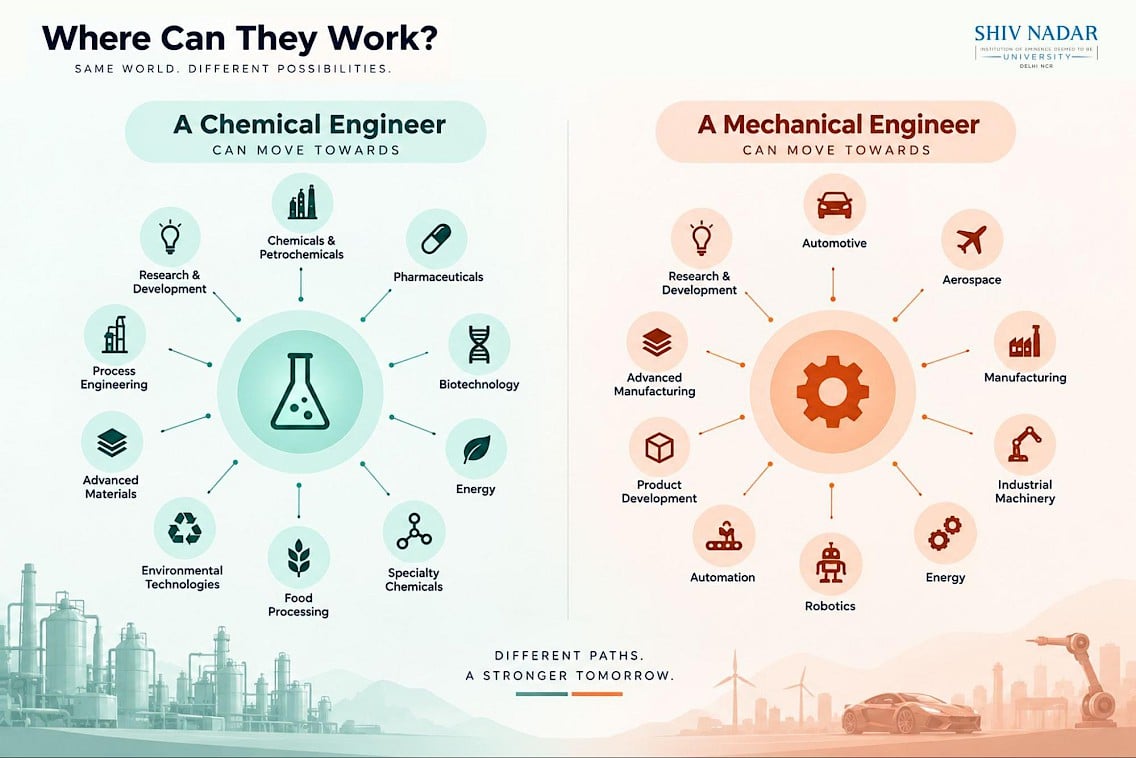
The underlying industries are substantial. The Indian chemical sector was estimated at around US$250 billion in 2024 and is projected to reach US$1 trillion by 2040. Meanwhile, India's manufacturing sector is being positioned for a much larger role in the economy, with the government targeting a 25% GDP share by 2035.
Career Scope at a Glance
Area | Chemical Engineer | Mechanical Engineer |
Chemical manufacturing | Very strong | Limited |
Pharmaceuticals | Very strong | Limited |
Manufacturing | Strong | Very strong |
Energy | Very strong | Very strong |
Automotive | Limited | Very strong |
Robotics | Limited | Very strong |
Advanced materials | Very strong | Strong |
Sustainability | Very strong | Strong |
Process engineering | Very strong | Limited |
Product design | Limited | Very strong |
Research & development | Very strong | Very strong |
So, which has more scope? Neither has a universal advantage. Chemical Engineers have a stronger natural connection to process- and material-intensive industries, while Mechanical Engineers have an exceptionally broad connection to machines, manufacturing and physical systems.
Where Are the Emerging Opportunities for Chemical and Mechanical Engineers?
The next wave of engineering careers is moving beyond conventional plant and manufacturing roles. Chemical and mechanical engineers are increasingly finding opportunities in industries shaped by clean energy, advanced materials, automation, electric mobility and sustainable manufacturing.
Emerging Area | Chemical Engineers | Mechanical Engineers |
Clean Energy | Hydrogen, bioenergy, carbon capture, sustainable fuels | Energy systems, turbines, thermal systems, renewable-energy equipment |
Electric Mobility | Battery materials, electrolytes, thermal processes | EV powertrains, battery thermal management, vehicle design |
Advanced Materials | Polymers, nanomaterials, biomaterials, speciality chemicals | Composites, smart materials, advanced manufacturing |
Automation & AI | Process modeling, optimization, predictive process control | Robotics, industrial automation, digital manufacturing |
Sustainability | Waste-to-value processes, pollution control, resource efficiency | Energy-efficient systems, green manufacturing, low-carbon machinery |
Healthcare & Biotech | Bioprocessing, pharmaceuticals, microfluidics | Medical devices, biomechanics, precision equipment |
Advanced Manufacturing | Process scale-up and materials processing | Additive manufacturing, industrial systems, machine design |
The shift is already visible in the energy sector. In 2024, 83% of India's power-sector investment went toward clean energy, creating demand for engineers who can work across energy, materials, manufacturing and process technologies.
For chemical engineers, the opportunity increasingly centers on developing and scaling new processes and materials- from bio-based products and hydrogen to advanced polymers and resource-efficient manufacturing. Mechanical engineers, meanwhile, are moving deeper into robotics, EVs, automation, advanced manufacturing and energy systems.
The strongest career prospects may therefore belong to engineers who combine their core discipline with data, simulation, automation and sustainability skills, rather than treating their engineering specialization as a fixed career lane.
Chemical Engineer vs Mechanical Engineer: What Skills Do They Need?
Both careers demand strong analytical thinking, problem-solving and technical knowledge, but they apply these skills to very different challenges. A chemical engineer works around processes, reactions and materials, while a mechanical engineer focuses more on machines, systems, movement and physical design.
Skill Area | Chemical Engineer | Mechanical Engineer |
Analytical thinking | Analyses reactions, processes, energy use and material behavior | Analyses forces, motion, energy, structures and machine performance |
Problem-solving | Improves processes, reduces waste and solves production or safety issues | Optimizes machines, components and manufacturing systems |
Mathematics & modelling | Uses process modeling, simulations and calculations to predict system behavior | Uses mathematical and computational models to test designs and system performance |
Thermodynamics | Applies it to reactions, energy balances, heat transfer and industrial processes | Applies it to engines, thermal systems, refrigeration and energy technologies |
Process/design thinking | Designs and scales processes from laboratory concepts to industrial production | Designs, develops and improves mechanical systems, components and machines |
Data & technology | Uses simulation, process-control tools and increasingly AI/data-driven methods | Uses CAD, simulation, automation, robotics and computational tools |
Safety & efficiency | Focuses heavily on process safety, environmental impact and resource efficiency | Focuses on mechanical reliability, operational safety and efficient system design |
Communication & teamwork | Works with scientists, operators, environmental specialists and other engineers | Works with designers, manufacturers, technicians and multidisciplinary engineering teams |
The simplest distinction: if you enjoy figuring out how a substance or process can be transformed efficiently and safely, chemical engineering may suit you better and if you're more interested in how a machine or physical system can be designed, built and improved, mechanical engineering may be the stronger fit.
The overlap is significant, too. Both increasingly require analytical thinking, technological literacy, systems thinking and adaptability as engineering work becomes more digital and interdisciplinary.
What Is the Salary of a Chemical Engineer vs Mechanical Engineer?
In India, salaries for both roles vary significantly by experience, location, industry and employer. Current salary data shows the two careers are fairly close overall, although better-paying opportunities can differ by sector.
Career | Average Salary in India | Typical Salary Range | Senior-Level Range |
Chemical Engineer | ₹24,655/month | ₹14,655–₹42,072/month | ₹12–25 LPA |
Mechanical Engineer | ₹23,332/month | ₹12,408–₹43,873/month | ₹6–15 LPA |
*Salary figures are indicative and can change with experience, location, company and role.
Sources- Indeed.
So, which pays more? At the average level, Chemical Engineering currently has a slight edge, but the difference isn't large enough to make salary the deciding factor. Sector matters more: Chemical Engineers can move into areas such as petrochemicals, specialty chemicals, energy and process industries, while Mechanical Engineers have opportunities across manufacturing, automotive, energy, robotics and industrial systems.
Chemical Engineer vs Mechanical Engineer: Which Career Should You Choose?
Imagine you are given two problems.
Problem 1- A company has developed a new material, but producing it at scale is too expensive. You want to understand:
- What reaction is happening?
- How can the process be optimized?
- How much energy is being consumed?
- How can waste be reduced?
- How can production be scaled safely?
Chemical Engineering may be the better fit.
Problem 2- A company has developed a new machine, but it is too heavy, expensive and inefficient. You want to understand:
- How should it be redesigned?
- Which material should be used?
- How will the components move?
- Can manufacturing be improved?
- Can automation make it more efficient?
Mechanical Engineering may be the better fit.
If you enjoy... | Chemical Engineer | Mechanical Engineer |
Chemistry | Yes | No |
Processes | Yes | No |
Reactions | Yes | No |
Materials | Yes | Yes |
Thermodynamics | Yes | Yes |
Machines | No | Yes |
Product design | No | Yes |
Manufacturing | Yes | Yes |
Robotics | No | Yes |
Automation | Yes | Yes |
Energy | Yes | Yes |
Sustainability | Yes | Yes |
Computational modelling | Yes | Yes |
And there is a third possibility: you may be interested in the overlap. Modern energy systems, advanced manufacturing, electric mobility, sustainable materials and smart factories increasingly require engineers who can work across disciplinary boundaries.
Turn Engineering Knowledge into Real-World Impact at Shiv Nadar University (Institute of Eminence)
At Shiv Nadar University, the two disciplines have distinctly different academic and research directions while still allowing interdisciplinary exploration.
Chemical Engineering
The program spans 8 semesters and a minimum of 163 credits, covering core areas such as Fluid Mechanics, Chemical Reaction Engineering, Thermodynamics, Separation Processes, Heat and Mass Transfer, Process Control, Process Engineering Design and Process Safety.
Students can pursue two undergraduate specializations:
- Modeling and Simulation
- Bioenergy and Biomaterials
The Modeling and Simulation route develops computational and analytical approaches to physical, chemical and biological systems, while the Bioenergy and Biomaterials route connects Chemical Engineering with sustainability, waste valorization, renewable energy and alternative fuels.
The department also has dedicated laboratories for Unit Operations, Mass Transfer, Chemical Reaction Engineering and Process Control, alongside computational facilities using tools such as Aspen Plus, ANSYS, COMSOL Multiphysics and MATLAB. Students can also engage in undergraduate research through the Opportunity for Undergraduate Research (OUR) program.
Mechanical Engineering
The Mechanical Engineering program focuses on material science, solid and fluid mechanics, thermodynamics, heat transfer, automation and control, design and manufacturing.
Its three undergraduate specialization areas are:
- Computational Techniques
- Energy Technology
- Robotics and Automation
The department's research and laboratory infrastructure includes a Bio-inspired Robotics and Design Lab, Advanced Manufacturing Lab, Energy Systems and Technology Lab, Surface Science and Tribology Lab and Multi-Functional Composites Lab. Facilities include a FESEM, wind tunnel, universal tensile tester, tribometer, potentiostat, arc melter, iCVD setup and 3D printers.
The program also offers a multidisciplinary final-year project, while industry partnerships and funded research provide opportunities for internships and research.
Chemical Engineer vs Mechanical Engineer at Shiv Nadar University
Particular | Chemical Engineer pathway | Mechanical Engineer pathway |
Duration | 8 semesters | 8 semesters |
Minimum credits | 163 | — |
Core direction | Processes, materials, reactions | Machines, systems, design |
Specialisations | Modelling & Simulation; Bioenergy & Biomaterials | Computational Techniques; Energy Technology; Robotics & Automation |
Practical exposure | Process & computational laboratories | Robotics, manufacturing, energy & materials laboratories |
Research areas | Sustainability, microfluidics, materials, process engineering | Robotics, energy, smart materials, advanced manufacturing |
Project exposure | Research project/thesis/internship | Multidisciplinary final-year project |
Interdisciplinary scope | AI, nanotechnology, sustainability | AI/ML, energy, robotics, advanced manufacturing |
The broader School of Engineering also emphasizes interdisciplinary education, research and innovation, with a 63,000 sq. ft. Research Block and an on-campus incubation center.
In short, the Chemical Engineering route is better suited to those drawn to processes, materials, energy and industrial transformation, while Mechanical Engineering offers a broader path across machines, manufacturing, automation, energy and physical systems.
Final Verdict
Choosing between a Chemical Engineer vs Mechanical Engineer career becomes easier when you stop asking which one has more scope and start asking which kind of problems you want to solve. Go for Chemical Engineering if you are drawn to processes, materials, energy, reactions and improving how products are made safely and efficiently; choose Mechanical Engineering if you enjoy designing machines, physical systems, manufacturing processes, automation and figuring out how things can work better.
And if your interests overlap, that is not a problem. Modern industries increasingly bring both disciplines together in areas such as energy, advanced materials, robotics, manufacturing and sustainable technologies. The right choice ultimately depends less on the job title and more on the kind of engineering problems you want to spend your career solving.
So, ready to take the next step? Explore the right engineering pathway and start building the skills for the career you want.
FAQs
Q1. Should I choose Chemical Engineering or Mechanical Engineering as a career?
Ans. Choose Chemical Engineering if you enjoy processes, materials and industrial production. Choose Mechanical Engineering if you prefer machines, design, manufacturing and automation.
Q2. What are the main differences between Chemical Engineering and Mechanical Engineering?
Ans. Chemical Engineering focuses on transforming materials through industrial processes, while Mechanical Engineering focuses on designing, analyzing and improving machines and physical systems.
Q3. What does a Chemical Engineer do compared with a Mechanical Engineer?
Ans. Chemical Engineers optimize processes, reactions, materials and production systems. Mechanical Engineers design, test and improve machines, components and mechanical systems.
Q4. Which career typically pays more: Chemical Engineering or Mechanical Engineering?
Ans. Both can offer strong salaries. Chemical Engineering can have a slight advantage in some sectors, but experience, industry, location and employer have a bigger impact.
Q5. What industries hire Chemical Engineers and Mechanical Engineers?
Ans. Chemical Engineers work in chemicals, petrochemicals, energy, pharmaceuticals, materials and environmental industries. Mechanical Engineers work across manufacturing, automotive, aerospace, energy, robotics and industrial automation.
Q6. Can a Mechanical Engineer transition into Chemical Engineering roles?
Ans. Yes, particularly in overlapping areas such as process equipment, energy, manufacturing and plant operations, although specialized chemical roles may require additional domain knowledge.
Q7. Which has more career scope: Chemical Engineers or Mechanical Engineers?
Ans. Mechanical Engineering generally offers a broader range of industries, while Chemical Engineering offers strong opportunities in process-driven sectors such as chemicals, energy, materials and pharmaceuticals.
Q8. Can Mechanical Engineers work in robotics and automation?
Ans. Yes. Mechanical Engineers can work in robotics through areas such as robotic design, automation, mechatronics, manufacturing systems and motion control.
Q9. What skills should aspiring Chemical and Mechanical Engineers develop?
Ans. Both need analytical thinking, problem-solving, mathematics and technical skills. Chemical Engineers should also build expertise in processes and safety, while Mechanical Engineers benefit from design, manufacturing and automation skills.
Q10. Can Chemical Engineers and Mechanical Engineers work together?
Ans. Absolutely. They often collaborate on industrial plants, energy systems, manufacturing facilities, process equipment, automation and sustainable engineering projects.