Beyond the Thesis: The Transformative List of Ph.D. Courses for Tomorrow’s Thinkers
Blog / October 24, 2025
Ph.D. in Computer SciencePh.D. Course ListPursuing a Ph.D. is one of the most rewarding academic achievements you can aim for. It represents not only mastery in a specific field but also the opportunity to contribute original research that shapes industries, technologies, and knowledge systems. If you’re planning to advance your career through a doctoral degree, understanding the available list of Ph.D. courses and their individual scopes can help you make a well-informed choice.
A Ph.D., or Doctor of Philosophy, is the highest academic qualification in most fields. It involves in-depth research, analysis, and innovation. From humanities and management to sciences and engineering, nearly every academic discipline today offers Ph.D. programs that align with evolving global trends.
What Is a Ph.D. Course?
A Ph.D. (Doctor of Philosophy) course is a research-oriented academic program designed to develop a scholar’s ability to conduct independent and original research. The focus is not just on gaining knowledge, but on contributing new insights or solutions within a particular field of study.
Typically, a Ph.D. program includes a combination of coursework, examinations, and a dissertation or thesis. It may take three to six years to complete, depending on the research topic, field, and university regulations.
Why Pursue a Ph.D.?
Choosing to pursue a Ph.D. is about more than just earning a title; it’s about deep intellectual engagement and innovation. Some of the top reasons to consider a Ph.D. include:
- Specialized Knowledge: Attain mastery in your chosen discipline.
- Research Contribution: Create original findings that may impact academia, industries, or policies.
- Career Advancement: Qualify for top-tier academic, research, and industry roles.
- Intellectual Growth: Develop strong analytical, problem-solving, and critical thinking skills.
- Recognition: A Ph.D. establishes your credibility as an expert in your field.
Types of Ph.D. Programs in India
In India, Ph.D. programs are structured to suit different learning preferences, professional goals, and personal commitments. Understanding these types helps students choose the path best aligned with their aspirations.
1. Full-Time Ph.D. Programs
Full-time Ph.D. programs are the traditional model where students dedicate themselves entirely to research and coursework under continuous faculty supervision.
Key Features:
- Duration: Typically 3–5 years, depending on the discipline.
- Requires full-time enrollment and regular on-campus interaction.
- Ideal for students who can commit exclusively to research.
- Provides access to university labs, libraries, and research facilities.
2. Part-Time Ph.D. Programs
Part-time Ph.D. programs cater to working professionals or individuals with other commitments who wish to pursue research alongside their careers.
Key Features:
- Duration: Generally 5–7 years.
- Offers flexible schedules with periodic on-campus sessions.
- Often provided by private universities supporting employed scholars.
- Enables candidates to integrate academic research with professional work.
3. Integrated Ph.D. Programs
Integrated Ph.D. programs combine a master’s and doctoral pathway, enabling students to begin research training early after completing their bachelor’s degree.
Key Features:
- Duration: Around 5–6 years.
- Includes master’s-level coursework followed by doctoral research.
- Commonly offered in science and technology fields by IISc, IITs, and similar institutions.
- Designed for students with early clarity on research interests.
4. External or Distance Ph.D. Programs
External or distance Ph.D. options are ideal for professionals who cannot relocate but wish to pursue advanced research through flexible, remote arrangements.
Key Features:
- Focused mainly on independent research with limited campus visits.
- Suitable for experienced professionals or researchers in industry.
- Offered by select private and deemed universities.
- Requires self-motivation and strong research discipline.
5. Collaborative or Industry-Linked Ph.D. Programs
These programs bridge academia and industry, allowing students to work on real-world research challenges with corporate or institutional partners.
Key Features:
- Duration: Typically 3–5 years.
- Involves joint mentorship from academia and industry experts.
- Focuses on applied research and innovation-driven projects.
- Encourages technology transfer and industry-based problem-solving.
List of Popular Ph.D. Courses in India
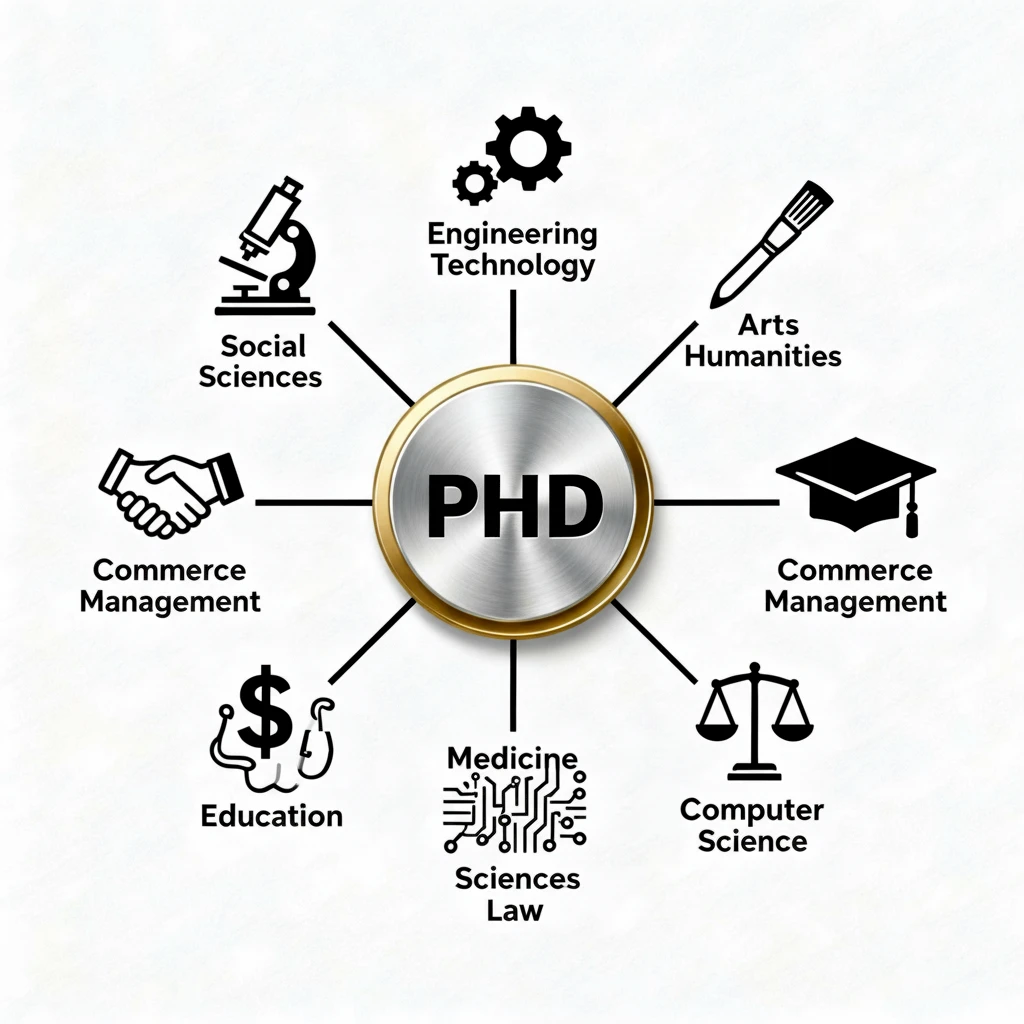
India’s Ph.D. landscape is more diverse and dynamic than ever before. As research becomes increasingly interdisciplinary, today’s doctoral candidates are exploring new frontiers — blending science with data, management with psychology, and law with technology. Whether you aim to teach, innovate, or influence policy, the right Ph.D. program can shape both your expertise and your impact.
Here’s an in-depth look at some of the most popular Ph.D. courses in India that are shaping academic and professional futures.
1. Ph.D. in Science
A Ph.D. in Science is the foundation of modern research and innovation. It attracts students who seek to explore nature’s mysteries, challenge established theories, and develop solutions that transform the world.
- From Physics and Chemistry to Biotechnology and Environmental Science, scholars dive into experimental and theoretical research — designing models, testing hypotheses, and publishing original findings.
- Emerging areas of focus: Quantum computing, nanotechnology, renewable energy, genetic engineering, and bioinformatics.
- Ph.D. graduates in science often lead research institutions, work in national labs like CSIR or ISRO, or collaborate with international projects tackling real-world problems such as climate change, disease control, and sustainable technology.
2. Ph.D. in Engineering & Technology
Engineering Ph.Ds are no longer confined to machines and circuits — they now define the backbone of India’s innovation economy. This program is ideal for students who want to solve practical problems through technology and research.
- With specializations in Mechanical, Electrical, Civil, Computer Science, Electronics, and Artificial Intelligence, research spans everything from smart infrastructure to robotics and automation.
- In-demand specializations: Sustainable engineering, renewable energy systems, data-driven design, robotics, and intelligent systems.
- Graduates emerge as innovators, R&D heads, or university professors who bridge the gap between academia and industry, shaping the technologies that drive progress.
3. Ph.D. in Arts & Humanities
The Arts and Humanities give meaning to progress by studying culture, creativity, and the human condition. A Ph.D. in this field is ideal for thinkers, writers, and researchers who want to explore how society expresses itself through history, language, and art.
- Students can specialize in History, Literature, Linguistics, Philosophy, or Fine Arts, with opportunities to research subjects such as postcolonial identity, ethical philosophy, digital media, and art history.
- Emerging research areas: Digital humanities, film and cultural studies, linguistics and AI, and philosophical ethics in technology.
- Ph.D. holders often work in academia, publishing, or cultural institutions, using their expertise to interpret how ideas, art, and language shape the world around us.
4. Ph.D. in Social Sciences
A Ph.D. in Social Sciences explores the patterns and behaviors that influence societies. It suits those who are curious about human interactions, economic systems, governance, and social justice.
- Core disciplines include Sociology, Psychology, Political Science, Anthropology, and Economics, with research often centered on policy reform, social development, and behavioral change.
- Current focus areas: Public policy, behavioral economics, mental health studies, globalization, and gender research.
- Graduates often work in think tanks, NGOs, international organizations, or government bodies, where their findings directly influence public policy and social progress.
5. Ph.D. in Commerce & Management
The world of business relies increasingly on research-driven strategy. A Ph.D. in Commerce or Management allows scholars to dissect the complexities of markets, leadership, and organizational behavior.
- Popular specializations include Finance, Human Resources, Marketing, Business Analytics, and Entrepreneurship. Scholars often study how data, innovation, and consumer psychology shape the business landscape.
- Emerging research themes: Digital transformation, corporate governance, sustainability in business, and leadership analytics.
- Graduates are equipped for academic, consulting, and executive roles, where they also learn to use their research to influence business models and decision-making on a global scale.
6. Ph.D. in Education
As education evolves through technology and policy, research in this field has never been more important. A Ph.D. in Education focuses on developing new teaching methods, improving curricula, and enhancing learning outcomes.
- Specializations include Curriculum Design, Educational Technology, Pedagogy, and Policy Development.
- Trending topics: Digital learning models, teacher education, inclusive education, and AI in pedagogy.
- Ph.D. scholars in this domain often become educational leaders, policymakers, or EdTech researchers — helping institutions adapt to the demands of 21st-century learning.
7. Ph.D. in Law
Law today is a dynamic and interdisciplinary domain. A Ph.D. in Law is ideal for those who want to shape legal thinking, policy frameworks, or international governance.
- Common specializations include Constitutional Law, Corporate Law, International Law, and Criminal Justice.
- Growing areas of interest: Cyber law, environmental law, human rights, and legal technology.
- Graduates often work as legal scholars, policy advisors, or consultants to governments and international organizations. Their research contributes to reforming judicial systems and upholding justice in the digital era.
8. Ph.D. in Medicine & Allied Health Sciences
Healthcare research is rapidly expanding as science and technology merge. A Ph.D. in Medicine or Allied Health Sciences allows scholars to contribute to breakthroughs that save lives and redefine public health.
- Key areas include Pharmacology, Nursing, Biochemistry, Public Health, and Medical Biotechnology.
- Emerging frontiers: Genomics, personalized medicine, epidemiology, and healthcare data analytics.
- Ph.D. graduates often lead research in hospitals, biotech firms, or universities, driving innovations that improve diagnostics, treatments, and healthcare systems worldwide.
Eligibility for Ph.D. Courses (General)
The basic eligibility to apply for a Ph.D. in India includes:
- A Master’s degree or equivalent qualification in a relevant field.
- A minimum of 55% aggregate marks (50% for SC/ST/OBC or differently-abled candidates).
- Qualifying entrance exams such as UGC-NET, CSIR-NET, GATE, or university-specific tests.
- Submission of a research proposal or synopsis outlining the intended area of study.
Some universities also conduct personal interviews or require prior research publications.
Duration of Ph.D. Courses
The average duration for most Ph.D. programs ranges from 3 to 6 years, depending on the subject, nature of research, and the university’s academic structure.
- Full-time Ph.D.: 3–5 years
- Part-time Ph.D.: 4–6 years
- Integrated Ph.D. (after Bachelor’s): 5–7 years
Completion time can vary based on research progress and thesis approval.
Factors to Consider When Choosing a Ph.D. Program
Choosing the right Ph.D. program shapes your academic journey and professional future. Evaluating factors like university reputation, faculty expertise, funding, and infrastructure helps ensure your research goals align with institutional strengths and career aspirations.
- Reputation of the University
Select a university known for academic excellence and global recognition. A strong reputation ensures quality research guidance, access to top resources, and better postdoctoral or industry opportunities that enhance your long-term academic and professional prospects. - Faculty Expertise and Research Focus
Choose a program where faculty expertise aligns with your research interests. Mentors with strong publications, projects, and collaborations offer valuable guidance, shaping your research direction and helping you produce impactful, high-quality work. - Funding and Scholarships
Financial support is vital for research stability. Explore scholarships like UGC-JRF, CSIR, or institutional grants to reduce expenses and focus on academic excellence without financial pressure during your Ph.D. journey. - Infrastructure and Research Facilities
Modern labs, advanced computing systems, and access to digital libraries are essential for effective research. Strong infrastructure supports experimentation, data analysis, and collaboration across disciplines, improving both learning and research outcomes. - Location and Connectivity
Consider the university’s location, cost of living, and accessibility. Institutions near research hubs or industries offer better collaboration, exposure, and networking opportunities, contributing to a more balanced and productive research experience. - Alumni Success and Career Outcomes
Alumni achievements reflect the program’s impact. Graduates in reputed universities, research organizations, or global firms highlight program quality and create networks that support mentorship, collaborations, and future career growth.
Admission Process for Ph.D. Courses
The admission process may differ by university, but the general steps include:
- Application Submission – Apply through the official university portal.
- Entrance Exam – Appear for UGC-NET, CSIR-NET, GATE, or university-level tests.
- Interview or Viva – Discuss your research interests with the selection panel.
- Research Proposal Approval – Submit a detailed research plan for faculty review.
- Final Admission – Once approved, you can register and begin coursework.
Career Opportunities After a Ph.D.
After completing a Ph.D., students can explore diverse opportunities in:
- Academia and Teaching
- Working Areas: Universities, IITs, NITs, Private Colleges, and Research Institutions.
- Job Roles: Assistant Professor, Lecturer, Academic Researcher, Postdoctoral Fellow.
- Average Salary Range: ₹8–20 LPA depending on institution, experience, and research publications.
- Government Research organizations
- Working Areas: DRDO, ISRO, CSIR, ICMR, DST, NITI Aayog.
- Job Roles: Research Scientist, Policy Analyst, Scientific Officer, Project Director.
- Average Salary Range: ₹10–18 LPA with benefits such as research grants and allowances.
- Private and Corporate R&D Labs
- Working Areas: Technology, Healthcare, Automotive, and Pharmaceutical Research Divisions.
- Job Roles: R&D Scientist, Data Scientist, AI Researcher, Innovation Manager.
- Average Salary Range: ₹12–25 LPA depending on company and domain expertise.
- Consulting Firms and Think Tanks
- Working Areas: Management Consulting, Policy Research, Economic Advisory, and Innovation Strategy.
- Job Roles: Research Consultant, Policy Advisor, Data Strategist, Senior Analyst.
- Average Salary Range: ₹10–22 LPA based on firm reputation and analytical expertise.
- International Research Collaborations
- Working Areas: Global Universities, Research Consortia, Postdoctoral Fellowships, International NGOs.
- Job Roles: Postdoctoral Researcher, International Fellow, Visiting Scholar, Project Scientist.
- Average Salary Range: ₹15–35 LPA, varying by country and funding.
Ph.D. holders are often regarded as experts in their domains and enjoy long-term career stability, intellectual satisfaction, and leadership opportunities.
Ph.D. in Computer Science: A Growing Field of Research
Among all doctoral programs, the Ph.D. in Computer Science stands out for its high relevance in today’s digital and data-driven world. With the rise of artificial intelligence, data analytics, and automation, this field offers vast opportunities for groundbreaking research and innovation.
Overview
A Ph.D. in Computer Science is a research-intensive program that prepares scholars to contribute to cutting-edge advancements in computing technologies. The focus ranges from developing new algorithms and improving software systems to creating solutions for complex computational challenges.
Common Research Areas
Students pursuing this doctorate can specialize in topics such as:
- Artificial Intelligence (AI) and Machine Learning (ML)
- Data Science and Big Data Analytics
- Cybersecurity and Cryptography
- Cloud Computing
- Quantum Computing
- Natural Language Processing (NLP)
- Internet of Things (IoT)
- Human-Computer Interaction and
- Computer Vision and Image Processing
Eligibility Criteria
To pursue a Ph.D. in Computer Science, candidates generally must:
- Hold a Master’s degree in Computer Science, Information Technology, or a related field.
- Have secured at least 55% marks or equivalent CGPA (with relaxation for reserved categories).
- Qualify entrance exams such as UGC-NET, CSIR-NET, GATE, or university-specific tests.
- Submit a strong research proposal or statement of purpose.
Duration and Structure
The duration of a Ph.D. in Computer Science is typically 3–5 years, including coursework, research work, and thesis submission. The first year often focuses on research methodology and advanced computing concepts, followed by independent research under faculty supervision.
Career Opportunities After A Ph.D. in Computer Science
Graduates of this program can explore roles in:
|
Industry |
Top Companies |
Job Roles |
Average Salary (INR per annum) |
|
Academia |
IITs, NITs, IIITs, IISc, Private Universities |
Professor, Lecturer, Academic Researcher |
₹8–15 LPA |
|
Research & Development |
DRDO, ISRO, CSIR, TCS Research, Infosys Labs |
Research Scientist, AI/ML Engineer, Innovation Specialist |
₹10–20 LPA |
|
Tech Industry |
Google, Microsoft, IBM, Amazon, NVIDIA, AI Startups |
Data Scientist, AI Researcher, System Architect, Machine Learning Engineer |
₹12–25 LPA |
|
Government & Defence |
NIC, MeitY, DRDO, Defence Cyber Agency |
Cybersecurity Analyst, Data Analyst, IT Policy Researcher |
₹8–18 LPA |
Why Choose a Ph.D. in Computer Science?
- Demand for Research-Based Roles in Emerging Technologies
With rapid advancements in AI, data science, and cybersecurity, the global demand for research-driven professionals is growing, offering immense opportunities for innovation and leadership in technology.
- Excellent Career Scope in Both Academia and Industry
A Ph.D. in Computer Science opens prestigious roles in academia, global tech firms, and research organizations, combining intellectual growth with high-impact contributions to innovation and advanced computing.
- Opportunities to Publish, Present, and Collaborate Internationally
Ph.D. scholars gain opportunities to publish research papers, attend global conferences, and collaborate with international experts, building networks that strengthen academic recognition and research excellence worldwide.
- Strong Potential for Innovation-Driven Careers and Entrepreneurship
Doctoral research often leads to groundbreaking innovations and startups, empowering graduates to create new technologies, secure patents, and contribute to the global digital and AI ecosystem.
Why Choose Shiv Nadar University for Your Doctoral Journey
If you’re considering doctoral research,, there’s a compelling case for choosing Shiv Nadar University. Here’s a detailed breakdown of what makes Shiv Nadar University a top choice for pursuing a Ph.D., particularly if you’re also interested in a discipline like computer science or another cutting-edge area.
- Research-Centric Environment
Shiv Nadar University fosters a multidisciplinary, inquiry-driven culture where doctoral students work independently under expert faculty engaged in global research, publications, and innovation.
- Diverse Ph.D. Programs
Shiv Nadar University offers Ph.D. options across Engineering, Natural Sciences, Humanities and Social Sciences, and Management—ideal for those choosing a discipline from a wide list of Ph.D. courses.
- State-of-the-art Infrastructure
Ph.D. scholars access cutting-edge research facilities, from high-performance computing clusters to microscopy and cell culture labs, supporting experimental, computational, and applied research.
- Strong Support for Scholars
With clear Ph.D. regulations, full-time and part-time options, and industry-sponsored pathways, Shiv Nadar University ensures every doctoral journey is structured, flexible, and well-guided.
Final Thoughts
Whether you aspire to become a researcher, academician, or industry innovator, a Ph.D. can open new doors of opportunity. With countless specializations available, from the natural sciences to humanities and emerging fields like computer science, you can align your research interests with your long-term goals.
Choosing the right Ph.D. program is about finding a subject that inspires you and a university that nurtures your potential. With dedication and curiosity, a Ph.D. journey can lead to discoveries that truly make a difference.
FAQs
1. What are the eligibility criteria for Ph.D. courses in India?
Typically, to apply for a Ph.D. you must hold a recognized Master’s degree (or equivalent) in the relevant discipline, often with a minimum of 55% marks (some institutions allow 50% for reserved categories). Some programs may also require you to qualify a national or institutional entrance exam and submit a research proposal.
2. How long does it take to complete a Ph.D.?
The duration varies by field and institution, but most full-time Ph.D. programs span about 3 to 5 years in India. Part-time modes may extend to 4-6 years depending on the research progress and university policy.
3. Is a Ph.D. in Computer Science worth it, and what are the specializations?
Yes, a Ph.D. in Computer Science offers strong value if you’re interested in research, innovation, or high-level roles in academia or industry. Some common specializations include artificial intelligence (AI), machine learning (ML), data science, cybersecurity, cloud computing, IoT, and more. If you’re motivated to publish research, collaborate, and work at the frontier of technology, this path can be very rewarding.
4. Can I pursue an online Ph.D. in India?
No. Currently, fully online Ph.D. programs in India are not recognized by the University Grants Commission (UGC). You must attend in-person or research-based sessions as required by your institution and fulfill coursework, thesis, and research requirements.
5. What should I consider when selecting a Ph.D. program from the list of available courses?
Here are key factors to check:
- Research infrastructure and lab facilities of the institution.
- Expertise and availability of potential supervisors in your chosen area.
- The topic’s relevance, future demand (especially for computer science specializations), and your own interest.
- Funding, scholarship/support for Ph.D. students (stipend, assistantships).
- University recognition, accreditation, and the mode (full-time/part-time).