Beyond the Basics: Emerging Topics Shaping the New B.Sc. Chemistry Syllabus
Blog / March 06, 2026
If you think B.Sc. Chemistry is just endless reaction mechanisms and bulky lab records, you’re stuck in 2014. The syllabus has quietly evolved with time. Core chemistry is still there, where you will get to study organic, inorganic, and physical, but now you’ll also see computational chemistry and spectroscopy; you actually interpret research projects, skill-based electives, and sometimes even Python. Universities are updating their programs at the industry's new requirements. Degrees now focus on practical use after graduation, not just passing exams.
Why the B.Sc. Chemistry Syllabus Is Changing
Two things are pushing this change forward-
- The first is NEP 2020. The National Education Policy introduced a flexible credit system that allows universities to add electives, specializations, and skill-based courses from the very first year. The rigid old structure simply did not allow that.
- The second is industry demand. Pharmaceutical companies, biotech firms, and materials science labs now expect graduates to arrive with computational skills, instrumentation exposure, and some understanding of biological systems at the molecular level. Programs that deliver this have a clear edge in placements and postgraduate admissions.
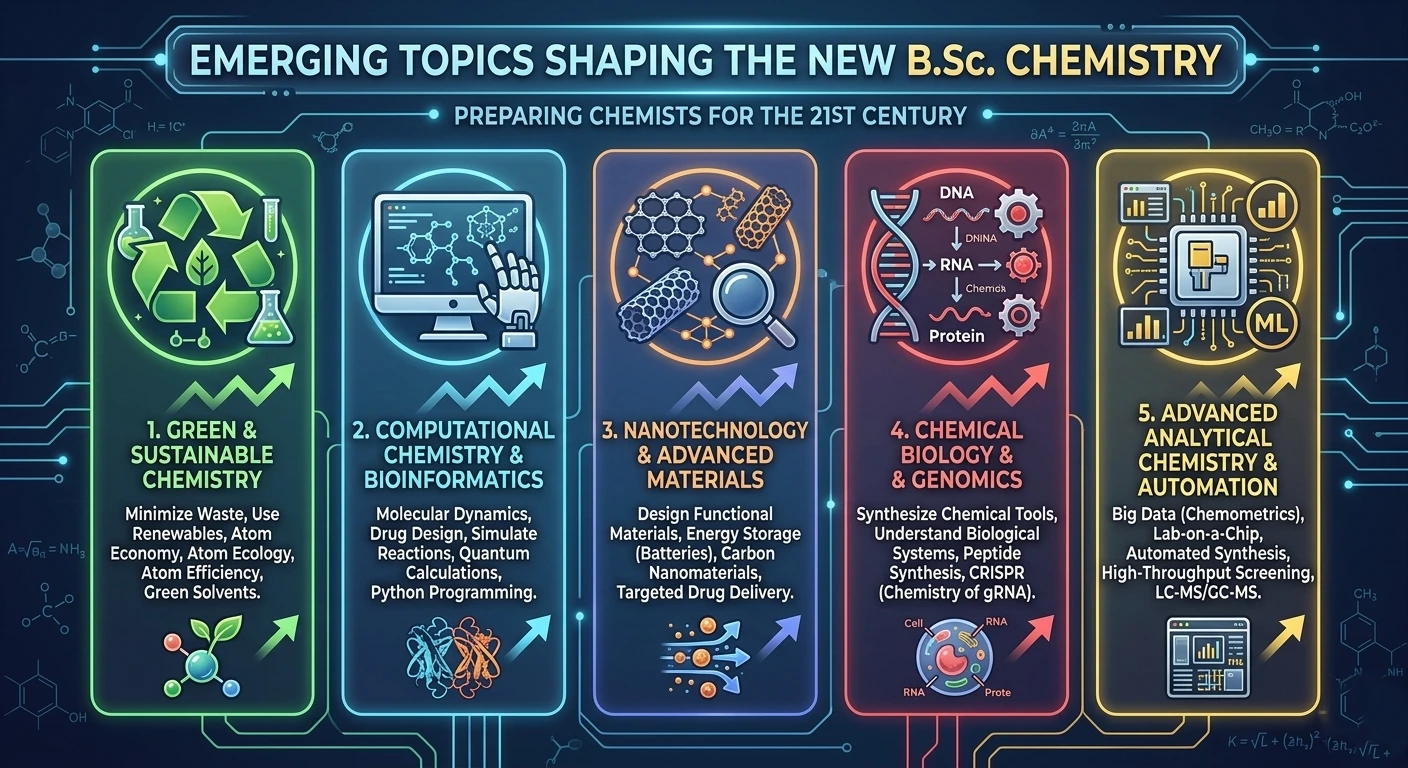
Emerging Topics Integrated Into the New B.Sc. Chemistry Syllabus
Beyond the three foundational branches, here is what the modern curriculum has added and when it typically appears-
|
Emerging Topic |
What Students Learn |
When It Appears |
|
Computational Chemistry and Molecular Modelling |
|
Year 1, Semester 2 onward |
|
Cheminformatics and Machine Learning |
|
Year 3 elective |
|
Chemical Biology |
|
Year 1 to 3 (foundational to advanced) |
|
Materials Chemistry and Nanoscience |
|
Year 2 foundation, Year 3 in-depth |
|
Organometallic and Bioinorganic Chemistry |
|
Year 3 core |
|
Green Chemistry |
|
Woven throughout |
|
Advanced Analytical Instrumentation |
|
Year 1 onward |
|
Python for Chemistry |
|
Year 3 elective |
Three of these deserve a closer look because they represent the biggest shift in what a B.Sc. Chemistry degree can do for you. Computational Chemistry is now taught in Year 1 at research-focused schools, allowing students to gain a deeper understanding over three years instead of a quick overview later.
Chemical Biology combines chemistry & life sciences, covering topics previously only available at the postgraduate level. Additionally, Cheminformatics with Machine Learning is a highly valuable skill set for chemistry graduates in 2026, especially for jobs in AI-driven drug discovery.
What the B.Sc. Chemistry Syllabus 1st Year Covers
|
Semester |
Core Subjects |
|
Semester 1 |
|
|
Semester 2 |
|
At a research-focused institution, Semester 1 covers atomic structure, molecular orbital theory, thermodynamics as well as spectroscopy basics as a single integrated course.
Semester 2 adds Molecular Modelling as a standalone subject and Physical Methods in Chemistry, where students get hands-on access to NMR, IR, UV-Vis, HPLC & X-ray diffraction instruments in the actual lab, and not just in theory.
The B.Sc. Chemistry syllabus 1st year lays the groundwork for an exciting learning journey. In years 2 and 3, we’ll dive deeper into those foundational topics and discover new ideas!
Career Scope: How Specializations Map to Real Roles
|
Specialization |
Career Roles |
Higher Studies Path |
|
Computational Chemistry |
|
|
|
Materials Chemistry and Nanoscience |
|
|
|
Chemical Biology |
|
|
|
General B.Sc. Chemistry |
|
|
Entry-level salaries typically range between “INR 3.5 LPA and INR 8 LPA”, with higher packages at institutions with strong research & computational training. These numbers rise considerably at the postgraduate level.
What a Research-Oriented Program Looks Like in Practice at Shiv Nadar University (Institution of Eminence)
The difference between a standard B.Sc. Chemistry program and a research-oriented one are not just about brochure language. It shows up in the actual curriculum and lab access from the first semester. Shiv Nadar University's B.Sc. (Research) in Chemistry program is a useful reference point for what a modern, research-first curriculum actually involves-
- Three Specialization Tracks Available- Students select from Materials Chemistry, Computational Chemistry, or Chemical Biology, with structured courses over three years instead of just electives at the end.
- Active Research Areas Open to Undergraduates- They can participate in funded research through the REAL (Research Experiential & Applied Learning) platform in fields like Cheminformatics, Green Chemistry, Nano-Biotechnology, Ultrafast Spectroscopy as well as Medicinal Chemistry.
- Molecular Modelling in Semester 2- Students use Gauss View, Avogadro & CSD molecular databases in their first year, often before computational chemistry is introduced at most institutions.
- Proven Global Outcomes- The chemistry graduates from the university have secured research positions at Nanyang Technological University Singapore, the Australian National University & Case Western Reserve University, and received the DAAD-WISE fellowship & PhD offers in Astrochemistry from the University of Maryland.
Conclusion
The most important shift in the modern B.Sc. Chemistry curriculum is such that the genuinely useful content starts in Year 1, not Year 3. Computational modelling, advanced instrumentation, and chemical biology are no longer rewards for surviving the foundational years. In the best programs, they are built in from the beginning, because that is what the field actually requires in 2026.
If you are choosing a program or planning your electives, look specifically for hands-on instrumentation access, computational chemistry courses introduced early & a formal specialization structure. The foundational branches are still essential. The programs worth your time are the ones that build something substantially more useful on top of them.
FAQs
What is the syllabus of B.Sc. 1st year chemistry?
In the first year of B.Sc. Chemistry, you study organic, inorganic, and physical chemistry, along with basic mathematics, lab work, spectroscopy fundamentals, and sometimes introductory molecular modelling.
What is the future of B.Sc. Chemistry?
The future of B.Sc. Chemistry is strong, especially in computational chemistry, materials science, chemical biology, and AI-driven drug discovery, where industry demand and research funding are growing steadily.
Is B.Sc. Chemistry a good option?
Yes, if you enjoy problem-solving and science. B.Sc. Chemistry builds strong analytical skills and opens pathways into research, pharma, biotech, education, and competitive exams.
Which chemistry field is in demand?
Computational chemistry, materials chemistry, nanoscience, and chemical biology are currently in high demand, especially in pharmaceutical research, semiconductor industries, and AI-based drug development.
Which job is best for B.Sc. Chemistry graduates?
After B.Sc. Chemistry, popular roles include quality control analyst, research assistant, lab technologist, forensic analyst, and computational chemistry trainee, depending on your specialization.
Which project is best for B.Sc. Chemistry?
Projects in molecular modelling, green chemistry synthesis, nanomaterials, spectroscopy-based analysis, or cheminformatics stand out because they combine theory with practical, industry-relevant skills.
Is B.Sc. Chemistry difficult?
It can be challenging, especially physical chemistry and mathematics, but consistent study, lab practice, and conceptual clarity make B.Sc. Chemistry manageable and rewarding.