Beyond Circuits and Signals - How a Ph.D. in ECE Creates Architects of the Next Technological Revolution
Blog / October 14, 2025
Ph.D. in Electronics and Communication EngineeringPh.D. in ECE career pathsJust look around yourself, your house, your community, or even around your city. You will see a variety of machines that think, systems that speak, and networks that never sleep.
How are all these things working?
The answer lies in Electronics and Communication Engineering.
From the chip in your phone to the signal that drives your GPS, ECE is the reason machines can sense, process, and act. But most of it stays hidden, working in silence.
You don’t see signal processors deciding how your MRI image appears. You don’t see embedded systems making traffic signals smarter or life-saving alerts on wearable devices. You don’t see the chipsets that make your satellite TV stream in real time.
But without ECE, none of it would work.
A Ph.D. in ECE takes you into the logic that makes all these things possible.
When systems begin to make decisions, the question shifts from “How do they work?” to “Why do they work this way, and what can we do better?” This is why Ph.D. researchers in ECE don’t just build systems. They design the frameworks for how modern life operates - quietly, seamlessly, and intelligently.
Rewiring the Past: How Electronics Became the Architecture of Modern Life
To understand the future of ECE, look at its path.
The early days focused on signals, sending dots and dashes across a wire. That wire became wireless. Then came the transistor, and suddenly, machines could compute.
With every breakthrough:
- Communication changed - from person-to-person (telegraphy)
- To machine-to-machine (embedded controllers)
- To environment-aware systems (IoT and smart devices)
Here’s how ECE has shaped every major tech wave:
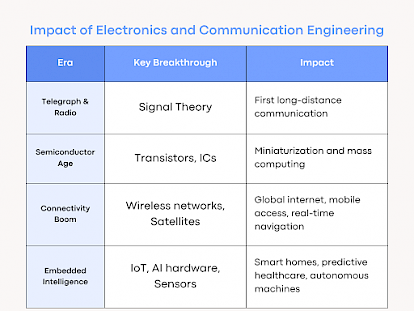
At each point, ECE wasn’t just creating tools. It was reshaping how humans and machines connect.
But there’s a shift happening now.
We need more than faster circuits. We need deeper insight into materials, into computation, into how systems think and respond.
This is where Ph.D. in ECE scholars step in, not as tech builders, but as architects of intelligent systems that understand, learn, and adapt.
The Ph.D. Journey: From Engineering Things to Engineering Thought
Doing a Ph.D. in Electronics and Communication Engineering isn’t about spending some years in a lab. It’s about transforming how you think.
You move from solving problems to asking new ones and from learning systems to designing them from scratch. This journey opens up research areas that shape the next decades and century, not just the next product cycle.
Here are key areas where Ph.D. students are leading:
- Neuromorphic Computing
- Quantum Communication
- Bio-Electronics
- Human–Machine Interfaces
- Sustainable Electronics and
- Edge AI
Your research could lead to:
- Patentable technologies
- Startups in healthcare, defense, or energy and
- Positions in top innovation labs, public policy, or academia
When Innovation Meets Conscience: Making Technology Human Again
If you plan to pursue a Ph.D. in ECE, this is where your work becomes more than technical. You start asking what systems should serve, not just how they function.
Here’s where Ph.D. research in ECE is making a difference:
Healthcare access
- Remote sensors track vital signs in real time, reduce hospital visits, and give rural patients better monitoring.
Rehabilitation systems
- Brain-controlled prosthetics allow movement in stroke survivors.
Affordable communication tools
- Satellite internet that reaches remote villages.
Sustainable circuits
- Solar-powered sensors or circuits made of biodegradable materials.
Fair AI hardware
- Energy-efficient systems that don’t compromise privacy or transparency.
You work with people from other fields like public health, climate research, urban planning, etc. Because the goal isn’t to make smarter machines, it’s to build systems that understand real human needs.
Designing Tomorrow: How Ph.D. Minds Are Building the Next Age of Intelligence
Not every breakthrough is born in a startup garage. Many start in doctoral labs, where someone asked a question no one else did.
That’s what a Ph.D. in ECE enables. You become the person who builds what the future runs on.
Look at what’s on the horizon:
|
Area |
What It Means for the Future |
|
Quantum-AI systems |
Merging AI models with quantum processors for secure, fast tasks |
|
Edge-to-space networks |
Data collection that starts on the ground and ends in orbit |
|
Recyclable electronics |
Materials that don’t end up in landfills |
|
Emotion-aware systems |
Machines that detect and respond to human feelings |
|
Bio-integrated circuits |
Sensors that dissolve inside the body after healing |
Want to Lead the Next Technological Revolution? Apply for Ph.D. in ECE at Shiv Nadar University (Institution of Eminence)
The demand for Ph.D. level expert professionals in the field of electronics and communication is quickly growing across the globe, and the gap between demand and supply is constantly widening all over the world.
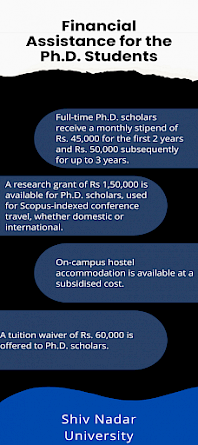
The Ph.D. in Electronics and Communication Engineering program at Shiv Nadar University is designed to fill this gap with skilled professionals. It prepares students for rewarding careers in academia, industries and research laboratories across the world.
The School of Engineering offers six specializations for this program:
- Power system stability integrated with renewable energy and storage
- RF and Microwave (Electromagnetics, Antenna) Engineering
- Signal Processing and Communication
- VLSI Circuit design
- Wireless mobile communication and networks
- Advanced Semiconductor Devices / MEMS Devices
Synopsis
Circuits and signals built our modern world. But the next phase isn’t about more devices; it’s about what those systems understand, and why it matters.
By now, you’ve seen that Ph.D. research in ECE is more than another degree. It’s a training ground for deep thinking, systems vision, and societal impact.
You don’t just learn how to make faster chips. You ask deeper questions: Can this tech reduce suffering? Can it cut waste and energy use? Will it serve more people fairly?
That shift, from building to understanding, is what makes the difference. Your work can lead the world towards unexplored advancements.
FAQs
In how many years can I complete my Ph.D. in ECE?
Any Ph.D. course generally takes 4-6 years, but this will depend on factors including whether you are studying part-time or full-time, which university you attend, the particular field of study you pursue, and your own progression.
How much can I earn after Ph.D. in ECE?
After completing your Ph.D. you can earn 10-15 LPA as the starting salary, but based on your skills and research work, you can earn even higher than 25 LPA.
Can I pursue a part-time Ph.D.?
Yes, you can pursue a part-time Ph.D. program, as many universities in India, like Shiv Nadar University, invite applications for the part-time Ph.D. course.