B.Tech. Admission 2026: Eligibility, Entrance Exams & Important Dates
Blog / December 03, 2025
Looking for the B.Tech. admission 2026 last date? JEE Main registration closes in February 2026, followed by other exams like SNUSAT + APT, SAT, ACT, and CUET through March-April. Missing these deadlines means losing your chance at 15.98 lakh engineering seats across India.
B.Tech. admissions have surged to an eight-year high with 12.53 lakh students enrolled in 2024-25, a 67% jump since 2017-18. Competition is intense, especially for high-demand branches: Computer Science filled 3.90 lakh seats alone, reflecting booming opportunities in AI, Data Science, and Cybersecurity.
This guide provides complete B.Tech. admission eligibility criteria, exam schedules, and application processes for IITs, NITs, and 5,875+ AICTE-approved colleges. You'll learn:
- Exact last dates for JEE Main, JEE Advanced, and SNUSAT + APT, SAT, ACT, and CUET
- Minimum eligibility: 10+2 with 50-75% in PCM (varies by institution)
- Direct admission options and lateral entry procedures
B.Tech. Admission 2026: Important Dates & Deadlines
Knowing about the application deadlines is the first step in your engineering admission journey. Here's a complete timeline of major entrance exams and application windows.

National-Level Entrance Exam Schedule
|
Serial No. |
Entrance Exam |
Registration Opens |
Last Date to Apply |
Exam Date |
Result Declaration |
|
1. |
JEE Main Session 1 |
January 2026 |
February 2026 |
January 2026 |
Within 15 days |
|
2. |
JEE Main Session 2 |
March 2026 |
April 2026 |
April 2026 |
Within 15 days |
|
3. |
JEE Advanced |
May 2026 |
June 2026 |
May/June 2026 |
June 2026 |
|
4. |
CUET UG 2026 |
February 2026 |
March 2026 |
May 2026 |
June 2026 |
SNUSAT + APT Application Timeline
SNUSAT, the Shiv Nadar University Scholastic Aptitude Test, offers multiple test cycles, providing flexibility for students. The early round has three distinct phases:
|
Serial No. |
Phase |
Application Deadline |
SNUSAT Exam Date |
Result Release |
Fee Payment Deadline |
|
1. |
Phase 1 |
December 31, 2025 |
January 11, 2026 |
January 31, 2026 |
February 09, 2026 |
|
2. |
Phase 2 |
January 31, 2026 |
February 08, 2026 |
February 23, 2026 |
March 02, 2026 |
|
3. |
Phase 3 |
March 31, 2026 |
April 12, 2026 |
May 04, 2026 |
May 11, 2026 |
SNUSAT Test Format:
- SNUSAT: 40 questions in 90 minutes (Quantitative Reasoning + Logical Reasoning)
- APT (for B.Tech. programs): 40 questions in 60 minutes (Mathematics + Physics)
- Home-proctored online format
- Sample questions are provided in the application dashboard
Students applying through the SAT or ACT have year-round test availability, making these options particularly suitable for international curriculum students.
B.Tech. Admission Eligibility Criteria
Understanding B.Tech. admission eligibility requirements help you identify which colleges you can target based on your academic profile.
Basic Eligibility Requirements
All engineering aspirants must meet these fundamental criteria:
- Passed 10+2 from a recognized board
- Mandatory subjects: Physics, Chemistry, Mathematics (PCM)
- Valid entrance exam score (JEE/SNUSAT/SAT/ACT/CUET)
Category-Wise Minimum Percentage Requirements
|
Serial No. |
Institution Type |
General/EWS |
OBC-NCL |
SC/ST |
|
1. |
IITs (via JEE Advanced) |
75% |
75% |
65% |
|
2. |
NITs/IIITs/GFTIs |
75% |
75% |
65% |
|
3. |
Top Private Universities |
65% |
65% |
65% |
|
4. |
Other Engineering Colleges |
50-60% |
50-60% |
45-50% |
The 65% eligibility criterion at top private universities opens opportunities for students who may not meet the 75% requirement for IITs and NITs but still want access to quality engineering education.
Branch-Specific Eligibility Criteria
|
Serial No. |
B.Tech. Specialization |
Mandatory Subjects |
Minimum Aggregate |
|
1. |
Computer Science Engineering |
Physics, Mathematics |
65% |
|
2. |
Electrical & Computer Engineering |
Physics, Mathematics |
65% |
|
3. |
Chemical Engineering |
Physics, Chemistry, Mathematics |
65% |
|
4. |
Civil Engineering |
Physics, Mathematics |
65% |
|
5. |
Mechanical Engineering |
Physics, Mathematics |
65% |
B.Tech. Entrance Exams 2026 Overview
Multiple entrance exams provide different pathways to engineering admission. Understanding each exam's structure and acceptance helps you choose the right preparation strategy.
JEE Main and JEE Advanced
JEE Main 2026:
- Conducting Body: National Testing Agency (NTA)
- Exam Pattern: 90 questions (30 each in Physics, Chemistry, Mathematics)
- Duration: 3 hours
- Attempts: Unlimited
- Colleges: 31 NITs, 25 IIITs, 30+ GFTIs, 1000+ private colleges
JEE Advanced 2026:
- Eligibility: Top 2.5 lakh JEE Main qualifiers
- For admission: 23 IITs
- Maximum attempts: 2 consecutive years
- Difficulty level: Highest among engineering entrance exams
CUET UG for Engineering
CUET (Common University Entrance Test) has expanded to engineering admissions:
- Accepted by: 45+ central universities
- Subjects tested: Physics, Chemistry, Mathematics (domain-specific)
- Advantage: Single exam for multiple university applications
University-Specific Entrance: SNUSAT + APT
SNUSAT offers distinct advantages for engineering aspirants:
Test Structure:
- SNUSAT: Quantitative Reasoning (20 questions) + Logical Reasoning (20 questions)
- APT (for Engineering): Mathematics (20 questions) + Physics (20 questions)
- Total Duration: 150 minutes (SNUSAT: 90 min + APT: 60 min)
Key Features:
- Home-proctored online examination
- Six test cycles from January to July 2026
- Focus on aptitude and conceptual understanding
- Sample questions provided before the exam
- Multiple attempt opportunities across phases
International Tests: SAT and ACT
College Board SAT:
- Sections: Math, Evidence-Based Reading & Writing
- Score range: 400-1600
- Accepted at select private universities
- Year-round test availability
ACT:
- Sections: English, Math, Reading, Science
- Score range: 1-36
- Alternative to the SAT with science section
B.Tech. Application Process 2026
A systematic approach to applications ensures you don't miss critical steps or deadlines.
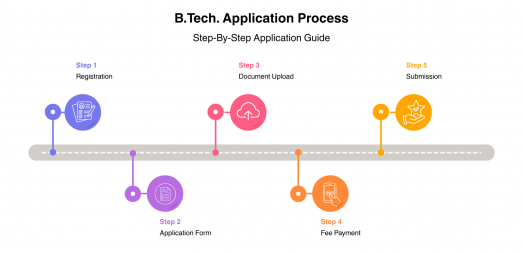
Step-by-Step Application Guide
Step 1: Registration
- Visit the official admission portal
- Create an account with email/mobile verification
Step 2: Application Form
- Enter personal details (verify name spelling matches documents)
- Fill academic information (board, subjects, percentage)
- Select program preferences
- Choose admission route (JEE/SNUSAT/SAT/ACT/CUET)
Step 3: Document Upload
- Upload scanned documents as per specifications
- Verify that each document appears correctly
Step 4: Fee Payment
- Application fee: ₹1,000-2,500 (varies by institution)
- SC/ST concession: 50% typically
Save the payment confirmation immediately
Step 5: Submission
- Review all entries carefully
- Submit application
- Download confirmation page
- Note the application number for tracking
Document Checklist
Required documents for B.Tech. applications:
- Class 10th and 12th marksheets (scanned, PDF/JPEG, under 200KB)
- Transfer certificate and character certificate
- Category certificates (SC/ST/OBC-NCL) if applicable
- Income certificate for scholarship applications
- Passport-size photographs (JPEG format)
- Aadhaar card
- Valid email ID and mobile number
Popular B.Tech. Specializations and Career Prospects
Choosing the right engineering branch significantly impacts your career trajectory. Here's data-driven insight into different specializations.
Branch-Wise Enrollment and Salary Statistics
|
Serial No. |
Engineering Branch |
2024-25 Enrollment |
Average Starting Salary |
Top Salary Range |
|
1. |
Computer Science Engineering |
3.90 lakh students |
₹6-10 LPA |
₹30-50 LPA |
|
2. |
Mechanical Engineering |
2.36 lakh students |
₹4-6 LPA |
₹15-20 LPA |
|
3. |
Civil Engineering |
1.72 lakh students |
₹4-5 LPA |
₹12-18 LPA |
|
4. |
Electronics & Communication |
1.60 lakh students |
₹5-6 LPA |
₹20-25 LPA |
|
5. |
Electrical Engineering |
High demand |
₹5-7 LPA |
₹18-25 LPA |
Emerging High-Demand Specializations:
- Artificial Intelligence & Machine Learning
- Data Science & Engineering
- Cybersecurity
- Biotechnology Engineering
B.Tech. Fee Structure and Financial Planning
Understanding the complete cost structure helps families plan engineering education financing effectively.
Typical Annual Costs by Institution Type
|
Serial No. |
Institution Category |
Annual Tuition |
Living Expenses |
Total Per Year |
|
1. |
IITs |
₹2-2.5 lakh |
₹1.5-2 lakh |
₹3.5-4.5 lakh |
|
2. |
NITs/IIITs |
₹1.5-2 lakh |
₹1.5-2 lakh |
₹3-4 lakh |
|
3. |
Top Private Universities |
₹4-6 lakh |
₹2-2.5 lakh |
₹6-8.5 lakh |
Scholarship Opportunities
Merit-Based Scholarships:
- 95%+ in Class 12: 50% tuition waiver
- 98%+ School Topper: 100% tuition waiver
- JEE Main 98+ percentile: 100% tuition waiver
- JEE Main 95-98 percentile: 50% tuition waiver
Category-Specific Scholarships:
- Women in Engineering: ₹1 lakh annual reduction
- Need-Based Aid: Up to 100% tuition + hostel (family income <₹3 lakh/year)
- Sports Excellence: 20-100% waiver for national/international athletes
- Armed Forces Dependents: 25-100% tuition waiver
Forge Your Path to Engineering Excellence at Shiv Nadar University (Institution of Eminence)
Shiv Nadar University, recognized as an Institution of Eminence, offers a wide range of B.Tech. programs through various admission pathways. The university fosters an international atmosphere, employs innovative teaching methods, and promotes critical research partnerships. Students benefit from hands-on experience in advanced facilities, which include laboratories for Cloud Computing, IoT, Mechatronics, Thermal Energy, Process Control, and more.
B.Tech. Programs Offered at Shiv Nadar University
School of Engineering:
- B.Tech. in Chemical Engineering
- B.Tech. in Chemical Engineering with specialisation in Bioenergy and Biomaterials
- B.Tech. in Chemical Engineering with specialisation in Modelling and Simulation
- B.Tech. in Civil Engineering
- B.Tech. in Computer Science and Engineering
- B.Tech. in Electrical and Computer Engineering
- B.Tech. in Mechanical Engineering
Admission Routes to Shiv Nadar University
|
Serial No. |
Route |
Entrance Requirement |
Additional Test |
|
1. |
Route 1 |
JEE Main 2026 or 2025 |
No |
|
2. |
Route 2 |
SNUSAT + APT |
No |
|
3. |
Route 3 |
College Board SAT |
No |
|
4. |
Route 4 |
ACT |
No |
|
5. |
Route 5 |
CUET 2026 |
Interview |
How to Apply to Shiv Nadar Universitty
- Visit snuadmissions.com and click "Apply Now"
- Select B.Tech. program and admission route
- Fill the application form with academic details
- Upload required documents
- Select applicable scholarship options
- Pay the application fee
- Schedule SNUSAT or upload entrance exam scores
- Receive admission decision within 2-4 weeks
- Accept the offer by paying the fees before the deadline
Conclusion
With competition at an all-time high and lakhs of seats filling fast, timely action is the key to securing your B.Tech. admission in 2026. From tracking last dates and meeting eligibility criteria to choosing the right entrance exam and specialization, early planning can make the difference between missing out and getting into a top engineering college.
Don’t wait for deadlines to slip by. Shortlist your preferred colleges, register for the right entrance exams, and complete your applications well in advance.
Apply now and stay ahead in the B.Tech. Admission 2026 race. Your engineering journey starts with one smart decision today.
Frequently Asked Questions
What is the last date for B.Tech. admission 2026?
Deadlines vary by entrance exam. JEE Main registration closes in February 2026. SNUSAT offers multiple cycles from January to July 2026, with the early-round phase 3 closing on March 31, 2026. Apply early for better scholarship access.
What is the minimum percentage required for B.Tech. admission?
Requirements vary: IITs/NITs need 75% (65% for SC/ST), top private universities require 65%, and other colleges accept 50-60%. Diploma holders need 60% for lateral entry.
Can I apply through multiple entrance exams?
Yes, applying through multiple routes (JEE, SNUSAT, SAT, ACT, CUET) maximizes your admission chances across different institutions.
How do SNUSAT and JEE Main differ?
JEE Main tests an extensive Physics, Chemistry, and Mathematics syllabus. SNUSAT focuses on aptitude (Quantitative and Logical Reasoning) plus subject knowledge through APT. SNUSAT offers six test cycles versus JEE's two sessions.
Are scholarships available for B.Tech. students?
Comprehensive scholarships exist based on merit (Class 12 marks, entrance exam scores), financial need, gender (Women in Engineering), sports achievements, and defense background. Scholarships can cover 50-100% of tuition fees.