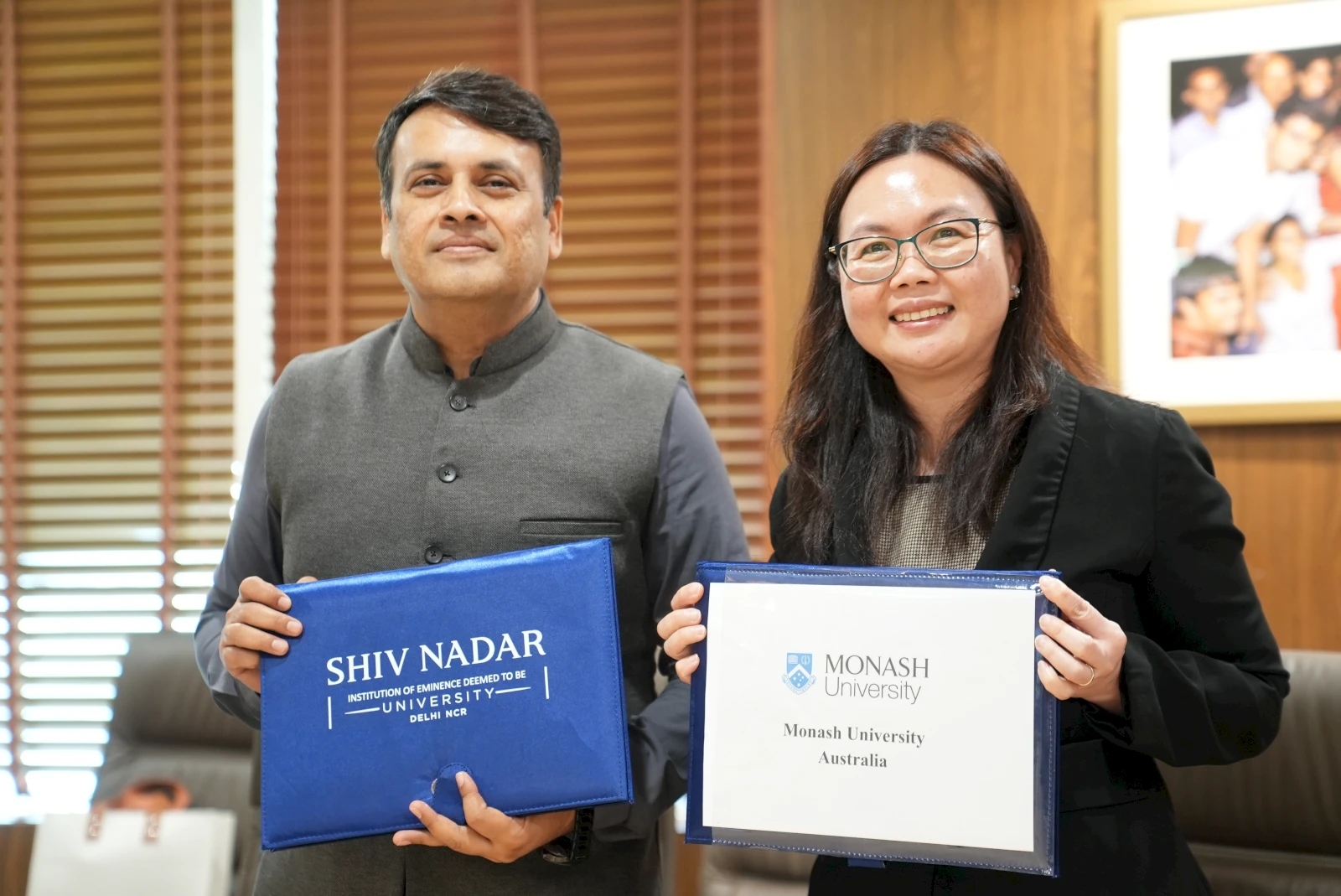
SNU-Monash MoU Opens Global Pathway in AI and Cybersecurity
A new 3.5+2 pathway linking Shiv Nadar University, Delhi-NCR, with Monash University in Australia will give eligible Computer Science and Engineering students a route from their B.Tech studies to postgraduate programmes in three rapidly developing fields of technology.
Under the newly signed B.Tech-MS credit transfer agreement, students can complete seven semesters of their undergraduate programme at Shiv Nadar University before progressing to a master’s degree at Monash in Artificial Intelligence, Data Science or Cybersecurity.
Admission to the pathway will be subject to the academic and entry requirements set by the two universities. Students will also complete the thesis or project requirement of the eighth semester of their B.Tech. under the joint supervision of faculty members from Shiv Nadar University and Monash University.
The agreement was signed on the Shiv Nadar University campus by Professor Rajeev Kumar Singh, Dean of the School of Engineering, and Professor Juliana Sutanto, Associate Dean (International) in Monash University’s Faculty of Information Technology.
Interactive sessions with Biotechnology and Computer Science students followed the signing, bringing members of the visiting delegation into direct conversation with the academic community. The discussions covered the new student pathway and the scope for developing a broader relationship between the two institutions.
The agreement builds on academic connections that are already taking shape. Abhinav Dhall, Associate Professor and Deputy Associate Dean (International) at Monash University, pointed to his experience working with faculty members and doctoral students at Shiv Nadar University.
“Shiv Nadar University’s association with the HCL Group gave us at Monash University considerable confidence in the institution. It is an outstanding university and an Institution of Eminence. Despite being relatively young, it is already making its mark in India and internationally. I serve on the doctoral committees of two Ph.D. students with Professor Rajeev. Through my interactions with them, I have found the students to be highly diligent. The quality of graduate training is also very high, which reflects Shiv Nadar University’s standing as an Institution of Eminence.”
While the formal agreement focuses on student mobility and postgraduate progression, the visit also opened conversations about potential research partnerships. “Discussions are already underway with Shiv Nadar University’s AI Centre of Excellence, particularly regarding projects that combine technology, health, and community impact,” said Professor Singh.
Professor Sutanto added. “I’ve been speaking with the AI Centre of Excellence about potential research collaborations, and I see considerable opportunity. For example, we have discussed community-based health projects, and Monash Professor of Digital Health Chris Bain is now one of the Centre’s advisers. There is real potential for us to work together, not only on academic publications but also to create meaningful impact.”
That prospective research relationship would seek to connect academic work with challenges affecting communities in the region.
“Shiv Nadar University is uniquely placed to conduct research that matters to communities while advancing knowledge in important fields. Such a partnership would be mutually beneficial. The University has the right ingredients to make a significant impact across the region in which it is based,” Professor Sutanto said.
She also placed the discussions within the wider context of collaboration between universities in India and Australia.
“At Monash, we see the potential for a broader, high-impact collaboration. An Australian university and an Indian university bring complementary access, expertise and skills. By working together, we can achieve much more for the Global South.”
The credit transfer pathway is the first defined academic route under the partnership. It combines undergraduate study at Shiv Nadar University, jointly supervised project work, and postgraduate education at Monash, while research discussions point to further areas where the two universities could work together.