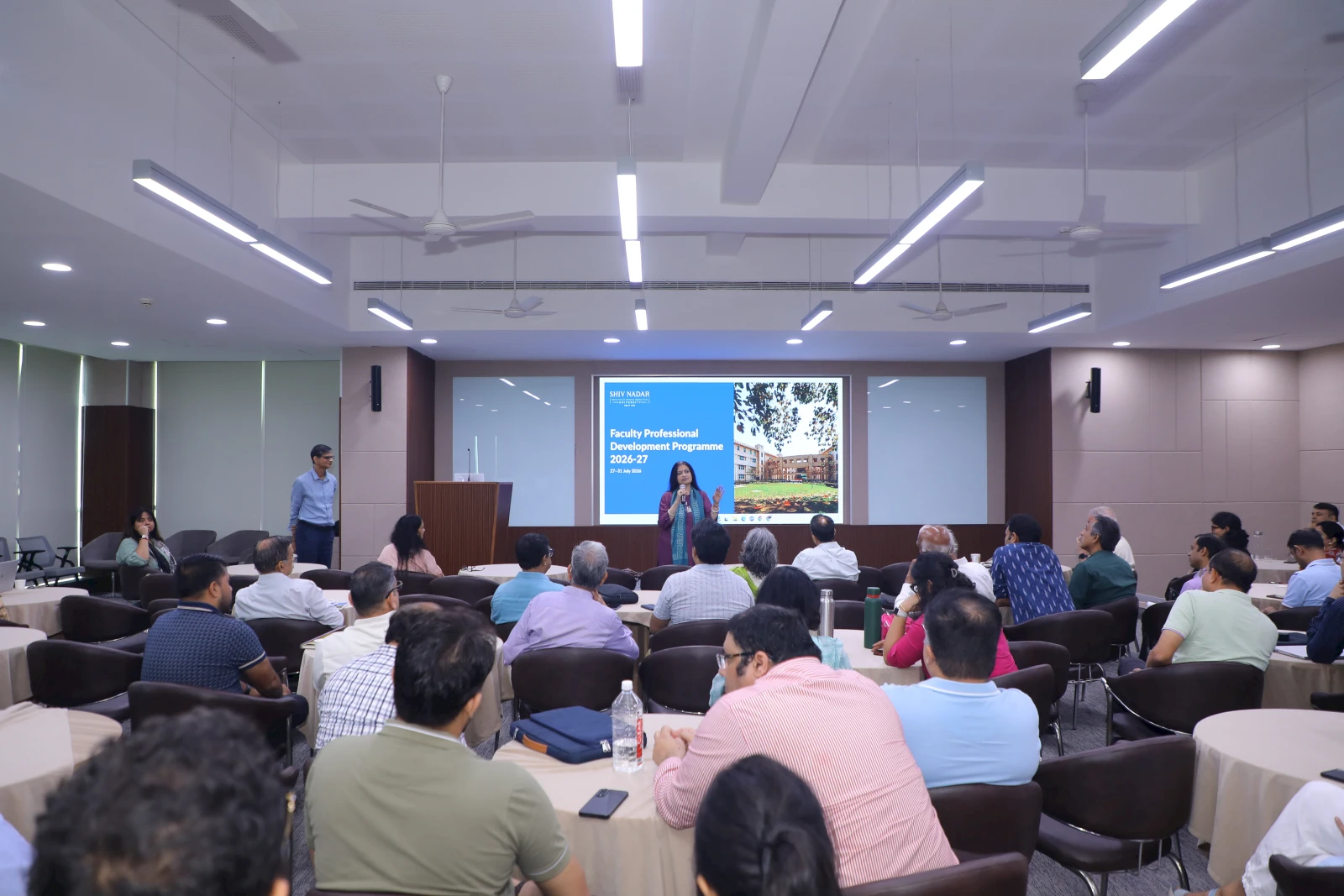
AI takes centre stage at Faculty Professional Development Programme
Shiv Nadar University, Delhi-NCR, concluded a week-long Faculty Professional Development Programme that placed artificial intelligence, research excellence and academic policy reform at the heart of faculty development ahead of the 2026-27 academic year. The five-day programme, held from 27 to 31 July, brought together university leaders, faculty and external experts to explore teaching innovation, research strategy and institutional priorities.
The programme opened on 27 July with remarks from Professor Partha Chatterjee, Dean of Academics, who introduced the Faculty Professional Development Programme 2026 and outlined its themes. This was followed by a Vice-Chancellor's address by Professor Ananya Mukherjee on academic futures and institutional priorities in an AI-enabled world.
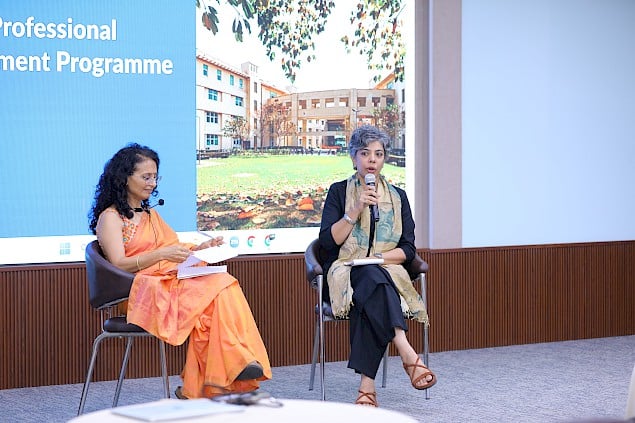
Research formed a major pillar of the opening day. Professor Suneet Tuli, Pro-Vice Chancellor and Dean Research, and Dr Rakesh Ganguly, Deputy Director of OARAR, led a session on tracking and showcasing research, including the soft launch of a new research website. The afternoon shifted to classroom innovation with a hands-on workshop on embedding AI into teaching, led by Dr Samiksha Bajpai of Shiv Nadar University and Dr Vidya Subramaniam of OP Jindal University. The day concluded with a session by NeuraStudios on agentic AI, covering AI walls, safeguards and industry best practices for future-ready universities.
The second day focused on academic policy and institutional practice, with Professor Chatterjee opening the proceedings. Dr Ankur Mehra and Dr Shabana Mitra, Associate Dean in the Office of the Dean of Academics, led sessions reviewing academic developments during 2025-26, including updates on minors, the Graduate Pathways Programme, major changes, long-term student leave, course bidding, course outlines and timetables. They also introduced new academic initiatives planned for 2026-27, including a postgraduate handbook, a visiting faculty policy, a summer term, a disability policy, and grade moderation and transcript updates, while gathering feedback from faculty members.
Later, Dr Ankur Mehra and Dr Shabana Mitra returned to lead a session on course management and teaching practices, covering updates to the SAMS system, course outlines, evaluations and expectations for timely conduct.
The day concluded with the Festival of Pedagogies: AI in Teaching, where faculty presenters showcased innovative applications of artificial intelligence in teaching, assessment and student engagement.

Dr. A. Satyanarayana Reddy (Mathematics) demonstrated AI-enhanced mathematical tools for teaching, learning, evaluation and research, while Dr. Gatha Sharma (English) explored the possibilities of the multimodal text. Dr. Nidhi Malhotra (Chemistry) presented a Montessori-inspired approach to understanding complex research, and Dr. Ajit Kumar (Mathematics) showed how AI can help students retain course content through active recall and spaced repetition. Dr. Hemant Sreekumar (AMP) shared pedagogical innovations through the courses he takes, while Dr. Ojasvi Khare (Economics) demonstrated statistical analysis of text, Dr. Sweta Kumari (Computer Science and Engineering) showcased the use of AI tools to build large-scale class projects, and Dr. Amitabh Chatterjee (Electrical Engineering) presented a pedagogical framework for explaining the concept of noise in electrical engineering. Together, the sessions illustrated how faculty across disciplines are thoughtfully integrating AI into teaching to deepen learning, strengthen critical thinking, and enhance student engagement.
Research took centre stage again on Wednesday during the Research X Impact Conclave. Professor Ananya Mukherjee delivered the welcome address on building impactful research agendas and collaborations. Professor Shivkumar Kalyanaraman, Chief Executive Officer of the Anusandhan National Research Foundation, spoke on the organisation's research and innovation vision for India. Professor Ponnurangam Kumaraguru of IIIT Hyderabad and ANRF conducted a workshop on Saral AI, focusing on transforming scholarly work into accessible, multilingual content.

The programme included presentations from ANRF grantees, followed by an overview of research policies and processes from the Office of the Dean of Research. The session covered doctoral regulations, grant and consultancy processes, research staff hiring, undergraduate research activities, faculty grants for interdisciplinary research, and intellectual property rights.
The Day 4 schedule shifted to school-specific academic priorities, with parallel sessions for the School of Humanities and Social Sciences, led by Pro-VC Humanities and Social Sciences, Professor Rajat Kathuria; the School of Engineering, led by Dean Professor Rajeev Kumar; the School of Management and Entrepreneurship, and the School of Natural Sciences, led by Pro-VC Sciences Strategy and Translation, Professor Sanjeev Galande.
The afternoon featured presentations from the first completed Faculty Grant for Interdisciplinary Research (FGIR) projects, highlighting outcomes from five interdisciplinary initiatives. Professor Paromita Goswami (SME) and Dr Aadya Kaktikar (Arts and Performing Arts) presented 'Behaving Better: Cognition of Sexual Harassment and the Role of Policy', which examined perceptions of sexual harassment and the role of institutional policy. Dr Sailesh Narayan Behera (Civil Engineering), Dr Samit Bhattacharyya (Mathematics) and Dr Yamini Sudha Sistla (Chemical Engineering) showcased research on 'Indian Pollution Scenarios of PM10 and PM2.5', integrating local air quality measurements with regional emission modelling, atmospheric chemistry, health impact assessment and spatial distribution analysis.
Professor Subhabrata Sen (Chemistry) and Dr V.M. Rajesh (Chemical Engineering) presented their work on the visible light-induced removal of 1,4-dioxane from water using micro- and millifluidic technology. Dr Prem C. Pandey (CESE), and Dr Jagabandhu Dixit (Civil Engineering), discussed transnational case studies on development activities in the Hindu Kush Himalaya region and their impact on natural and human landscapes. The session concluded with Dr Parthapratim Munshi (Chemistry) and Dr Meha Bhogra (Mechanical Engineering) presented research on organic photoswitchable ferroelectric and piezoelectric materials for next-generation smart electronic devices and energy harvesting.
The programme concluded on Friday with a workshop led by Dr Meghna Singh Bhadaria on turning research into zines, providing faculty with new approaches to communicating academic work. Closing reflections were delivered by Professor Chatterjee, Professor Tuli, Professor Kathuria and Professor Galande, bringing together the themes explored throughout the week before the programme ended.
Across five days, the programme brought together discussions on teaching innovation, academic governance, research policy and the growing role of artificial intelligence in higher education, while providing faculty with practical workshops and opportunities for interdisciplinary collaboration.