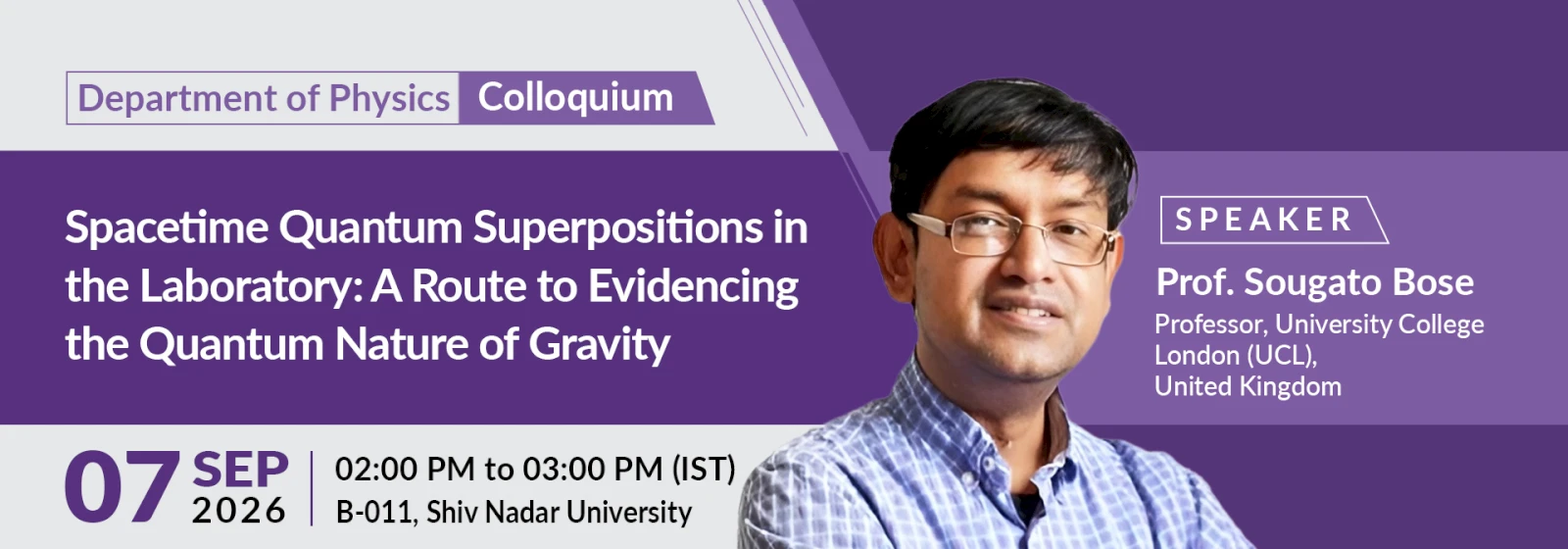
Spacetime Quantum Superpositions in the Laboratory: A Route to Evidencing the Quantum Nature of Gravity
Abstract:
I will discuss schemes to test the nonclassical behaviour of gravity in the laboratory. By this, I mean examining whether spacetime follows the fundamental postulates of quantum mechanics, such as whether it can be quantum superposed or whether it follows the measurement postulate of quantum mechanics. Four related approaches will be described. First, through gravitational entanglement generation between matter-wave interferometers formed of large objects. The justification of this approach in proving the quantum nature of gravity will be described. In this context, I will elaborate on the experimental challenges. Secondly, the nonclassicality of gravity explored through measurements will also be described. Subsequently, I will also describe a method using post-selection in which quantum superpositions of spacetimes manifest in terms of an effective repulsive action of gravity. Finally, I will describe a method of evidencing Bell-nonlocality of gravity which tests the fundamentally quantum nature of spacetime in a loophole-free, device-independent way.
- Biography: Sougato Bose, Professor of Physics at UCL, obtained his PhD from Imperial College London in 2000 working under the supervision of Prof. Sir Peter Knight. He came to Imperial for his PhD in 1996 supported by an Inlaks Scholarship after completing his undergraduate and masters from IIT, Kharagpur, India. He subsequently held the positions of a Junior Research Fellow (JRF) at St John's College, Oxford, 1999-2002, and a postdoctoral scholar at the California Institute of Technology (Caltech), USA, 2002-2003, before starting at UCL in 2003. Bose has pioneered/co-pioneered some important directions in the area of quantum technologies such as: 1. Probing the macroscopic limits of quantum mechanics by using radiation pressure on movable mirrors, 2. Entangling atoms in distant cavities by detecting photons to scale quantum computers, 3. Study of quantum entanglement in a spin chain, 4. Using a 1D magnet as a data-bus for short-distance quantum communications, 5. Coupled cavity models for the quantum simulation of many-body systems, 6. Table-top experimental proposal for testing the quantum nature of gravity. Among his many honours and recognitions, notable ones include the Maxwell Medal and Prize of the Institute of Physics (IOP), UK (2008), a Royal Society Wolfson Research Merit Award, and an European Research Council (ERC) Starting Grant.
I will discuss schemes to test the nonclassical behaviour of gravity in the laboratory. By this, I mean examining whether spacetime follows the fundamental postulates of quantum mechanics, such as whether it can be quantum superposed or whether it follows the measurement postulate of quantum mechanics. Four related approaches will be described. First, through gravitational entanglement generation between matter-wave interferometers formed of large objects. The justification of this approach in proving the quantum nature of gravity will be described. In this context, I will elaborate on the experimental challenges. Secondly, the nonclassicality of gravity explored through measurements will also be described. Subsequently, I will also describe a method using post-selection in which quantum superpositions of spacetimes manifest in terms of an effective repulsive action of gravity. Finally, I will describe a method of evidencing Bell-nonlocality of gravity which tests the fundamentally quantum nature of spacetime in a loophole-free, device-independent way.
- Biography: Sougato Bose, Professor of Physics at UCL, obtained his PhD from Imperial College London in 2000 working under the supervision of Prof. Sir Peter Knight. He came to Imperial for his PhD in 1996 supported by an Inlaks Scholarship after completing his undergraduate and masters from IIT, Kharagpur, India. He subsequently held the positions of a Junior Research Fellow (JRF) at St John's College, Oxford, 1999-2002, and a postdoctoral scholar at the California Institute of Technology (Caltech), USA, 2002-2003, before starting at UCL in 2003. Bose has pioneered/co-pioneered some important directions in the area of quantum technologies such as: 1. Probing the macroscopic limits of quantum mechanics by using radiation pressure on movable mirrors, 2. Entangling atoms in distant cavities by detecting photons to scale quantum computers, 3. Study of quantum entanglement in a spin chain, 4. Using a 1D magnet as a data-bus for short-distance quantum communications, 5. Coupled cavity models for the quantum simulation of many-body systems, 6. Table-top experimental proposal for testing the quantum nature of gravity. Among his many honours and recognitions, notable ones include the Maxwell Medal and Prize of the Institute of Physics (IOP), UK (2008), a Royal Society Wolfson Research Merit Award, and an European Research Council (ERC) Starting Grant.
All are cordially invited.
Share this: