What Can You Do With a Ph.D. in Physics? Exploring the Scope in India & Beyond

Blog / July 14, 2026
India's quantum technology workforce is on track to grow from roughly 800 professionals in 2023 to over 20,000 by 2030, according to NASSCOM estimates. That single piece of data tells a bigger story about where India’s physics job market is headed.
Many government investments through the ₹6,003-crore National Quantum Mission, along with rapid growth in the semiconductor sector and deep-tech research, are reshaping India's physics job market. This creates demand for the analytical and modeling skills that a physics doctorate develops.
If you think a Ph.D. in Physics only leads to a university career, that's no longer the case. The same analytical and research skills are now valued in quantum computing, semiconductor research, data science, quantitative finance, and several other deep-tech sectors.
This guide helps you know where a physics doctorate actually leads, what it pays, and how the Ph.D. Physics Scope in India compares with opportunities abroad.
More Than Equations- What a Ph.D. in Physics Really Teaches You
Before learning about the jobs, it is necessary to understand what the degree teaches. In essence, a Ph.D. in physics teaches you how to solve unknown problems. From this process, you will develop transferable skills that employers want in both academia and industry.
Here is a list of the five most important skills-
- Mathematical modeling and simulation- building models of complex systems, often in Python, MATLAB, or C++.
- Statistical reasoning and data analysis- extracting a real signal out of noisy experimental or observational data.
- Independent research design- framing a problem, running experiments or derivations, and defending conclusions.
- Technical writing and communication- publishing in peer-reviewed journals and presenting at conferences.
- Domain depth- genuine expertise in a specific area such as condensed matter, particle physics, astrophysics, or materials science.
These are the exact skills that show up in job postings for data science, quant research, as well as R&D roles. This is why the Ph.D. Physics career scope India extends well past the classroom.
Top Career Opportunities After a Ph.D. in Physics
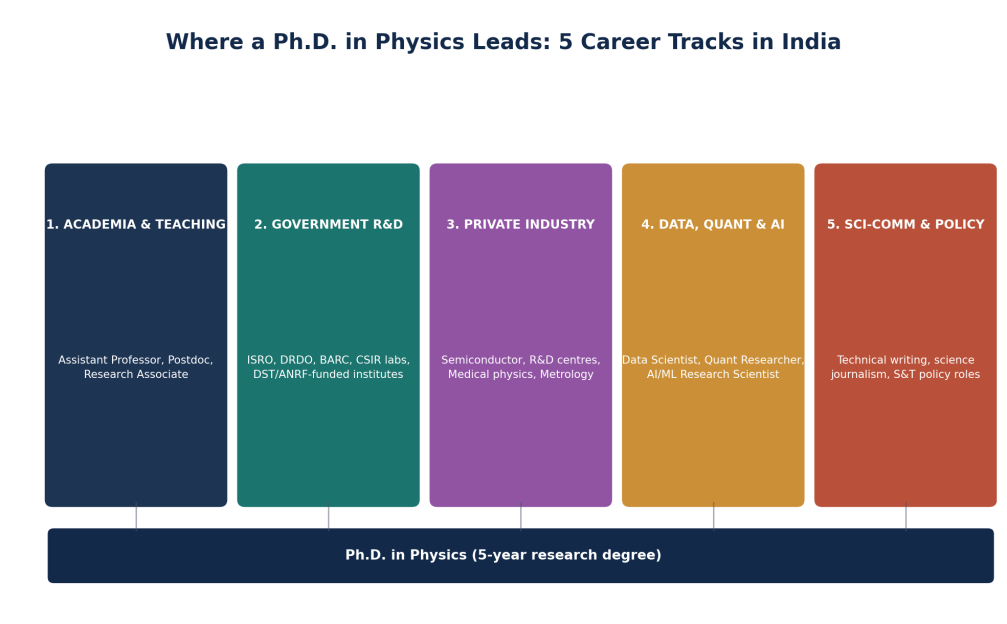
Below is the curated list of 5 popular career tracks in India for Ph.D. in Physics holders-
1. Academia and Postdoctoral Research
The most traditional route is to complete one or more postdoctoral positions and then move ahead towards roles such as Assistant Professor, Research Associate, or Postdoctoral Fellow at universities and research institutions. In India, academic hiring runs through university-specific interviews as well as national schemes.
2. Government R&D- ISRO, DRDO, BARC, and CSIR Labs
India's largest public research employers are its government scientific agencies. Entry routes differ by organization-
- ISRO primarily recruits physics graduates through its Scientist/Engineer exam. But they also bring Ph.D. holders on a project-specific basis for specialized research work.
- DRDO runs a lateral Scientist C/D/E recruitment route for experienced researchers, where a relevant Ph.D. can count toward the experience requirement.
- BARC's OCES/DGFS scheme is aimed mainly at B.Tech. candidates via GATE, so most Ph.D. holders enter Atomic Energy institutions through direct scientist or research associate postings rather than through this specific scheme.
- CSIR laboratories (such as NPL, IUAC, RRI-affiliated networks) and the Anusandhan National Research Foundation (ANRF) fund fellowships like the Ramanujan Fellowship for researchers returning to India or relocating within the country.
3. Private Industry R&D
Various sectors like semiconductor and devices, medical imaging and physics devices, metrology and instrumentation, as well as corporate research and development centers need physicists with a Ph.D. to fill many roles in the areas of device physics, materials characterization, and applied research.
4. Data Science, Quantitative Research, and AI
This is the fastest-growing non-traditional track. The statistical and computational training from a Ph.D. in Physics transfers directly into data science, machine learning research, and quantitative finance. These are the sectors where physics scholars are actively recruited precisely because of their modeling and problem-solving background.
5. Science Communication, Policy, and Technical Writing
A smaller but steady stream of physics scholars move into science journalism, technical and grant writing, patent analysis, S&T policy research, and curriculum/content roles.
What is the Salary after a Ph.D. in Physics in India?
Salary after a Ph.D. in Physics depends heavily on the sector, not just seniority. The table below lines up indicative annual pay across the main tracks-
Role / Track | Typical Sector | Indicative Annual Pay (INR) |
Private-sector entry-level (industry R&D) | Private Industry | ₹3.5 - 5 LPA |
SERB National Post-Doctoral Fellowship | Government (Academic) | ₹6.36 LPA - ₹6.84 LPA |
Government Research Scientist | Government R&D | ₹5 - 13.1 LPA |
Assistant Professor | Academia | ₹8 - 14 LPA |
Data Scientist | Private Industry | ₹8 - 18.7 LPA |
Quant Researcher | BFSI / Quant Finance | ₹21.8 - 46.4 LPA |
Source: Salary figures are based on data available on Glassdoor.
Ph.D. Physics Career Scope India vs. Abroad
For many years, after earning a Ph.D. in Indian physics, a postdoctoral position in the US, Europe, Japan, or Singapore was almost the standard next step. This was mostly due to the fact that these ecosystems offered better-resourced labs, larger partnerships, and more financed posts.
Two things have changed the equilibrium, but that pattern still remains true to a large extent-
- India's own postdoctoral and re-entry fellowships such as SERB's N-PDF and Ramanujan Fellowship, and the SERB Overseas Postdoctoral Fellowship are designed specifically to keep talent in, or bring it back to, the Indian system.
- India's private-sector R&D and deep-tech hiring (semiconductors, AI research, quantitative finance) has expanded enough that some physics scholars now skip the traditional postdoc route entirely and move directly into industry roles that did not really exist a decade ago.
However, India's structural R&D constraint is real- according to the Economic Survey 2025-2026, gross R&D expenditure stands at about 0.64% of GDP, compared to 3.48% in the US, 2.43% in China, and 4.91% in South Korea.
The private sector in India contributes only about 41% of this spending, compared to 70-79% in those economies. As a result, core research positions in India remain limited, making overseas postdoctoral fellowships a common next step for those pursuing careers in academic research.
Ph.D. in Physics at Shiv Nadar University (Institution of Eminence)- Preparing Researchers forGlobal Careers
The Department of Physics at Shiv Nadar University has been active since 2011, with a mission to conduct outstanding research with national and international recognition by promoting creativity, excellence, and collaboration. Its five-year Ph.D. program is built around this mission, offering scholars a focused set of research areas along with strong institutional support.
Research Areas Offered by Shiv Nadar University
- Experimental Condensed Matter Physics and Materials Science
- Experimental and Theoretical Soft Matter and Biophysics
- Experimental Nuclear Physics
- Theoretical Condensed Matter Physics
- Theoretical High Energy Physics
- Mathematical and Statistical Physics
- Cosmology and Astrophysics
- Quantum Information, Technologies, and Foundations
What Sets This Course Apart?
- Interdisciplinary research- the department actively encourages and facilitates research that crosses traditional subject boundaries.
- International collaboration- many faculty members have worked at leading international research institutes and continue to collaborate with scientists worldwide, giving scholars exposure beyond India.
- Industry-linked research- the department supports collaborative research with industry, with some faculty exploring joint research programs with established technology companies.
- Regular academic exchange- scholars have access to seminars, conferences, and workshops held throughout the year.
- Advanced infrastructure- dedicated experimental and computational facilities support both theoretical and lab-based research.
For students weighing where to pursue doctoral research in physics, Shiv Nadar University's combination of assured funding, breadth of research areas, and lab infrastructure makes it worth a closer look. It's well suited to anyone looking for a well-supported, research-intensive environment to build a career in physics.
Conclusion
A Ph.D. in Physics is no longer a degree limited to academia. As India's investments in quantum technology, semiconductors, AI, and advanced research continue to grow, the Ph.D. Physics career scope for physics in India is expanding across both the public and private sectors.
Whether your goal is to pursue cutting-edge research, join a government laboratory, or build a career in deep-tech industries, choosing the right doctoral program and developing strong research skills can open diverse and rewarding career opportunities in India and beyond.
FAQs
Q1. Is a Ph.D. in Physics worth it in India?
Ans. Yes, if you want a career in research, academia, or advanced R&D. It is essential for university faculty and government research roles, while also offering strong opportunities in quantum technology, semiconductors, AI, data science, and quantitative finance.
Q2. What can I do with a Ph.D. in Physics besides teaching?
Ans. Besides teaching, Physics Ph.D. graduates can work in government R&D, semiconductor research, quantum computing, data science, AI, quantitative finance, science policy, technical writing, patent analysis, and postdoctoral research in India or abroad.
Q3. How long does a Ph.D. in Physics take in India?
Ans. A Ph.D. in Physics in India typically takes five years to complete. The program usually includes coursework in the initial phase, followed by supervised research and thesis submission, although the duration may vary based on research progress.