MS Software Engineering vs MS Computer Science: Key Differences Explained
Blog / August 10, 2026
Every career move in tech eventually comes down to a choice like this: build things directly, or stay ready to lead the people who do. According to the U.S. Bureau of Labor Statistics, computer and information technology occupations are projected to grow much faster than the average for all occupations through 2034, adding about 317,700 openings a year, with a 2024 median annual wage of $105,990, more than double the median across all occupations.
So the real question is not whether tech pays off, but which master's degree, Software Engineering or Computer Science, gets you to the version of that career you actually want. One takes you straight into building products, while the other keeps a wider set of roles, including future management tracks, open to you. Here is what actually separates the two, and how to figure out which path fits your goals.
What is an MS in Software Engineering?
An MS in Software Engineering is a practice-focused degree built around the full software development lifecycle of planning, coding, testing, deployment, and maintenance, so graduates are ready to work on real products from day one.
- It centers on applying established engineering principles to design, build, test, and maintain software systems.
- Coursework typically covers software design and architecture, quality assurance and testing, and project or systems management.
- Learning is hands-on, through labs and team-based projects that mirror how software gets built in the industry.
- Many programs allow further specialization, such as cybersecurity, for students who want to focus on securing the systems they build.
- Best suited to students who already know they want to work as developers, engineers, or technical leads.
What is an MS in Computer Science?
An MS in Computer Science takes a broader view of computing as a field, covering the theoretical and technical foundations that sit underneath software, so graduates can move into almost any corner of the tech industry.
- It focuses on algorithms, data structures, computer systems, and increasingly artificial intelligence and machine learning.
- Offers more room for specialization, from AI and machine learning to cybersecurity, data systems, or software development itself.
- Graduates are not limited to one type of role; the same degree can lead to work as a software developer, data scientist, cybersecurity analyst, or systems architect.
- Best suited to students who want to keep their career options open or are not yet ready to commit to one specialization.
MS Software Engineering vs MS Computer Science: Key Differences
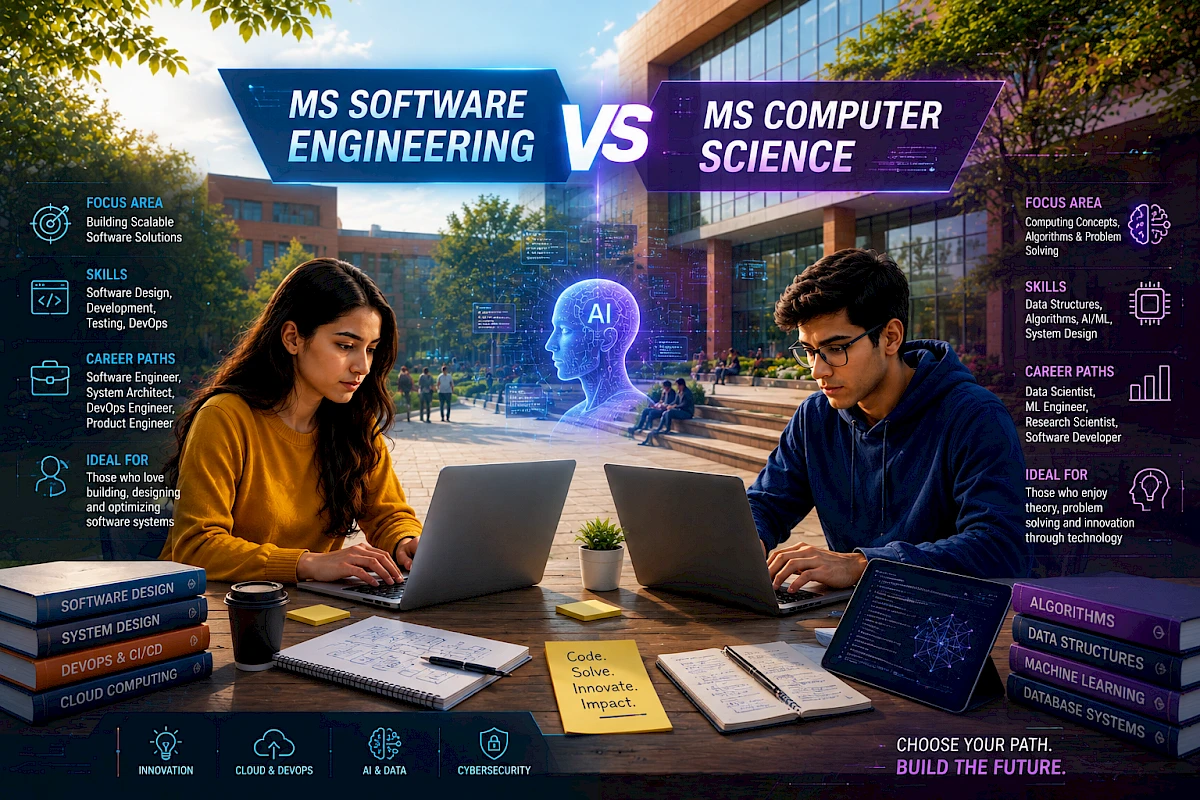
At a glance, an MS in Software Engineering is the more applied of the two degrees, while an MS in Computer Science is the more flexible one. The table below breaks down how they compare across the factors that matter most when choosing between them:
Factor | MS Software Engineering | MS Computer Science |
Core focus | Designing, building, testing, and maintaining software | Computing theory, algorithms, systems, and emerging technologies |
Approach | Applied, project and lifecycle-driven | Broad and research-oriented, with applied electives |
Typical roles | Software developer, software engineer, technical lead | Software developer, data scientist, cybersecurity analyst, systems architect |
Best suited for | Students set on building and shipping software | Students who want flexibility across computing disciplines |
Admission Requirements at a Glance
Admission requirements for both degrees generally cover two things: your academic record and, if you are applying from a non-English-medium background, your English proficiency score. Here is what most programs look for:
- A minimum cumulative GPA from your bachelor's degree, usually calculated on a 4.0 scale.
- Standard application documents, including transcripts, a resume, written statement, and at least one letter of recommendation.
- An English proficiency score through TOEFL, IELTS, PTE, or Duolingo, if applicable.
- Slightly higher English proficiency benchmarks for software engineering programs in some cases, given the heavier project and team-collaboration component.
Exact GPA and test score cutoffs vary by university and by specialization within the same degree, so it is worth checking the specific requirements for each program you are considering.
Which One Should You Choose?
Both degrees can lead to strong outcomes for international students who complete their program in the United States, including eligibility for Optional Practical Training, which allows graduates to gain U.S. work experience after finishing.
The right choice comes down to how specific you want your coursework to be versus how much flexibility you want to carry into your career, as the table below sums up:
If you... | Consider |
Already know you want to build software for a living, across web, enterprise, or embedded products | MS Software Engineering, for coursework structured around the same lifecycle you will use on the job |
Are drawn to the theory behind computing and want the option to pivot into AI, data science, or cybersecurity | MS Computer Science, for a broader base that keeps more career doors open |
Are not yet ready to commit to one specialization | MS Computer Science, since you can specialize later through electives or on-the-job experience |
Want practical, portfolio-ready experience by graduation | MS Software Engineering, for project and lifecycle-driven coursework |
Pursue MS Software Engineering or MS Computer Science Through Shiv Nadar University (Institution of Eminence)'s Accelerated Master's Program
Shiv Nadar University has partnered with Arizona State University, recognized as the top U.S. public university for international students by the Institute of International Education, to offer an Accelerated Master's Program. Under this pathway, you begin your degree at Shiv Nadar University's International College and complete it on campus at Arizona State University, one of the largest engineering schools in the country, across MS Software Engineering, MS Software Engineering with a Cybersecurity specialization, and MS Computer Science.
Key Benefits of the ASU–SNU Pathway
- All three programs are delivered through ASU's Ira A. Fulton Schools of Engineering, with one semester at Shiv Nadar University's International College before transferring to ASU
- MS Software Engineering and its Cybersecurity specialization are based at ASU's Polytechnic campus, while MS Computer Science is based at the Tempe campus, each totaling 30 credits
- Estimated fees: MS Software Engineering and its Cybersecurity specialization run INR 3,00,000 at SNU plus USD 35,946 at ASU; MS Computer Science runs INR 3,00,000 at SNU plus USD 40,749 at ASU, with housing estimated separately at around USD 20,000 per year
- MS Computer Science asks for a minimum cumulative GPA of 3.25 (or 3.00 for applicable master's applicants) with TOEFL 90+, IELTS 7.0+, or Duolingo 115+; MS Software Engineering and its Cybersecurity specialization ask for a minimum GPA of 3.00 with slightly higher English benchmarks of TOEFL 90+, IELTS 7.0+, Pearson 64+, or Duolingo 125+
- Graduates may be eligible for Optional Practical Training of up to three years in the U.S., subject to U.S. government regulations, at substantial cost savings compared to a fully residential program at ASU
- Top employers of ASU graduates include Amazon, Banner Health, Boeing, Honeywell, and Intel Corporation, among others
Whichever specialization you lean toward, this pathway lets you start close to home and finish at a top U.S. engineering school, without giving up the career flexibility either degree is meant to offer.
Conclusion
MS Software Engineering and MS Computer Science both open strong doors in tech, but they get you there differently. One builds you into a specialist who can design and ship software from day one; the other keeps your options open across the wider computing landscape. If you are ready to explore a pathway that lets you start in India and finish at a top U.S. engineering school, you can review the eligibility criteria and begin your application for Shiv Nadar University's Accelerated Master's Program with ASU. Apply now!
FAQs
Q1. Is MS Software Engineering harder than MS Computer Science?
Ans. Neither degree is inherently harder than the other. MS Software Engineering demands strong project and systems-design skills since coursework is built around real development cycles, while MS Computer Science demands comfort with theory, algorithms, and abstraction. Which one feels harder usually depends on whether you prefer applied, hands-on work or conceptual, research-style learning.
Q2. Can I switch careers between software engineering and computer science after graduating?
Ans. Yes, to a large extent. Both degrees share a strong programming foundation, so many graduates move between developer, engineer, and analyst roles regardless of which degree they hold. That said, highly specialized roles, such as core AI research, tend to favor computer science backgrounds specifically.
Q3. Do these programs offer a cybersecurity specialization?
Ans. Yes, a cybersecurity specialization is available under the MS Software Engineering pathway. It combines the same software development foundation with a focused track on securing systems and applications.
Q4. What GPA do I need to apply?
Ans. Minimum GPA requirements vary by program. MS Computer Science requires a minimum cumulative GPA of 3.25 (or 3.00 for applicable master's applicants). In contrast, MS Software Engineering and its Cybersecurity specialization require a minimum GPA of 3.00, both on a 4.00 scale.
Q5. Am I eligible to work in the U.S. after completing the program?
Ans. Students who complete their degree at ASU may apply for Optional Practical Training, which allows up to three years of work experience in the United States, subject to approval under U.S. government regulations.
Q6. How long does the program take to complete?
Ans. Under the Accelerated Master's Program with ASU, you spend one semester at SNU's International College before transferring to ASU, where you complete the remainder of your degree over roughly 12 to 18 months on campus.
Q7.Which campus will I study at once I transfer to ASU?
Ans. MS Software Engineering and MS Software Engineering (Cybersecurity) are based at ASU's Polytechnic campus, while MS Computer Science is based at ASU's Tempe campus.