Cybersecurity Scope in India 2026: Emerging Roles, Salaries & Future Trends

Blog / August 03, 2026
Cybersecurity is one of the fastest-growing fields in technology today, and it's easy to see why. As businesses, governments, and everyday life move further online, the need to protect data, systems, and networks from attackers has never been greater. If you’ve a knack for deep-diving into what the current cybersecurity scope in India looks like, this article breaks it all down, including career paths, salaries, the skills you'll need, and where the industry is heading. Also, if you’re a student deciding on a specialization, it will help you understand why cybersecurity is one of the smartest fields to be in right now, and how a structured program can help you get there faster.
What is the Scope of Cybersecurity in India in 2026?
The cybersecurity scope in India currently spans cloud infrastructure security, application security, incident response, identity management, and regulatory compliance, making it one of the country's most in-demand and fastest-growing technology fields. What was once a narrow IT specialization now touches nearly every layer of how organizations build, deploy, and protect digital systems.
This shift isn't unique to India, but it's playing out here with particular intensity- a rapidly digitizing economy, large-scale digital payment infrastructure, and an accelerating shift to cloud computing have combined to create sustained, long-term demand for security talent across sectors, not just IT.
The numbers behind this growth make the picture clearer-
- India's information security spending is projected to reach around US$3.4 billion in 2026, per Gartner's security spending research.
- The cost of a data breach in India has reached a record ₹25.5 crore in 2026, with AI now playing a central role in how attacks unfold, per IBM's 2026 Cost of a Data Breach Report.
- Banking is expanding its cybersecurity teams fastest: the RBI's June 2026 Financial Stability Report ranked AI-enabled cyberattacks as the top near-term threat to India's banking system, ahead of ransomware and phishing.
Together, these numbers explain why cybersecurity roles are opening up faster than they can be filled, and why the scope for someone entering the field today is so strong.
Quick snapshot-
Metric | Detail |
Nature of Demand | Cross-industry, not limited to IT/software |
Career Entry Points | Technical (SOC, AppSec, cloud security) and non-technical (GRC, policy, risk) |
Global Spending Trend | Rising year-over-year, per Gartner's security spending research |
India-specific Driver | Digital Personal Data Protection (DPDP) Act compliance requirements |
Why is Cybersecurity One of the Fastest-Growing Careers?
Cybersecurity demand in India is accelerating because organizations are simultaneously moving to the cloud, adopting AI, and facing a rising volume of sophisticated cyberattacks, all while new data protection regulations raise the cost of getting security wrong.
A few forces are driving this at once-
- AI-powered Threats- Attackers are using AI to automate phishing, generate convincing deepfakes, and scale attacks faster than traditional defenses can keep up.
- Cloud Adoption- As more Indian enterprises shift core infrastructure to multi-cloud environments, the attack surface and the need for cloud-specific security skills grow with it.
- Digital Payments at Scale- India's UPI ecosystem processes an enormous volume of daily transactions, making financial infrastructure a high-value target and a top compliance priority.
- Regulatory Pressure- The Digital Personal Data Protection (DPDP) Act requires organizations to build in data protection by design, pushing compliance and security roles higher up the priority list.
- Critical Infrastructure Protection- Government initiatives around Smart Cities and Digital India have expanded the definition of "critical infrastructure" that needs securing, from utilities to public data systems.
In short, Cybersecurity is growing because digital transformation and cyber risk are now inseparable. Every new system added to an organization's stack is also a new asset that needs defending.
Is Cybersecurity a Good Career in India?
Yes, and for more reasons than just the paycheck. Here are a few reasons that back the fact that you should go for a cybersecurity career-
- Salary- Entry-level roles are competitive, and pay scales up quickly with experience.
- Demand- Industries that handle data, which is essentially every industry, need cybersecurity talent.
- Long-term Stability- Threats aren't going away, which means the need for defenders isn't either.
- Global Opportunities- Cybersecurity skills transfer easily across countries and companies.
- Remote Work- Many roles, especially in monitoring and analysis, are well suited to remote or hybrid setups.
- Recession Resilience- Security budgets tend to hold up even when other IT spending is cut.
Which Industries are Creating the Highest Demand?
Cybersecurity hiring now spans nearly every industry that handles digital infrastructure or sensitive data.
Industry | Why They're Hiring |
Banking & FinTech | High-value transactions, fraud prevention, regulatory compliance |
IT & SaaS | Product and cloud infrastructure security at scale |
Healthcare | Protecting sensitive patient data and connected medical devices |
Government & Public Sector | Critical infrastructure and citizen data protection |
Telecom | Network security across expanding 5G infrastructure |
E-commerce | Payment security and customer data protection |
Manufacturing | Securing operational technology (OT) and connected factory systems |
Energy & Utilities | Protecting critical infrastructure from targeted attacks |
This spread means a cybersecurity career doesn't lock you into one sector, because the same core skills are transferable across finance, healthcare, government, and beyond.
What are the Top Cybersecurity Job Roles and Salaries?
Cybersecurity offers multiple entry points depending on whether you're drawn to hands-on technical work or risk and governance. Here's how the major roles break down-
Job Role | Core Responsibility | Best Suited For |
SOC Analyst | Monitors networks in real time, triages alerts, investigates incidents | Freshers and entry-level IT graduates |
Penetration Tester | Runs authorized simulated attacks to find vulnerabilities | Practical learners with strong technical curiosity |
Cloud Security Engineer | Secures multi-cloud environments and infrastructure-as-code deployments | Cloud/DevOps-inclined professionals |
Application Security (AppSec) Engineer | Works with developers to secure code, APIs, and CI/CD pipelines | Software engineers moving into security |
GRC Analyst | Manages governance, risk, and compliance (ISO 27001, SOC 2, DPDP) | Those interested in policy and risk management |
CISO | Owns an organization's overall security and risk strategy | Experienced security leaders |
Typical salary ranges in India (broad market indicators, varying by company, city, and experience)-
Experience Level | Typical Range (INR, Annual) |
Entry-level (SOC Analyst, Trainee) | ₹3.5-8 Lakhs |
Mid-level (Cloud Security, AppSec) | ₹12-30 Lakhs |
Senior (Security Architect, CISO) | ₹30-60+ Lakhs |
Cybersecurity Salaries by Role
Pay also varies quite a bit by the specific role, not just by seniority. The ranges below are drawn from live Glassdoor and PayScale salary data for India-
Role | Typical Salary Range (India, per annum) |
SOC Analyst | ₹4-6 LPA |
Ethical Hacker | ₹5-14 LPA |
Cloud Security Engineer | ₹6-16 LPA |
Security Architect | ₹17-34 LPA |
DevSecOps Engineer | ₹8-17 LPA |
GRC Analyst | ₹5-15 LPA |
Sources:Glassdoor, PayScale (Salary figures are indicative and may vary based on experience, location, employer, and market trends.)
Companies Hiring Cybersecurity Talent
Cybersecurity roles are in demand across global tech firms, consulting giants, and Indian IT majors alike, including-
- Microsoft
- Amazon
- Deloitte
- EY
- IBM
- Palo Alto Networks
- Cisco
- TCS
- Infosys
- Accenture
What are the Emerging Cybersecurity Roles in India?
As cybersecurity evolves beyond traditional network and endpoint protection, new roles are emerging around AI, cloud infrastructure, identity, and connected systems. These roles are likely to become increasingly important as organizations adopt newer technologies and face more sophisticated threats.
1. AI Security Specialist
AI security professionals focus on protecting AI systems from threats such as prompt injection, data poisoning, model theft, and other attacks targeting AI applications. As businesses adopt AI across their operations, securing these systems will become a specialized area within cybersecurity.
2. Cloud Security Specialist
The shift towards multi-cloud environments is creating greater demand for professionals who understand how to secure cloud infrastructure, applications, identities, and data. Cloud security roles are likely to remain important as more critical systems move away from traditional infrastructure.
3. Zero Trust Security Engineer
Zero Trust is changing how organizations approach access and verification. Instead of automatically trusting users or devices inside a network, security teams continuously verify access based on identity, device status, and context. This is creating opportunities for professionals who can design and implement Zero Trust security frameworks.
4. IoT and OT Security Specialist
Connected devices, smart infrastructure, and industrial systems are expanding the attack surface. IoT and operational technology (OT) security specialists focus on protecting these connected environments, making this an increasingly relevant cybersecurity specialization.
5. Identity and Access Management Specialist
As identity becomes a central security boundary, professionals specializing in identity and access management will play a larger role in preventing unauthorized access. Their work can include access controls, authentication, privileged access, and identity-based security.
What Skills do Employers Look for?
Employers hiring for cybersecurity roles generally look for a mix of technical fundamentals and softer, judgment-based skills, and most job descriptions weigh both.
Technical skills:
Skill Area | Why It Matters |
Networking (TCP/IP, firewalls) | Foundation for understanding how attacks move through systems |
Linux Administration | Most security tools and server environments run on Linux |
Scripting (Python, Bash) | Automates repetitive analysis and tooling tasks |
Cloud Platforms (AWS, Azure, GCP) | Reflects where most modern infrastructure now lives |
Identity & Access Management (IAM) | Central to preventing unauthorized access |
SIEM tools | Used for real-time monitoring and alerting |
Soft Skills:
- Analytical problem-solving under time pressure
- Clear written communication (incident reports, risk summaries)
- Attention to detail
- Cross-team collaboration with developers, IT, and leadership
Notably, coding is not mandatory for every path. GRC and risk-focused roles lean more on analytical and communication skills, while penetration testing and AppSec roles require stronger programming ability.
How AI is Changing Cybersecurity
AI is reshaping both sides of the cybersecurity battle-
- AI Attackers- As automated phishing, deepfakes, and faster attack development.
- AI Defenders- AI-powered threat detection that spots anomalies faster than manual review.
- Prompt Injection- A new category of vulnerability specific to AI systems.
- AI-powered SOC Tools- Assisting analysts by triaging alerts automatically.
- AI-driven Automation- Speeding up repetitive security tasks so teams can focus on complex threats.
This is one of the fastest-moving parts of the field right now, and it's creating entirely new specializations within cybersecurity itself.
What Does the Future of Cybersecurity in India Look Like?
Cybersecurity in India is moving beyond traditional network protection as AI, cloud computing, connected devices, and identity-based security reshape how organizations defend their digital systems.
Gartner projects India's information security spending to reach $3.4 billion in 2026, reflecting the continued growth of cybersecurity investments across industries.
Here are the major trends shaping the future of cybersecurity in India:
- AI Security: Protecting AI systems from threats like prompt injection, data poisoning, and model theft will become a major cybersecurity specialization.
- Identity-First Security: Identity will increasingly become the primary security boundary, with stronger authentication and continuous access verification replacing traditional perimeter-based approaches.
- Cloud-Native Security: As businesses expand across cloud platforms, securing cloud infrastructure, applications, APIs, and DevSecOps pipelines will remain a top priority.
- Zero Trust Architecture: Organizations will adopt Zero Trust frameworks that continuously verify users and devices instead of automatically trusting internal network access.
- IoT and OT Security: Smart devices, industrial systems, and connected infrastructure will create growing demand for professionals specializing in IoT and operational technology security.
- Quantum-Safe Cryptography: Although still emerging, organizations are beginning to prepare for future encryption challenges by exploring quantum-resistant security solutions.
- AI-Powered Security Operations: Automation will handle more routine security tasks, allowing cybersecurity professionals to focus on threat hunting, investigations, and complex incident response.
Overall, the future of cybersecurity in India points toward a more specialized and technology-driven industry, creating new career opportunities across AI, cloud, identity, and critical infrastructure security.
How Can Students Prepare for a Cybersecurity Career?
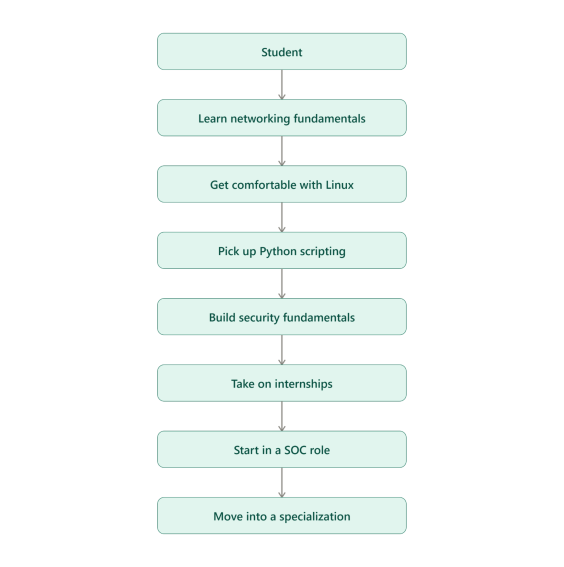
Most successful cybersecurity careers don't start with a security course but with a strong computing foundation. Understanding how networks, operating systems, and software systems actually work is what makes security concepts click later on. From there, exposure to cryptography, secure system design, and emerging technologies like cloud computing and IoT builds the specific context needed to think like a defender.
Build Your Cybersecurity Career with the B.Tech. in Computer Science and Engineering Program at Shiv Nadar University (Institution of Eminence)
If you're serious about a career in cybersecurity, the specialization you choose to build it on matters. The B.Tech. in Computer Science and Engineering at Shiv Nadar University is designed around the hands-on, systems-level thinking that cybersecurity careers demand, with Cybersecurity & Privacy offered as a dedicated specialization track.
- A curriculum built on four core priorities: hands-on learning, interdisciplinary systems thinking, critical thinking, and emerging technologies.
- A dedicated Cybersecurity & Privacy specialization track with electives spanning cryptography, ethical hacking, secure coding, cloud computing, blockchain, IoT, and information security foundations.
- Strong core foundations in Data Structures, Computer Networks, Operating Systems, and Computer Organization before students specialize, so security concepts are backed by real systems knowledge.
- Experiential and project-based learning built into every year, including a dedicated Software Project/Software Engineering course and two capstone project semesters (Project-1 and Project-2/Internship).
- A transparent, credit-based path to specialization: a minimum of 12 elective credits in the Cybersecurity & Privacy basket, with clear CGPA benchmarks, so students know exactly what it takes to graduate with the specialization formally recognized.
Cybersecurity's scope in India and globally is only going to grow from here. Choosing a program that combines strong fundamentals with a real specialization pathway, like the B.Tech. CSE program at Shiv Nadar University, is one of the most direct ways to get there.
Conclusion
Cyber threats are evolving alongside AI, cloud computing, and digital transformation, and organizations across every sector need people who can secure their systems and data. That demand isn't a short-term spike; it's structural. Building strong computing fundamentals through a well-rounded engineering degree, with room to specialize once you know which direction interests you, remains the most reliable way in. If you’re looking to shape a rewarding career in cybersecurity, don't wait any further. Apply now!
FAQs
- Is cybersecurity a good career in India?
Yes. Rising digitization, cloud adoption, and stricter data protection regulations have created sustained, long-term demand for cybersecurity talent across nearly every industry in India.
- Does cybersecurity require coding?
Not always. Roles like penetration testing and application security require strong coding skills, while governance, risk, and compliance (GRC) roles rely more on analytical and communication abilities.
- Can freshers get cybersecurity jobs?
Yes. Entry-level roles like SOC Analyst are specifically designed for freshers and recent graduates, often serving as a launchpad into more specialized roles later.
- Can non-CSE students enter cybersecurity?
It's possible, though a computer science background makes the transition considerably smoother, since it provides the networking, systems, and programming foundation most cybersecurity roles build on.
- Which programming language should I learn first for a cybersecurity career?
Python is widely recommended as a starting point because of its readability and heavy use in security automation and scripting tasks.
- Which cybersecurity certification should I choose first?
CompTIA Security+ is commonly recommended as a foundational, vendor-neutral certification before moving on to more specialized credentials like CEH or CISSP.
- Which cybersecurity jobs pay the highest?
Senior roles like Security Architect and CISO command the highest compensation, though experienced cloud security and application security professionals also earn strong mid-to-senior-level salaries.
- Is cybersecurity in demand beyond 2026?
Yes. Analysts widely expect demand to keep growing as AI adoption, cloud migration, and regulatory requirements continue to expand the scope of what needs securing.
- What is the difference between a SOC Analyst and a Penetration Tester?
A SOC Analyst monitors and responds to real-time threats defensively, while a Penetration Tester proactively simulates attacks to uncover vulnerabilities before attackers can exploit them.
- How can I start preparing for a cybersecurity career while still in college?
Focus first on networking, operating systems, and programming fundamentals, then use hands-on lab platforms and internships to apply those concepts to real security scenarios.