Bachelor of Management Studies Subjects: What the Course Really Covers

Blog / June 03, 2026
One of the most common uncertainties when considering a degree in management is what you will actually learn while studying.
Most brochures and descriptions of courses include terms such as management, leadership, and business skills.
However, students have questions concerning the actual Bachelor of Management Studies Subjects they will study throughout the course of their education.
The Bachelor in Management Studies program provides students with an understanding of how businesses function, grow, and adapt in an ever-changing and competitive world. Students learn both theoretical aspects of management as well as the basic principles of Business, effective and efficient methods of communicating, economics, marketing, analytics, and much more. As a result, you will gain exposure to numerous areas of the business world rather than being focused on one specific area.
This guide will outline the basic subjects offered in the Bachelor's degree and will provide you with some insight into how each of these subjects is important in developing managers, entrepreneurs, and business leaders in the future.
What Makes Management Education Relevant in a Changing World
Before diving into the subjects, here's why this degree matters right now-
- As of December 2024, India has over 1.57 lakh DPIIT-recognized startups, firmly establishing itself as the world's third-largest startup ecosystem, and these startups consistently seek management graduates for their business acumen and entrepreneurial skills.
- In 2024, 52.3% of fresh graduates were considered employable by industry, a 2% increase from the previous year, with management being among the top-performing domains.
- In 2024, graduates in the Master of Business Administration domain had the highest employability rating at about 71%, an increase from the previous year (60%). This reflects the growing premium employers place on management education at every level.
The business world is growing fast. A well-chosen BMS program puts you right at the intersection of that growth.
Bachelor of Management Studies Subjects- A Complete Year-by-Year Breakdown
1st Year Subjects
Here's what a typical BMS 1st year subject list looks like across Semester 1 and Semester 2-
Semester 1 - Core Subjects
Subject | What It Covers |
Principles of Management | Foundations of planning, organizing, leading & controlling |
Business Communication | Written and verbal communication for the workplace |
Financial Accounting | Basics of bookkeeping, ledgers, and balance sheets |
Microeconomics | Supply, demand, market structures |
Business Mathematics/Statistics | Quantitative techniques for business decisions |
Organisational Behaviour | How individuals and groups function in organizations |
Semester 2 - Core Subjects
Subject | What It Covers |
Managerial Accounting / Cost Accounting | Costing methods, budgeting, and cost control |
Business Law | Legal frameworks governing businesses |
Macroeconomics | National income, inflation, and fiscal policy |
Introduction to Marketing | Consumer behavior, segmentation, marketing mix |
Information Technology for Management | Basic IT tools and data management |
Business Environment | Economic, political, and social environment of business |
2nd Year Subjects
Semester 3 - Core Subjects
Subject | What It Covers |
Financial Management | Capital structure, working capital, investment decisions |
Marketing Management | STP (Segmentation, Targeting, Positioning), branding, digital |
Human Resource Management | Recruitment, training, performance management |
Business Research Methods | Primary/secondary research, data analysis |
Operations Management | Supply chain, logistics, quality management |
Corporate Governance & Ethics | Ethical frameworks, CSR, and regulatory compliance |
Semester 4 - Core + Electives Begin
Common elective subjects introduced in the 2nd year-
- Retail Management
- Banking and Financial Services
- Supply Chain Management
- Consumer Behaviour
- Investment Analysis
- Entrepreneurship Development
3rd Year Subjects
Semester 5 & 6 - Advanced Core + Deep Specialization
Subject | What It Covers |
Strategic Management | Business strategy, competitive advantage, Porter's frameworks |
International Business | Global trade, foreign exchange, cross-cultural management |
Entrepreneurship & Innovation | Business plan development, startup ecosystems |
Business Law (Advanced) | Company Act, IP rights, dispute resolution |
Project Management | Planning, executing and closing projects |
Business Simulation/Capstone | Real-world decision-making in a simulated environment |
Core Skills You Develop Across All BMS Subjects
Regardless of which college you attend or which specialization you choose, a well-designed BMS curriculum consistently builds these skills-
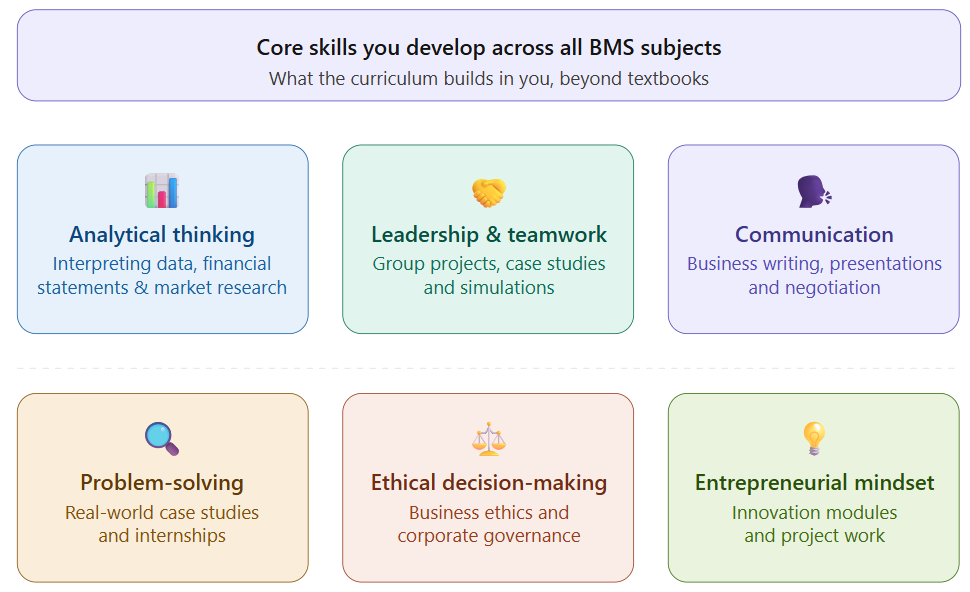
The curriculum is designed to teach strategic management, leadership, communication, resource management, and organizational behavior relevant to current and future business environments.
Bachelor of Management Studies at Shiv Nadar University (Institution of Eminence)- Preparing theNext Generation of Business Leaders
If you are looking for an undergraduate degree that equips you to manage a business, start a venture, and foster social change, you have come to the right location. The Bachelor of Management Studies program at Shiv Nadar University is structured within an interdisciplinary framework that effectively combines management with technology, social sciences, and entrepreneurship. This prepares you not only for your initial job but also for a lifetime of leadership.
What makes the BMS program so unique?
- Venture Lab™ – A year-long 10 credit project where students develop and test actual business concepts with support from the university’s corporate partners
- Required Internships – Complete two internships, one in the non-profit realm and one in the for-profit realm, to gain real-world experience
- Interdisciplinary Curriculum – Choose electives from engineering, natural sciences, humanities and business
- World-Class Faculty – Our professors hold advanced degrees from some of the best schools in the world, including the IIMs, IITs and MIT
- Accreditation – Shiv Nadar University has been accredited by NAAC at A+ and is in the top 2% of the world’s universities (QS World University Rankings 2023)
Synopsis
The Bachelor of Management Studies (BMS) program has been purposefully developed to provide more than just exposure to the world of business. From the first year, where you will receive a solid foundation for your future in management, economics, accounting, and communications, through to the advanced levels focused on strategy, entrepreneurship, and international business.
In an environment where businesses are looking for employees who can critically analyze problems, manage people, and deliver quality results based on analysis, a BMS gives you a sound foundation for your future career opportunities. An understanding of which BMS program would suit you will give you the skill set, practical experience and belief in yourself that will enable you to succeed in a competitive business world today.
FAQs
Q. What are the Bachelor of Management Studies subjects 1st year students study?
Ans. Bachelor of Management Studies subjects in the 1st year usually include Principles of Management, Financial Accounting, Business Communication, Microeconomics, Business Mathematics or Statistics, and more.
Q. What skills do students develop through BMS subjects?
Ans. BMS subjects help students develop analytical thinking, leadership, communication, problem-solving, teamwork, decision-making, as well as entrepreneurial skills.
Q. What career opportunities are available after studying BMS subjects?
Ans. BMS graduates can pursue careers in marketing, finance, consulting, human resources, operations, business development, entrepreneurship, and management training programs.