Number 22
HIMALAYAS PLUS
SEPTEMBER-OCTOBER 2026
Dear All,
The Centre of Excellence for Himalayan Studies (CHS), Shiv Nadar Institution of Eminence (SNIoE) is pleased to present the 22nd edition of our Newsletter, covering the months of September and October 2026 and publications ranging from the Modi-Xi thaw to the Pakistan-China border to environmental disasters in the Himalayas. Previous editions of HIMALAYAS PLUS can be accessed on our website.
Publications
James Leibold, Non-Resident Senior Fellow at the Centre, published an article in China Information that reads China's Xiaokang Border Village Programme in the Tibet Autonomous Region as an instrument of territorial consolidation and colonial-style governance rather than development.
The foreign policy journal Asia Policy carried a book review roundtable on Non-Resident Senior Fellow Wen-Hsuan Tsai's book Reshaping the State: Chinese Political Institutions under Xi Jinping (ANU Press), with five scholars reviewing the volume and Tsai writing the author's response. Tsai argues that Communist Party of China (CPC) General Secretary Xi Jinping has used the institutionalisation of policy implementation to concentrate power, even as the norms governing political succession have been dismantled.
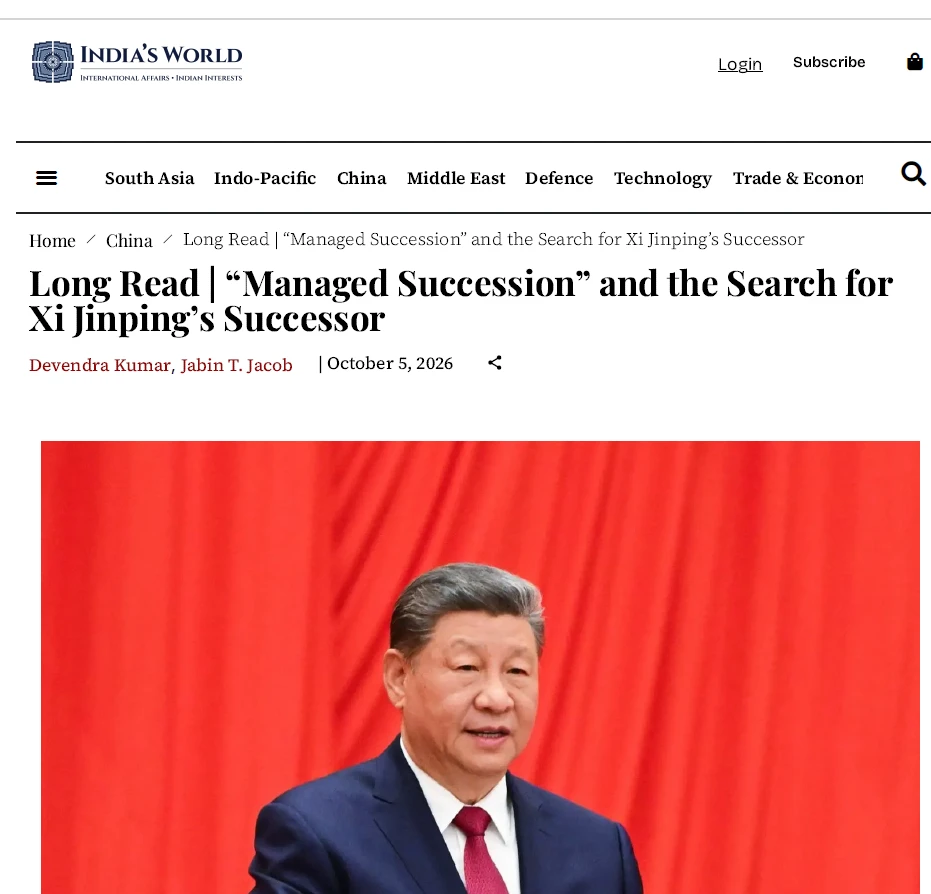
Jabin T. Jacob, Director, and Devendra Kumar, Associate Fellow, wrote in the foreign policy magazine, India's World, introducing the idea of managed succession to explain how Xi has consolidated his influence over the choice of his successor, by reshaping the political, institutional and ideological conditions that once governed succession in the CPC.
Claude Arpi, Distinguished Fellow at the Centre, published an article on the McMahon-Shatra Line in Trans Himalaya, for the Foundation for Non-Violent Alternatives. This is a dive into the history of the warlord Zhao Erhfeng's campaigns in Kham in Tibet between 1905 and 1911. It was this increased Chinese proximity to the Indo-Tibetan border that would drive greater contact between the British and the Tibetans in the years that followed.
India in Transition series
The Centre is pleased to announce a new publication initiative focused on the Indian Himalayas with the India in Transition series of the Centre for the Advanced Study of India, University of Pennsylvania. Kalzang Dorjee Bhutia, Non-Resident Senior Fellow, kicked off the collaboration with a piece on lithic histories in the Sikkim Himalayas and the Naga Hills.
The Tribune “On China” column
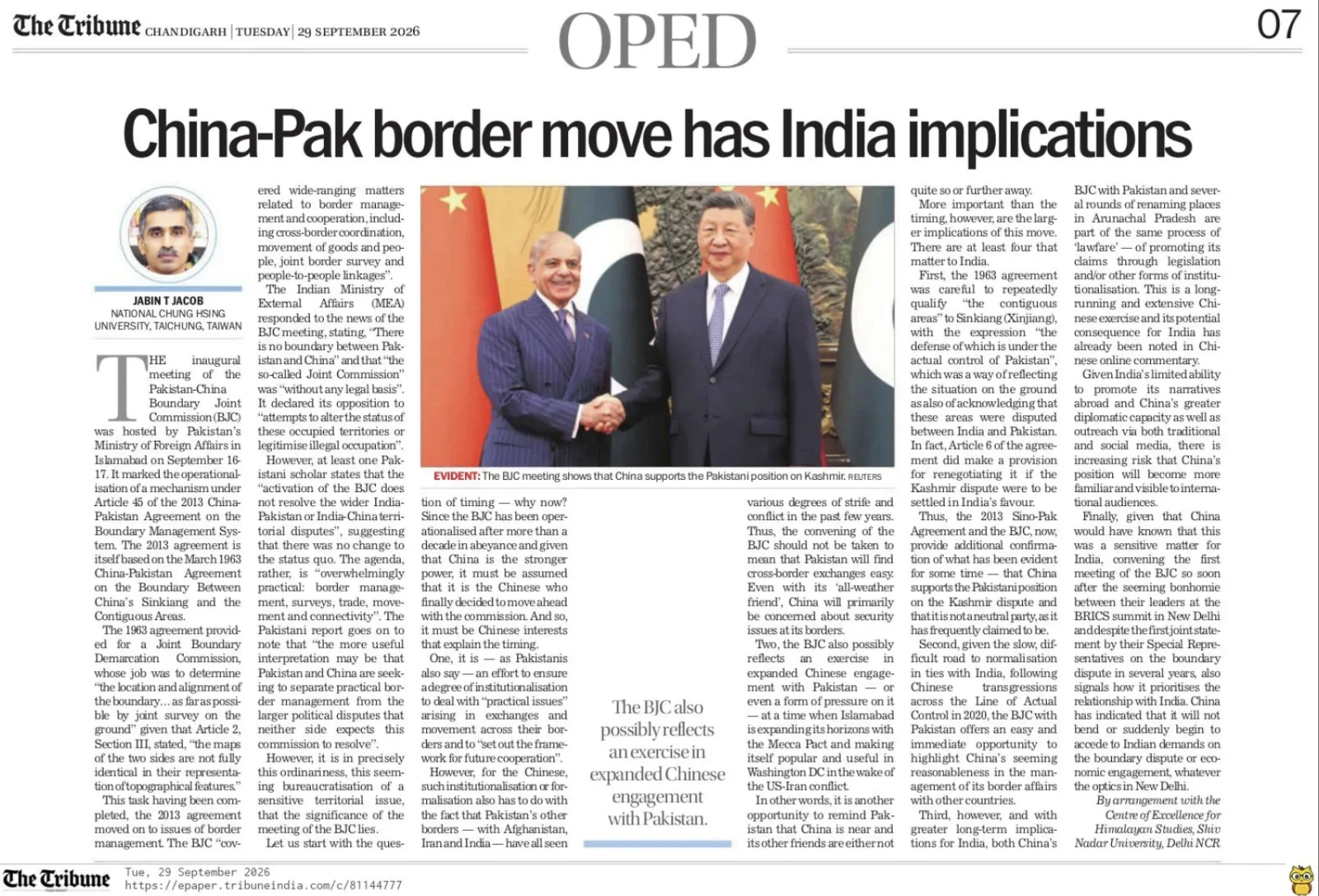
Under the Centre's “On China” column with The Tribune daily, Jabin T. Jacob suggests that the Mecca pact, the new defence grouping of Türkiye, Saudi Arabia and Pakistan, poses questions for China. He argues that Beijing is unlikely to join the grouping, that all three members prefer stronger ties with the United States, and that the pact is a diplomatic challenge China’s preferred bilateral approach cannot easily overcome. With Suyash Desai of the Foreign Policy Research Institute, Philadelphia, Jacob argues that the purge of General Zhao Zongqi, former commander of the Western Theatre Command, is about Xi Jinping's consolidation of power within the People's Liberation Army rather than a response to India or Galwan. In another piece, Jacob also examines the Pakistan-China Boundary Joint Commission, arguing that its inaugural meeting confirms that China backs Pakistan's position on Kashmir rather than being the neutral party it claims to be, and signals that Beijing will not bend to Indian demands despite the bonhomie at the BRICS Summit.
In a CHS Commentary, Devendra Kumar examines the policy signals in the appointment of Hu Changsheng as Party Secretary of the Tibet Autonomous Region, pointing to the CPC’s priority of rebuilding a clean and loyal cadre after a spate of corruption cases, and to likely shifts in economic policy and the Tibet Aid Program.
The Centre also published several Commentaries and Issue Briefs.
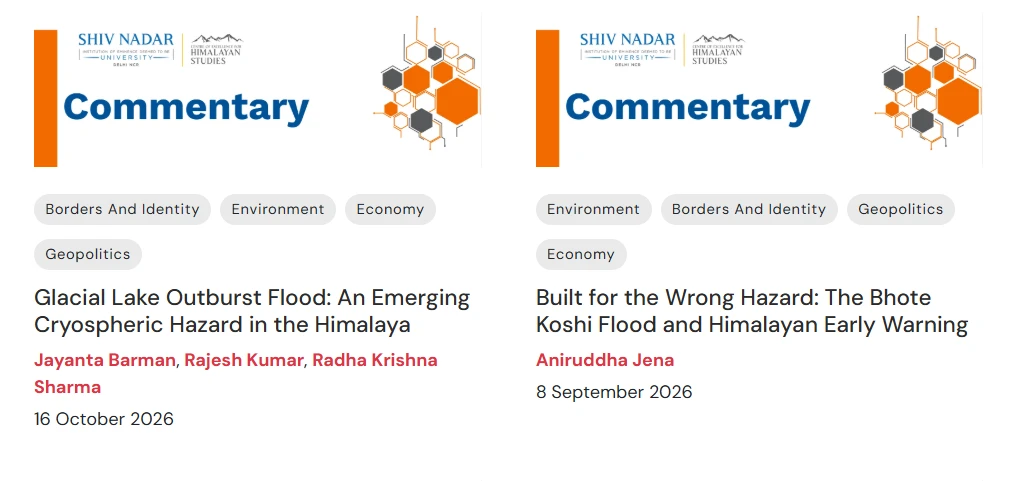
On Himalayan environmental hazards, Aniruddha Jena, Assistant Professor, School of Management, Indian Institute of Technology Mandi, draws on the Bhote Koshi flood to argue that Himalayan early-warning systems were built for the wrong hazard – calibrated for monsoon floods rather than cascading cryospheric events – and that transboundary data sharing, including between India and China, must become year-round, be insulated from bilateral tensions and reach the last mile. Jayanta Barman, PhD Scholar, and Rajesh Kumar, Assistant Professor, both of the Department of Geography, Sikkim University, along with Radha Krishna Sharma, Assistant Scientific Officer, Department of Science and Technology, Government of Sikkim, examine the glacial lake outburst flood as an emerging cryospheric hazard in the Himalaya and call for lake-specific management plans, sustained field monitoring and a community-driven approach with local people as first responders.
On the theme of Himalayan borders and identity, Rituparna Goswami, PhD Scholar, Centre for Historical Studies, Jawaharlal Nehru University, argues in an Issue Brief that today’s ‘outsider’ anxieties in Arunachal Pradesh stem from contradictions built into the colonial design of the Inner Line Permit system, now exposed by infrastructure-driven labour inflows, and makes the case for decentralised enforcement in partnership with civil society. Aryan Kanyal, a scholar in the Department of History, University of Delhi, shows how young musicians in Uttarakhand blend folk instruments with hip-hop in their songs to use as a medium of social critique on drug abuse, migration and the ecological cost of overdevelopment.
The Centre’s focus on economy covers both technology as well as infrastructure development.
Sruthi Kalyani, Policy Fellow, Centre for Society and Policy, Indian Institute of Science, Bengaluru, examines the dilemmas around China’s push into embodied AI, from control software that lags behind its robot hardware to demand that is largely state-constructed and a safety regime that deploys first and corrects later.
Myanmar scholar Wai Yan Phyo Naing, Visiting Scholar, Institute of Modern History, Academia Sinica, Taipei, argues that while Beijing may return to talks on the Myitsone Dam in northern Myanmar, it is unlikely to commit funds without a profitable electricity market, security and genuine local consent, pointing to prolonged negotiation with the military junta rather than a quick restart.
As part of its focus on geopolitics, the Centre has also widened its ambit to study issues related to Iran.
Abu Zafar, Academic Counsellor, Indira Gandhi National Open University, New Delhi, wrote a three-part Issue Brief series on how Pakistani newspapers covered the US-Israel war against Iran. The first reads the early coverage as a sign of Pakistan’s strategic anxieties, rooted in its proximity to Iran, its Shia population and its nuclear status, and in fears of encirclement. The second traces how the Pakistani press shifts from shock to a pragmatic reckoning with a prolonged war of attrition and its economic and sectarian fallout at home. The third shows how early pride in Islamabad’s role as mediator between Washington and Tehran faded as Pakistan came to be seen as a mere messenger and the United Arab Emirates sought the return of its US$3.5 billion deposit.
Deepika Saraswat, Associate Fellow, Manohar Parrikar Institute for Defence Studies and Analyses, New Delhi, argues that China has resisted US pressure to rein in Iran and promotes its own vision of regional security, but that its rhetoric without commitment is tempered by its wider economic interests and its ties with Washington.
Switching to a study of political ritual and questions of succession in a different political system, Bahram Kalviri, PhD Scholar, University of Hyderabad, presents an Issue Brief in which he reads former Iranian supreme leader Ali Hosseini Khamenei’s funeral as political theatre that staged continuity after Mojtaba Khamenei’s swift procedural succession. He argues that the very need for such a performance shows that the new leader’s authority is yet to be consolidated.
Himalayan Youth Series
The Himalayan Youth Series, a CHS initiative, offers a platform for young voices from across the Himalayan region. It gathers articles, narratives, poems and reflections by local youth on social, cultural, environmental and developmental questions, amplifying perspectives that often go unheard. This period carried three contributions – a poem, “Before Borders” by Ehsan Ali Dar, a recent graduate of the MA Anthropology programme in Central University of Sikkim; the poem “Voice of the Mountain (Lha)” by Ishey Angmo, a tour and monastery guide in Ladakh; and International Institute of Information Technology, Hyderabad doctoral student Yogender Mohan’s essay on the idea of “Himaliyat” as a shared Himalayan consciousness.
Event
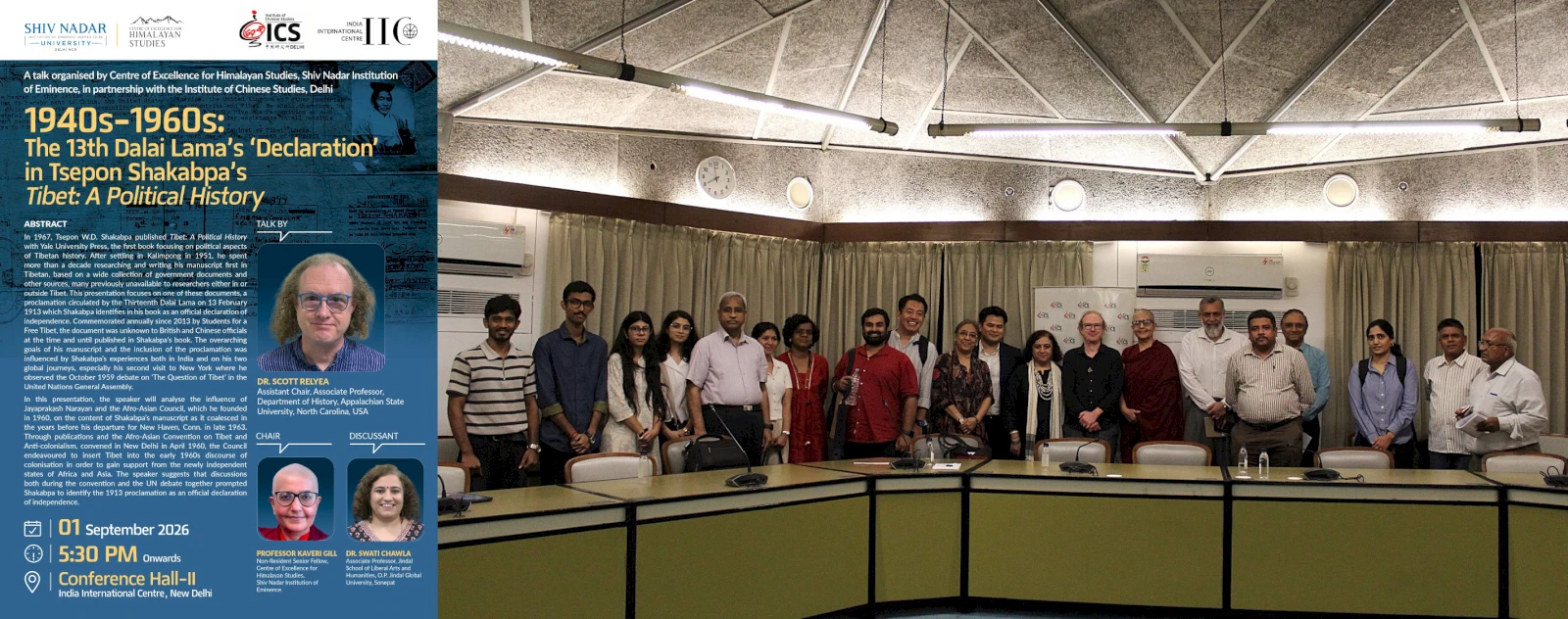
The Centre, in partnership with the Institute of Chinese Studies, Delhi, organised a talk, “1940s to 1960s: The 13th Dalai Lama’s ‘Declaration’ in Tsepon Shakabpa’s Tibet: A Political History,” by Scott Relyea, Associate Professor of East Asian History and Assistant Chair, Department of History, Appalachian State University, at the India International Centre, New Delhi. Kaveri Gill, Non-Resident Senior Fellow, chaired the session while Swati Chawla, Associate Professor, Jindal School of Liberal Arts and Humanities, O.P. Jindal Global University, was the discussant.
In the Media
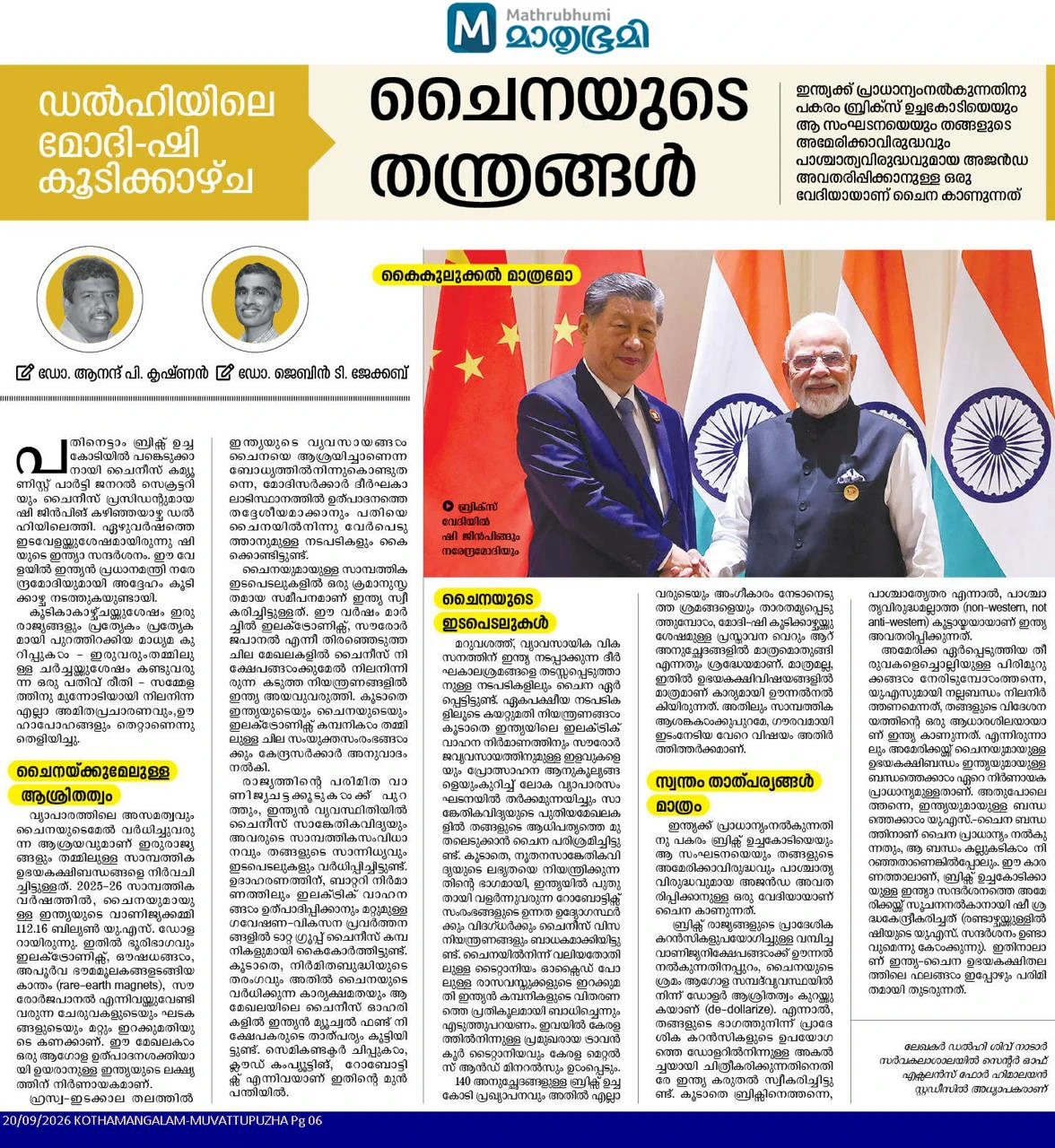
As New Delhi hosted the 18th BRICS Summit and Indian Prime Minister Narendra Modi met Xi Jinping on its sidelines, Jabin T. Jacob argued in The Indian Express that behind the Xi-Modi thaw lay larger Beijing signalling to Washington. With Krishnan, he wrote in Mathrubhumi on the economic takeaways of the Modi-Xi meeting, and in his Firstpost “China Compass” column he looked beyond BRICS bonhomie at China's India strategy and the US factor. He was quoted on the summit in the Economic Times, The Straits Times and VOA Chinese.
On the Pakistan-China Boundary Joint Commission, Jacob was quoted in the BBC on why the new border pact irked India, and in Nikkei Asia on how India's clout in Kashmir was tested by the new protocol.
On the US-China relationship, Jacob wrote in Firstpost on the G2 mirage, arguing that Sino-American rivalry leaves little room for cooperation. He was quoted on the subject in the South China Morning Post, and in The Economist on how India is pouring resources into scaling up infrastructure along the disputed boundary with China.
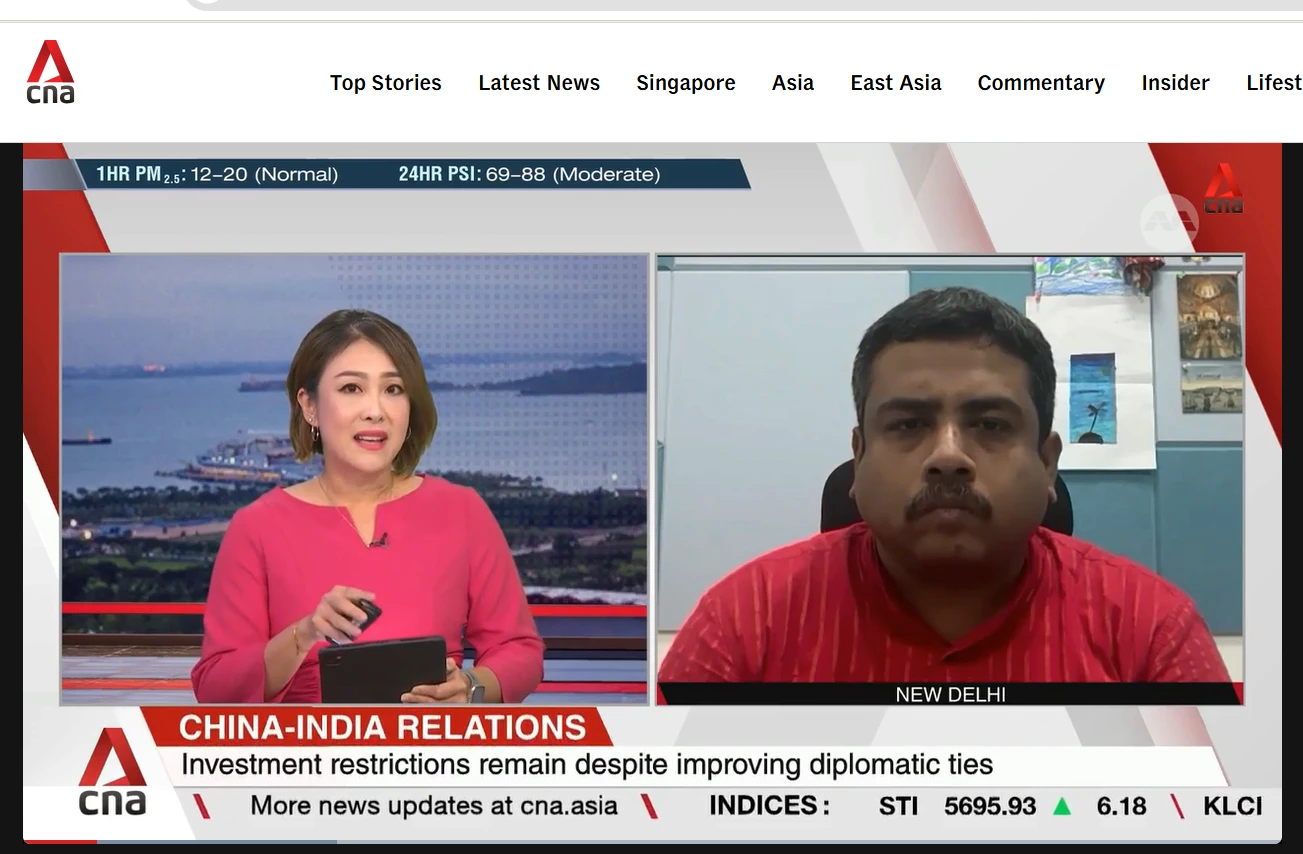
Krishnan wrote in The Hindu on how China’s state-promoted factory tours showcase its industrial and technological prowess, and what India could learn from them. In an interview with CNA, he discussed how improving diplomatic ties between India and China have yet to translate into stronger investment, as strategic mistrust and competition persist.
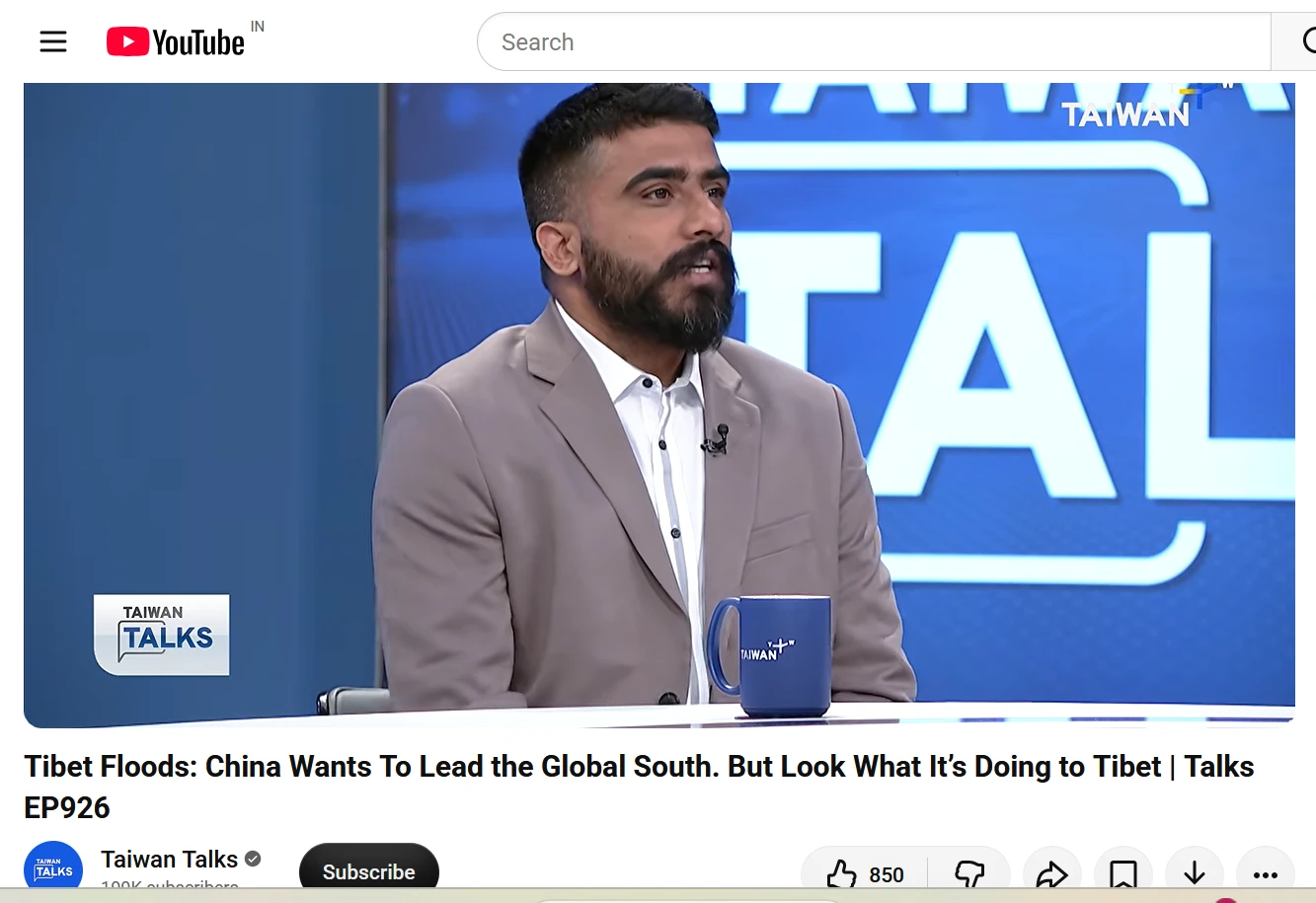
Devendra Kumar appeared as a panellist on Taiwan Talks (TaiwanPlus), first on the Tibet floods and what China's handling of Tibet reveals about its claim to lead the Global South, and then on China's military doctrine shift and loyalty tests at the Fifth Plenum.
Kaveri Gill wrote in The Wire that Nepal’s cancellation of an international Tibetan studies seminar under Chinese pressure opens a door for India’s Buddhism diplomacy, built on the Dalai Lama’s institutional legacy in India.
Claude Arpi, writing in Firstpost, contended that the pomp of Xi Jinping’s US visit masks, but does not resolve, China’s domestic troubles. He was also in conversation with Mayank Singh of Banaras Hindu University on China’s engagement in Ladakh.
Faculty Updates
James Leibold spoke at the Centre for International Studies, Sciences Po, Paris, and the University of Helsinki, on how the Chinese party-state is gradually hollowing out ethnic autonomy in its borderlands through the ideological project of ‘nation-building’ involving not just Party building but also by a still greater emphasis on building physical infrastructure.
Kalzang Dorjee Bhutia led a workshop at the University of California, Santa Cruz, “Balancing the Elements, Reclaiming Knowledge Sovereignty: Prayer Flags as Indigenous Ecological Justice,” in which participants made prayer flags using dyed cloth and ink from his village in western Sikkim.
Kaveri Gill chaired a talk by Geshe Lhakdor, Director of the Library of Tibetan Works and Archives, at the Tibet Festival “Spirit of Tibet: Celebrating Culture and Compassion” at the India International Centre, New Delhi. She spoke about her book Of Poverty and Plastic on the Author's Speak series of The Maintainers Network, and spoke on Nalanda philosophy at the 135th Brahmo Conference in New Delhi.
Rustam Ali Seerat, Non-Resident Associate Fellow, moderated an online panel, “Remembering the Hazara Genocide: Past, Present and the Path Forward,” organised by the Hazara Students Association in India, bringing together Abdul Razaq Wahidi, former Minister of Communications and Information Technology of Afghanistan, Ali Karimi of the University of Calgary, and Farkhonda Akbari of Monash University.
You can stay updated with our publications, events, and activities through our website, X (@Himalayas_SNU), Facebook, LinkedIn and Instagram. You can also find previous Newsletters here.
Share this: