 Read this in:
Himaliyat: Imagining a Shared Himalayan Consciousness
Developments in Ladakh in recent years have once again brought the Himalayas into national focus. The region requires attention not only during moments of crisis, but also due to sustained ecological stress, environmentally destructive development and governance frameworks that have more often than not overlooked local concerns. The recent mobilisation around the Sixth Schedule, despite the unfortunate turn it has taken in places, is at its core an attempt to hold political authority accountable to long-standing demands of the local people and the promises which have been made. If there is a silver lining to these events, it is that the Himalayas have entered public discourse in a more sustained and serious manner.
Yet attention alone does not guarantee understanding. What remains missing is a shared framework through which the concerns of the Himalayan region can be articulated collectively, without flattening its internal diversity. As a student from the western Himalayas, my engagement with these questions is shaped by both lived experience and academic inquiry. Drawing inspiration from the idea of ‘Punjabiyat’—an identity that transcends political borders and formal affiliations to express a shared linguistic, cultural, social and ethical orientation—I propose the notion of ‘Himaliyat’ as a similar conceptual lens for thinking about Himalayan unity.
Himaliyat is not intended as a singular cultural identity. Rather, it can be understood as a shared consciousness that encourages cooperation across the Himalayan belt. It aims to further diverse local objectives, bound by a rooted understanding of familiar concerns and a common commitment to ecological sustainability and social responsibility. Most importantly, this idea need not be limited to culture alone. It can extend across economic, environmental, developmental, and even linguistic domains, allowing different regions to articulate the specificities of their concerns within a broader pan-Himalayan framework.
Stretching from the Karakoram in the west to the Purvanchal hills in the east, Himalayan societies are marked by immense linguistic, religious, and social diversity. Yet across this range, similar and pressing concerns repeatedly surface. Issues of water, forests, and land, which are often articulated through the idiom of jal, jangal, aur zameen, form a shared material and ethical vocabulary (and worry). These are not abstractions but everyday realities that shape livelihoods (or their lack), belief systems, and the relationship between communities and their landscapes.
Recent developments across the Himalayan region illustrate how these shared concerns manifest in local contexts. In Kullu District of Himachal Pradesh, opposition to the Parvatmala Pariyojana (National Ropeways Development Programme) emerged from environmental anxieties, as well as socio-religious considerations. In Kinnaur, sustained mobilisation by youth and local communities reflects growing unease over ecologically fragile development in a tribal region. Monsoon-related disasters in regions of Jammu and Kashmir, Himachal Pradesh, and Uttarakhand have further highlighted the vulnerability of mountain ecologies to infrastructure-led interventions. Similar patterns can be observed in the Purvanchal hills and other Himalayan regions. While the contexts differ, the underlying anxieties remain remarkably consistent.
The Himalayas have also produced numerous thinkers and leaders who have articulated alternative visions of development rooted in ecological sensitivity. Figures such as Athup Lepcha, Sunderlal Bahuguna, and Dr. Y.S. Parmar demonstrated that political engagement and environmental responsibility need not be opposed. In contemporary times, many Himalayan youth continue to engage with similar concerns, although often in fragmented and locally bound ways. State- and Union Territory-specific demands, such as for the Sixth Schedule in Ladakh, risk being reduced merely to electoral instrumentality, rather than being addressed as genuine demands stemming from substantive questions of local governance and aspirations.
It is within this context that Himaliyat can be seen as a useful conceptual intervention. The idea is not meant to be either exclusionary or oppositional. Anyone committed to the well-being of the Himalayas, regardless of region, language, or political affiliation, can be part of this conversation. Inclusiveness, shaped historically through mobility and exchange, has long been a feature of Himalayan societies. Himaliyat seeks to build upon this legacy by imagining a pan-Himalayan framework that allows local and hyperlocal issues to be discussed and articulated collectively, rather than in isolation.
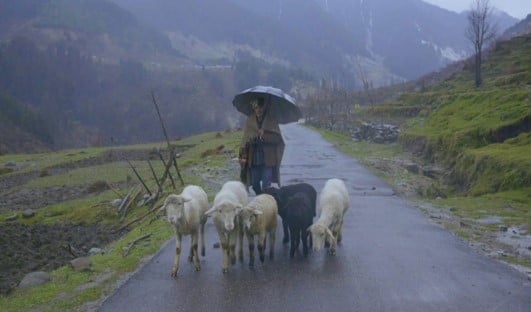
Image: A Gaddi Shepherd with Sheep in Chotta Bhanghal, Kangra
Source: (https://commons.wikimedia.org/wiki/File:Gaddi_in_chotta_bhanghal.jpg)

Critiques may view such a framework as anti-development. However, Himaliyat does not reject development as such but instead, calls for development that is context sensitive, ecologically informed, and socially accountable. Rather than opposing state institutions or democratic processes, it works within constitutional and institutional structures, offering a guiding principle through which policies can be evaluated. In this sense, Himaliyat is not an alternative to existing structures, but a companion framework and organising principle that seeks to make policies and actual governance on the ground more responsive to mountain realities.
One way of thinking about how Himaliyat might acquire institutional shape is through imagining a distinct Himalayan Council. Such a body could potentially bring together scientific expertise, traditional knowledge, and community perspectives to inform policy discussions related to disaster preparedness, ecological assessment, and sustainable livelihoods. By encouraging dialogue between state-led development policies, and the lived experiences of communities, the Himalayas could gain a more coherent presence in national planning without undermining regional diversity or democratic legitimacy.
Himaliyat, then, is not a utopian abstraction. It is a pragmatic attempt to think collectively about the future of the Himalayas which is rooted in constitutional values, ecological responsibility, and lived experience. At a time when the mountains are increasingly treated as sites of extraction or spectacle, Himaliyat invites a more reflective question: can the Himalayas speak in a shared voice, while remaining true to their many differences?
About the Author: Yogender Mohan, 23, hails from Bara Bhuin in Kullu District, Himachal Pradesh, and is currently pursuing a PhD at the International Institute of Information Technology (IIIT), Hyderabad.
Series Editors: Professor Kaveri Gill, Non-Resident Senior Fellow; Professor Jabin T. Jacob, Director; and Dr Samir Sharma, Non-Resident Associate Fellow — Centre of Excellence for Himalayan Studies.
Read this in: