Staging Continuity: Political Ritual and the Reproduction of Authority after Khamenei
Abstract
Leadership transitions in centralized regimes expose fundamental tensions between procedural succession and political consolidation. Following the killing of its Supreme Leader Ali Khamenei in February 2026, the Islamic Republic of Iran managed this vulnerability through a two-stage process of political stabilization. The rapid activation of constitutional mechanisms and the appointment of Mojtaba Khamenei achieved procedural succession, containing immediate institutional uncertainty. However, administrative resolution left critical questions regarding elite consensus, religious legitimacy, and support for security establishment unresolved. The July funeral subsequently functioned as a second-stage mechanism of political consolidation through narrative building. Operating as political theatre, the ceremony deployed Shia religious symbolism, revolutionary genealogy, and institutional choreography to transform formal succession into a publicly intelligible display of continuity. By projecting differentiated signals of closure to elites, integration to the security establishment, and order to the public, the regime managed the visibility of political contestation. Ultimately, the intense ritualization reveals a central paradox – the capacity to stage coherence reflects organizational strength, yet the necessity to perform it exposes underlying fragility and unfulfilled personal political authority.
Keywords: Iran; political succession; funeral politics; political ritual; regime resilience; symbolic power
Leadership transitions in highly centralized political systems are moments of acute institutional stress. When authority is concentrated in a single figure, succession does not merely involve replacing an officeholder; it raises questions about whether a structure built over years or decades around individual authority can continue to exist without its architect. In such contexts, the challenge is both procedural and symbolic – regimes must maintain the functioning of political institutions while demonstrating that authority survives the death of its embodiment.
This challenge became particularly visible following the killing of Iran’s Ayatollah Ali Khamenei on 28 February 2026. Over nearly four decades as Supreme Leader, Khamenei had accumulated extensive authority across the Islamic Republic’s political, religious, and security institutions, while playing a central role in managing elite cohesion and factional balance (Nader et al. 2011). His killing, therefore, created not only a leadership vacancy but a broader question of institutional continuity. The immediate activation of Article 111 and establishment of a temporary three-member leadership council demonstrated that constitutional mechanisms could function under conditions of sudden rupture.[i] The Assembly of Experts subsequently selected Mojtaba Khamenei as Supreme Leader in March, formally closing the procedural succession within days of his father’s death (Secretariat of the Assembly of Experts 2026).[ii]
Yet procedural closure did not eliminate political uncertainty. The succession established who would occupy the office, but it did not by itself determine how authority would be consolidated, legitimized, or exercised under a successor whose political relationships were still developing.[iii] It is within this gap between procedural succession and political consolidation that the July funeral becomes politically and analytically significant.
The internal politics of the succession were more complicated than the speed of the constitutional process suggests. Mojtaba’s elevation marked the first father-to-son succession to the Supreme Leadership and occurred despite his more limited public political profile compared with his father. At the same time, the Islamic Revolutionary Guard Corps (IRGC) remained a central actor in the Islamic Republic’s political and security architecture, making its relationship with the new leadership an Important element of the transition. These factors did not necessarily produce open disagreement, but they left unresolved questions about the configuration of authority within the emerging order.
The succession also raised questions of legitimacy. Although Mojtaba inherited the constitutional office of Supreme Leader, acceptance of the new leadership could not simply be assumed. Public demonstrations of allegiance, therefore, acquired particular significance. A large and orderly funeral could be presented as evidence that the transition had been accepted, even though participation itself might reflect grief, religious obligation, social expectations, or political loyalty. The regime consequently faced the challenge of making acceptance visible without being able to treat visibility as conclusive proof of legitimacy.
The funeral did not resolve the succession crisis. Its political function was not to determine leadership, but to transform an already completed procedural transition into a publicly intelligible narrative of continuity. Through religious symbolism, revolutionary imagery, institutional visibility, and mass participation, the ceremony embedded the new order within the ideological and institutional grammar of the Islamic Republic.
This paper argues that the funeral functioned as a second-stage mechanism of political stabilization – it did not produce succession but sought to shape and normalize it. Drawing on Kantorowicz’s (1997) distinction between the mortal body of the ruler and the enduring political body of the office, the analysis examines how the Islamic Republic sought to separate Khamenei’s physical death from the continuing authority of Velayat-e Faqih —a logic popularized through the regime slogan “Khamenei became young” to project the notion that despite the leader’s demise, nothing within the office had changed.[iv] The argument, however, does not equate symbolic continuity with political consolidation. Rather, it distinguishes between the regime’s demonstrated capacity to reproduce and publicly organize authority and the unresolved question of whether the new leadership has acquired the political relationships and legitimacy necessary to sustain it.
The analysis proceeds in four stages. First, it examines the constitutional mechanisms and elite coordination through which the succession was procedurally managed. Second, it interprets the funeral as political theatre, focusing on the religious, revolutionary, and institutional symbols through which continuity was constructed. Third, it examines how these performances addressed different constituencies whose interests and uncertainties were not identical. Finally, it considers the limits of this performance by assessing what the succession and funeral demonstrate about institutional capacity, and what they leave unresolved about elite alignment, popular legitimacy, and the consolidation of Mojtaba Khamenei’s authority.
Managing the Succession Narrative
The immediate aftermath of Khamenei’s death was marked by the rapid activation of constitutional mechanisms designed to prevent institutional paralysis. Article 111 of the Iranian Constitution was invoked, and a temporary three-member leadership council assumed the functions of the Supreme Leader while the Assembly of Experts prepared to select a successor. The arrangement demonstrated that the Islamic Republic possessed a predefined institutional mechanism for managing a sudden leadership vacancy. Its significance, therefore, extended beyond formal constitutional compliance – it reduced the possibility that the removal of the regime’s central political figure would immediately produce an administrative vacuum or open-ended contest over the locus of authority.
The subsequent selection of Mojtaba Khamenei in March further narrowed the period of formal uncertainty. However, the speed of the decision should not be treated as evidence that questions surrounding the succession had disappeared. The possibility of hereditary succession had long been politically sensitive, as dynastic transmission directly collided with the Islamic Republic's foundational rejection of monarchical rule. Indeed, concerns over dynastic optics had previously led Ali Khamenei to express opposition to having his son's candidacy formally evaluated by the Assembly of Experts’ selection committee (Araghi 2024). That Mojtaba nonetheless succeeded his father highlights that the political significance of his filial status functioned not as formal hereditary inheritance, but as indispensable political capital during an acute crisis. The transition was not entirely devoid of institutional alternatives; non-hereditary clerical figures with established institutional profiles, such as Alireza Arafi, were featured in pre-transition succession deliberations alongside a short-lived activation of collective leadership council (IRNA 2026a). However, the ultimate selection of Mojtaba bypassed these non-dynastic alternative, raising questions both over Mojtaba’s religious qualifications (Lob 2026) and of IRGC influence over the process (Maloney 2026). These questions are analytically important because they distinguish procedural resolution from substantive agreement among actors involved.
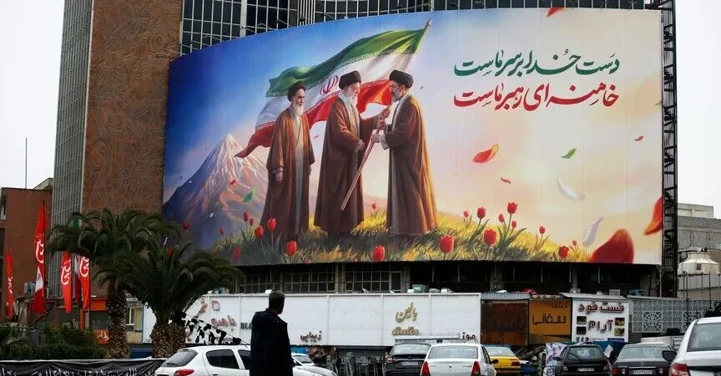
The regime’s management of the succession also extended into political communication. Official statements emphasized continuity, revolutionary legitimacy, and obedience to Velayat-e Faqih, framing the transition as the continuation of the Islamic Republic rather than a rupture. The Assembly of Experts called for unity around the principle of guardianship, framing the transition as a “renewal of the Ummah’s (community) pledge”. Broad state media and official discourse linked Mojtaba’s leadership to “the continuation of the path of the two Imams of the Revolution,” heralding his ascension as a “new chapter of guardianship” and a “new era for the regime” (Mehr News 2026a).
Figure 1
A large billboard in Tehran’s Vali-e Asr Square depicting three generations of leadership – Ruhollah Khomeini standing alongside Ali Khamenei, who hands the flag of Islamic Republic to Mojtaba. The Persian text reads, “God’s hand is over us, Khamenei is our leader.”