
Khatak Are Not Waste: Reclaiming Khatak from Over-Consumption to Care for Each Other and the Earth
Khatak, traditional offering scarves, are everywhere in the Himalayas—offered to lamas and rinpoches at public wangs; given to newlyweds, babies, and people celebrating birthdays, exam results, and promotions, and used to greet and farewell officials, friends, travelers, and mountaineers, and they are draped over statues and sacred sites. They now come in all manner of colors, lengths, sizes, and natural and synthetic fabrics. Some are patterned, some are plain. Some are branded with company names, and others are left blank for funerals.
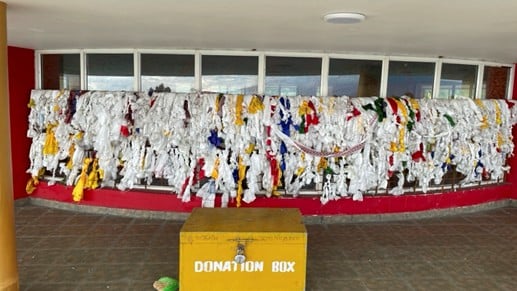
This abundance of choices and giving has led to an unintended consequence: there are simply too many to be reused. As common as khatak are in public spaces, they are outnumbered by the quantity we find in our homes—sorted into piles, stored in plastic bags, or tucked away in cupboards and drawers.
Our team, which includes members of Buddhist communities in Nepal and Sikkim in northern India, have been thinking about what to do with these accumulating khatak for the last four years. Increasingly, khatak are now appearing in clean-up campaigns in our mountains regions, and are used excessively in regional tourism.
In Tibetan and Himalayan communities, khatak are not waste. They are materials that bring about transformation through exchange. How, then, can we celebrate this aspect of khatak, while preventing harm to our relationships with each other and with our lands and waters?
Image 1
Synthetic and biodegradable khatak offered in Sikkim, 2024.
Source: Photo by Amy Holmes-Tagchungdarpa
Khatak in historical and cultural contexts
Historically, khatak were made of silk or cotton, and were offered only occasionally, in special situations or formal contexts, such as diplomatic exchanges, or else by single representatives of communities. After being offered, khatak would either be treasured and kept carefully in people’s personal shrines as amulets, or they would disintegrate naturally over time—or, where disposal was necessary, they could be burned.
Both historically and today, the aspirations behind offering khatak are positive: they create relationships and connections—known in Tibetan and many Himalayan languages as tendrel—and convey aspirations or blessings (Tib. chinlap) between people (both living and deceased), as well as between humans and more-than-human beings and environments. These include sacred objects (Tib. ten), sites, and living landscapes such as mountain passes and trees.
Today, however, in places like India and Nepal, the good intention behind the offering of khatak is increasingly obscured by their ubiquity. They are so widespread that people at public events and caretakers for sacred sites don’t know what to do with them all.
Once offered, khatak are understood to be charged with chinlap, or blessings, and therefore cannot simply be discarded. If they are disposed of improperly, instead of bringing auspiciousness and good wishes to the offerer and recipient, they become a source of pollution. In this sesne, khatak retain the capacity to bring transformation even when discarded. Khatak do not ever really become waste.
From sacred object to surplus material
The difficulty of disposal is not only spiritual but also material. Since the 1980s, manufacturers have made khatak from synthetic materials containing plastics, which are difficult and toxic to burn. This shift in materiality has paralleled a dramatic rise in consumption.
Khatak are no longer offered sparingly. They are readily available and affordable, which makes them an easy commodity to distribute en masse for all kinds of events. These synthetic khatak can be useful for making ropes and decorations at religious events. They can be washed and reused, although most are not reused since there are just too many.
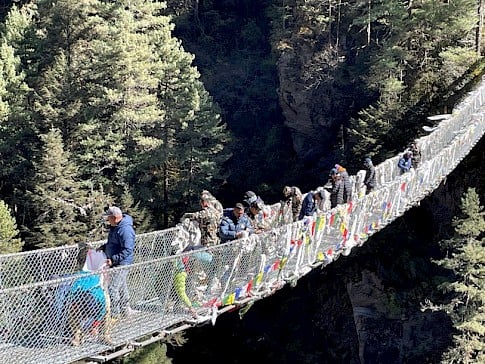
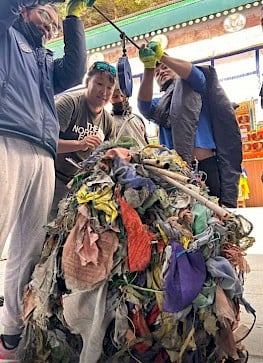
In this era of overuse, khatak linger as examples of what anthropologist Saskia Abrahms-Kavunenko calls “zombie” materiality—objects that persist beyond their intended life and purpose. (Brox) During a recent clean up campaign in Namche, Nepal, more than two tonnes of khatak and lungta (prayer flags) were gathered from a single village in Khumbu.
This issue is not confined to Nepal and India. We know from Dendup Chopel’s recent article for BDG that people in Bhutan are also discussing issues of consumption and waste at religious gatherings. Tibetan anthropologist Huatse Gyal’s film Khatak explores similar concerns on the Tibetan Plateau and in parts of Tibet and China.
Image 2
Namche Youth Group cleans up the Hillary Bridge to Namche with assistance from the Nepal Army and Armed Police Force, 2024.
Source: Photo by Pasang Y Sherpa
Image 3
Lungta (Tib. prayer flags) and khatak gathered during the Namche Youth Group clean up around sacred sites in Namche in early 2024.
Source: Namche Youth Archive
Rethinking use, value, and practice
The challenge of lingering khatak is not necessarily one of materiality, but of quantity. While affordability and accessibility are important, too many khatak are available in the market, and their overuse risks diminishing an appreciation of their power and value.
What, then, are possible alternatives?
First, to retain the beautiful, positive aspirations for connections that are associated with khatak, we have thought about more intentional, thoughtful use. Choosing biodegradable khatak, such as those created by our co-author Ang Dolma Sherpa at Utpala Craft, is part of this, or even making khatak at home from cotton.
More importantly, we must think about our consumption patterns. Biodegradable khatak cost more than synthetic ones, but this does not necessarily mean they are inherently more valuable or should be used more carefully. Instead, we might ask:
How can we unlink the cost of khatak from how many are used?
How many are needed at public gatherings and celebrations?
Is it appropriate to offer them to tourists and trekkers, who may not understand their significance?
Can communities return to the practices of their forebears, and join together to offer a single khatak, or else reuse khatak?
Reusing khatak by offering a single scarf to multiple elders and lamas, or on pilgrimage allows for it to accumulate chinlap, becoming even more meaningful and precious.
From abundance to care
Rethinking how we use khatak, the type of khatak we use, and how many khatak we use, invites deeper examination of our attitudes toward ten, and to our conception of abundance. Rather than equating abundance of blessings with the quantity of khatak, we can think about how abundance can be an attitude—a way to relate to other humans and the more-than-humans in our mountains, lands, and waters.
Excessive consumption can have unintended consequences for the well-being of our co-resident beings and landscapes. Reassessing our use of khatak can allow us to retain this beautiful and meaningful practice while also looking after our buddhas and local protectors—chokyong yullha zhidak—who inhabit these places.
Practiced thoughtfully, individually and collectively, such changes can make a real difference and restore an understanding of khatak as precious and generative, rather than as waste.
* Excess, Moderation, and Skillful Means: Bhutanese Dharma Leadership in a Changing World (BDG)
** Hybrid Event – Khata: Poison or Purity? – A film by Dr. Huatse Gyal (The University of British Columbia)
References
Brox, Trine and Elizabeth Williams-Oerberg, eds. 2022. Buddhism and Waste: The Excess, Discard, and Afterlife of Buddhist Consumption. London: Bloomsbury Publishing.
About the Authors:
Ang Dolma Sherpa is a social entrepreneur who won the top “ideator” award at Idea Studio Nepal 2019 for her concept of biodegradable khatak, or scarves. The platform led her to initiate Utpala Craft in 2020, creating a shift from synthetic prayer flags and khatak to biodegradable ones.
Pasang Yangjee Sherpa is a Sharwa anthropologist from Pharak, southern part of Mt. Everest region in northeastern Nepal. Her research, writing and pedagogy focus on climate change and Indigeneity among Himalayan communities, guided by the question: How do we live in the midst of dying? She is an assistant professor of Lifeways in Indigenous Asia, jointly appointed in the Institute for Critical Indigenous Studies and the Department of Asian Studies at the University of British Columbia, Canada.
Kalzang Dorjee Bhutia is a Lhopo religious studies scholar from west Sikkim in Northeast India. He is a Senior Fellow at the Centre for Excellence for Himalayan Studies at Shiv Nadar University. He studies relationships between human and more-than-human communities in Sikkim.
Amy Holmes-Tagchungdarpa teaches religious studies and Asian studies at Occidental College in Los Angeles and is originally from Aotearoa.
This article was originally published in Buddhistdoor Global on 28 March 2026 under the title ‘Khatak Are Not Waste: Reclaiming Khatak from Over-Consumption to Care for Each Other and the Earth’, and was co-authored by Ang Dolma Sherpa, Pasang Yangjee Sherpa, Kalzang Dorjee Bhutia, and Amy Holmes-Tagchungdarpa.