Physics of Neutron stars & Multimessenger astrophysics
Neutron stars are among the most extreme objects in the universe, packing more mass than the Sun into a sphere just tens of kilometers across, with matter compressed to densities several times that found in atomic nuclei --- conditions that cannot be replicated in any terrestrial laboratory.
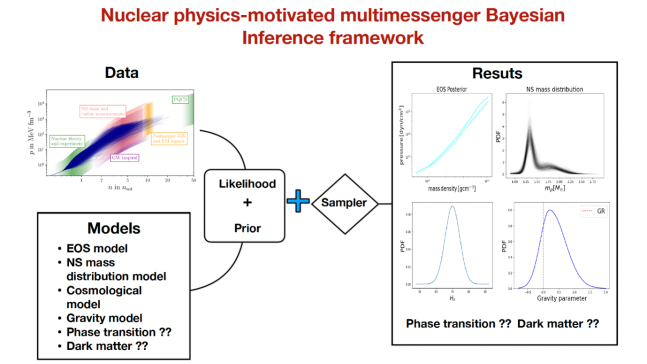
- We develop a nuclear physics-motivated, multimessenger Bayesian inference framework that combines nuclear theory and experiment, astrophysical neutron-star mass and radius measurements, gravitational-wave signals from the inspiral and postmerger phase of binary neutron star mergers, electromagnetic counterparts, and perturbative-QCD constraints. Within a common likelihood-and-prior setup, this framework jointly constrains the neutron-star equation of state, the neutron-star mass distribution, cosmological parameters such as the Hubble constant, and possible deviations from General Relativity, while probing open questions such as the presence of phase transitions or dark matter in dense nuclear matter.
- To connect these inferred physics inputs to observable signals, we perform binary neutron star merger simulations using smoothed particle hydrodynamics (SPH). These simulations follow the merger from the late inspiral through coalescence to the formation of a hypermassive remnant or black hole. Throughout this process, we track the evolution of the density, temperature, and chemical composition across the merger and post-merger phase. These simulations, incorporating finite-temperature equations of state, provide the theoretical link between the nuclear-physics-informed inference framework and the gravitational-wave and electromagnetic (kilonova) signals used to constrain it.


Bhaskar Biswas
Assistant Professor
School of Natural Sciences