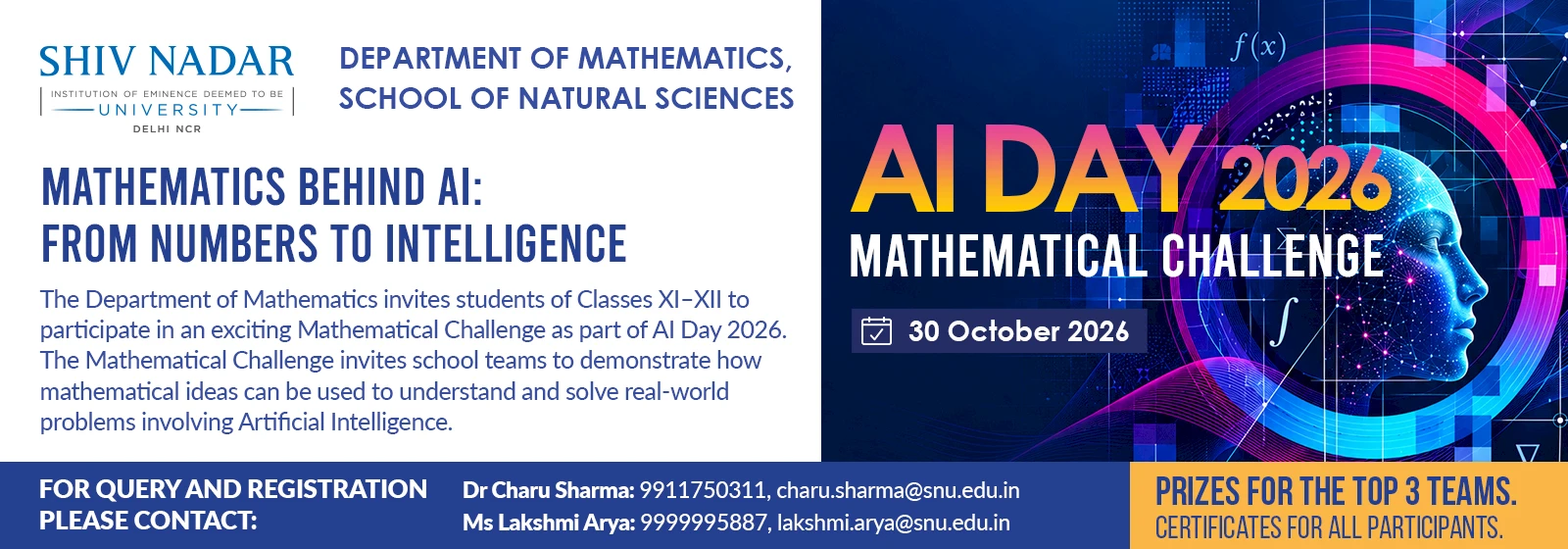
Mathematics Behind AI: From Numbers to Intelligence
The Department of Mathematics invites students of Classes XI–XII to participate in an exciting Mathematical Challenge as part of AI Day 2026.
Artificial Intelligence is often associated with computers, coding and futuristic technology. But behind every intelligent system lies something fundamental - mathematics. From predicting outcomes and recognising patterns to finding the best possible solution and understanding uncertainty, mathematical thinking forms the foundation of many AI systems.
The Mathematical Challenge invites school teams to explore this connection and demonstrate how mathematical ideas can be used to understand and solve real-world problems involving Artificial Intelligence.
The Challenge
The broad theme for the competition is:
“Mathematics Behind AI: From Numbers to Intelligence”
Each participating school will form a team of five students from Classes XI–XII. Teams may choose one of the following four challenge areas:
1. Can Mathematics Predict the Future?
Explore how data, probability, statistics, correlation or regression can help AI make predictions about weather, sports, traffic, energy consumption or other real-world phenomena.
2. How Does AI Recognize Patterns?
Investigate how machines learn to identify patterns in images, handwriting, language, spam emails or other forms of data, and explore the mathematical ideas that make this possible.
3. How Does AI Find the Best Solution?
Explore how mathematical optimization and algorithms can help solve problems such as finding the shortest route, scheduling, resource allocation or making the best choice among many possibilities.
4. Can We Trust an AI Prediction?
Examine the role of probability, statistics, accuracy, error and uncertainty in AI. When an AI system makes a prediction, how can we determine how reliable it really is?
What is expected from the teams?
Students are encouraged to go beyond a conventional presentation. They may use mathematical models, real-world data, visualizations, demonstrations, simulations, simple experiments or examples to communicate their ideas.
The objective is not to demonstrate advanced programming skills. Instead, students should show how mathematical thinking can help us understand, build, question or improve an AI-based solution.
A successful presentation could follow the simple structure:
Problem → Mathematical Idea → AI Connection → Demonstration → Real-World Application
Competition Format
- Team size: 5 students
- Eligibility: Classes XI–XII
- Presentation: 10 minutes
- Jury Interaction: 2 minutes
- Topic: One of the four challenge areas
- Advanced programming: Not required
- Use of AI tools: Permitted as supporting tools, but students must demonstrate their own understanding and explain the mathematical ideas involved.
What will the jury look for?
Teams will be encouraged to demonstrate:
- Clarity of mathematical thinking
- Understanding of the AI connection
- Creativity and originality
- Quality of the example or demonstration
- Ability to connect mathematics with a real-world problem
- Clarity and effectiveness of communication
The Bigger Idea
The Mathematical Challenge is designed to help students discover that AI is not simply about technology—it is also about mathematical thinking, problem-solving, modelling and reasoning.
Through this challenge, students will get a glimpse of how concepts they encounter in mathematics can become powerful tools for understanding the technologies shaping our world.
Come prepared not just to tell us what AI can do, but to show us the mathematics that makes it possible.
Other highlights: Industry expert talk to encourage students. One day program: 9AM-1PM. Venue: Shiv Nadar Institution of Eminence, Greater Noida Campus
Note: Limited number of teams
Registration Link: https://tinyurl.com/2m4ffhjp.
For query and registration please contact:
Dr Charu Sharma: 9911750311, [email protected]
Ms Lakshmi Arya: 9999995887, [email protected]
AI DAY 2026 | Department of Mathematics
Mathematics Behind AI: From Numbers to Intelligence
Share this: