
Xi has the measure of Trump
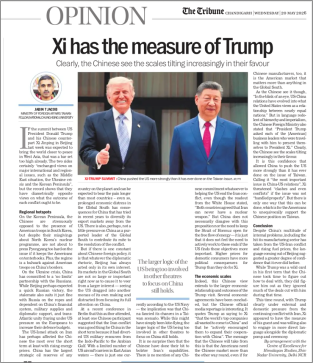
If the summit between US President Donald Trump and Communist Party of China General Secretary and Chinese President Xi Jinping in Beijing last week was expected to bring the world closer to peace in West Asia that was a bar set too high already. The two sides certainly “exchanged views on major international and regional issues, such as the Middle East situation, the Ukraine crisis, and the Korean Peninsula”[1] but the record shows that two countries also have diametrically opposite views on what the outcome of each conflict ought to be.
Regional Hotspots
On the Korean peninsula, the Chinese are strenuously opposed to the presence of American troops in South Korea but despite their misgivings about North Korea’s nuclear programme are not about to press Pyongyang too hard on the issue if it keeps the Americans on tenterhooks. Plus, the regime is a bulwark against American troops on China’s borders. On the Ukraine crisis, China has committed to a ‘no limits’ partnership with the Russians and while Beijing perhaps expected a quick Russian victory, the stalemate also suits it just fine with Russia on the ropes and dependent on China’s financial system, military supplies and diplomatic support, and trans-Atlantic unity fraying under American pressure on the Europeans to increase their defence budgets.
The US-Israel attack on Iran has perhaps affected the Chinese the most over the short-term at least with rising energy prices. China has the largest strategic oil reserves of any country on the planet and can be expected to bear the pain longer than most countries – even so, prolonged economic distress in the Global South has consequences for China that has tried in recent years to diversify its export markets away from the US. There is also, perhaps, not a little pressure on China as a purported leader of the Global South to contribute its mite to the resolution of the conflict.
But if there is one constant about Chinese foreign policy, it is that whatever the diplomatic rhetoric, Beijing has always acted only in its own self-interest. Its markets in the Global South are not so large or important right now as to cause it to veer from a larger interest – seeing the US dragged into another morass of its own making and distracted from focusing its full attention on China. At a recent conference in Berlin that this author attended, at least one Chinese participant suggested that the Iran conflict was a good thing for China in the short term because it had diverted US military resources from the Indo-Pacific to the Arabian Gulf. With a limited number of US aircraft carriers in East Asian waters – there is just one currently according to the US Navy[2] – the implication was that China fancied its chances in a Taiwan scenario. While this might have simply been kite-flying, the larger logic of the US being too involved in other theatres to focus on China still holds.
It is no surprise then that the Chinese have done their bit to bolster Iran’s capabilities.[3] There is no mention of any Chinese commitment whatsoever to helping the US end the Iran conflict even though the readout from the White House stated, “Both countries agreed that Iran can never have a nuclear weapon.”[4] But China does not necessarily disagree with this proposition nor the need to keep the Strait of Hormuz open for the free flow of energy[5] – it is just that the it does not feel the need to actively work to these ends if the US finds these objectives more important. Higher prices for domestic consumers have more political consequences for Trump than they do for Xi.
The Economic Scales
Indeed, this Chinese view extends to the larger economic relationship and outcomes of the Trump visit. Several economic agreements have been concluded[6] but the Chinese official media reportage is interesting. It quotes Trump as saying to Xi “that the world’s top companies all wanted to come to China” and that he “actively encouraged them to expand their cooperation with China”.[7] The message that the Chinese will take from this is that the Americans need the Chinese market more than the other way around even if for Chinese manufacturers, too, it is the American market that matters more than anything in the Global South.
As the Chinese see it though, “In the blink of an eye, U.S.-China relations have evolved into what the United States views as ‘a relationship between nearly equal nations’”.[8] But in language redolent of hierarchy and imperialism, the Chinese Foreign Ministry also stated that “President Trump asked each of the [American] business leaders who were traveling with him to present themselves to President Xi.”[9] Clearly, the Chinese see the scales tilting increasingly in their favour.
It is this confidence that allowed China to push the US more strongly than it has ever done on the issue of Taiwan. Calling it “the most important issue in China-U.S. relations”, Xi threatened “clashes and even conflicts” if the issue was not “handled properly”. But there is only one way that this can be done which is for the Americans to unequivocally support the Chinese position on Taiwan.
Conclusion
Whatever China’s multitude of internal problems, including the hit its manufacturing sector has taken from the US-Iran conflict and rising fuel prices, the language coming out of Beijing suggested a greater degree of confidence that it ever did before. While Trump was a wild card in his first term that the Chinese took time to figure out how to deal with, figure him out they did as they ignored much of the deals they had cut with him during that time. This time around, with Trump clearly under external and domestic pressure[10] from the continuing conflict with Iran, Xi appeared to have the measure of his guest and was willing also to engage in more direct language alongside the diplomatic pomp and ceremony.
This article was originally published in The Tribune as part of an arrangement with the Centre of Excellence for Himalayan Studies
[1] https://www.fmprc.gov.cn/eng/xw/zyxw/202605/t20260514_11910330.html
[2] https://news.usni.org/2026/05/11/usni-news-fleet-and-marine-tracker-may-11-2026
[3] https://www.tribuneindia.com/news/comment/what-us-wars-mean-for-chinas-military-ambition/
[4] https://www.whitehouse.gov/fact-sheets/2026/05/fact-sheet-president-donald-j-trump-secures-historic-deals-with-china-delivering-for-american-workers-farmers-and-industry/
[5] https://www.fmprc.gov.cn/mfa_eng/xw/fyrbt/202605/t20260515_11910982.html
[6] https://www.whitehouse.gov/fact-sheets/2026/05/fact-sheet-president-donald-j-trump-secures-historic-deals-with-china-delivering-for-american-workers-farmers-and-industry/
[7] https://paper.people.com.cn/rmrb/pc/content/202605/18/content_30157355.html. See also, https://www.washingtonpost.com/politics/2026/05/12/trump-xi-summit-economy/
[8] https://paper.people.com.cn/rmrb/pc/content/202605/18/content_30157355.html
[9] https://www.fmprc.gov.cn/eng/xw/zyxw/202605/t20260514_11910330.html
[10] https://www.reuters.com/business/aerospace-defense/stung-by-iran-war-trump-heads-china-need-wins-2026-05-12/