
Revisiting Minsar: Political Ambiguities and Lost Sovereignty
Abstract
This research paper aims to examine the historical and geopolitical trajectory of Minsar (alternatively referred to as Mensar, Menze or Mansar in various sources). It is a largely forgotten yet geopolitically significant Indian enclave in Tibet. Minsar represents a crucial chapter of Indo-Tibetan history and a significant aspect of Himalayan frontier security. Positioned along the historic Kailash–Mansarovar pilgrimage corridor, its revenues were reserved for the upkeep of sacred sites at Mount Kailash and the adjacent holy lakes of Mansarovar and Rakas Tal. Drawing upon archival revenue records and census reports, this study presents robust evidence of India’s long standing sovereign claims over Minsar. The enclave is presently under de facto Chinese control in the absence of any formal instrument of Indian renunciation. This study contends that Minsar’s strategic proximity to China’s G-219 highway, along with its cultural and religious linkages to India, necessitates renewed scholarly attention within the broader context of Himalayan territorial disputes.
Keywords: Minsar Enclave; border conflict; geopolitics; frontier; Kailash-Mansarovar Pilgrimage
India’s quest for a settled boundary with China continues to be an enduring challenge despite decades of negotiations and numerous rounds of diplomatic exchanges. The longest standing boundary dispute persisting in modern history shows minimal signs of a resolution anytime soon. The western part of Indo-China boundary consists of 37,244 sq. kilometers of desolate yet geopolitically significant territory of Aksai Chin. This barren and sparsely populated region is a major cause of conflict between the two South Asian powers.
Former Prime Minister Jawaharlal Nehru during Parliamentary debates following Chinese incursions had described Aksai Chin as a deserted expanse of land located at the height of 17,000 feet, devoid of any habitation and growth. However, these descriptions were limited only to the geographical features of Aksai Chin and by no means undermined the significance of the area. When studied within the broader context of Nehru’s views on the Himalayas, it becomes quite evident that he did not view this Himalayan space merely as a territorial claim. Rather, he perceived the region as deeply connected to India’s history, mythology, cultural traditions, and collective consciousness.
These views were further reflected in the statements of prominent leaders like Balraj Madhok and Mahavir Tyagi. Madhok pointed out, “There are so many regions like Baltistan and others where there grow no trees. Does it mean that they should be left out?’’ Echoing the same sentiment, Tyagi remarked, “No hair grows on my head. Does it mean that the head has no value?’’ (Palat 2017, 564-571). These statements are indicative of the fact that a majority of Indian leaders openly rejected the notion that geographical barrenness of high-altitude frontiers translated into their diminished strategic value. Such opinions played an important role in shaping official attitudes towards the strategic significance of distant border regions. Apart from Aksai Chin in the Ladakh region is another area that came under Chinese control in the run-up to the 1954 Panchsheel Agreement. This is the principality of Minsar in Tibet, and this article explores the history of this often-overlooked area whose control gradually slipped from India into Chinese hands.
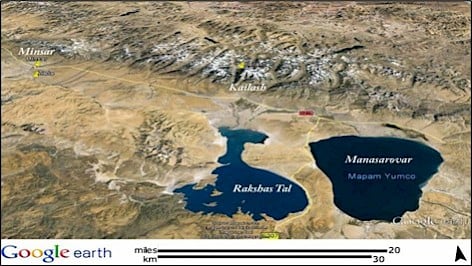
Most Indians are oblivious to the existence of Minsar, a small hamlet in present day Ngari Prefecture (Western Tibet) of Tibet Autonomous Region (TAR), 32 miles west of Mount Kailash. It shared cultural, historical, and religious ties with India for over three centuries and paid revenue to the Kashmir government (Arpi 2018). From the early 17th century, this village was under the administration of the Kingdom of Ladakh and then under the jurisdiction of Dogra rulers of Jammu and Kashmir. The revenue generated from Minsar was directed towards the maintenance of the Kailash-Mansarovar pilgrimage (Lall 1989, 113, 314; Radhu 2017, 38). At present, this Indian enclave in Tibet remains under the jurisdiction of China. This situation persists in the absence of any formal agreement between India and China which clearly indicates that India has relinquished its rights over Minsar.
Map 1
Source: https://claudearpi.blogspot.com/2015/03/what-about-minsar-indian-principality.html
This research paper is an attempt to trace India’s historical association with Minsar from the 17th century to the present. It aims at placing this region within the broader tradition of Indo-Tibetan interactions and linkages across the Himalayan region. This paper argues that Indian presence in Western Tibet was not merely rooted in territorial sovereignty, but was based on cultural ties, religious patronage, and economic rights. Drawing upon treaties, revenue records, travel reports, and local practices, this research paper explores how traditional Himalayan spaces functioned through shared authority, pilgrimage networks, and mutual arrangements which gradually got disrupted with the advent of colonial rule in the region. Revisiting India’s claim over this small principality will encourage scholars to move beyond the static notions of territorial assertions and study borders as shared spaces shaped by religion, economy, and everyday governance.
Geographical Location of Minsar
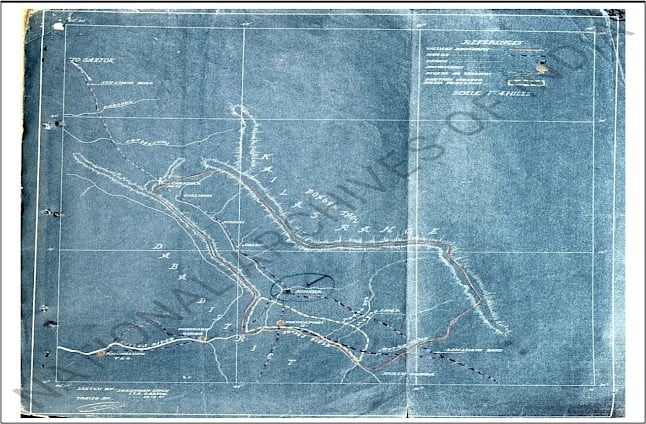
Minsar, with its vast plains and broad valleys, is located in the Ngari-khor-sum region (Western Tibet). It can be reached from Demchok, the last village on the Ladakh border, via a 10-day journey through Rudok and Gartok. This was once the traditional pilgrimage route for the Kailash-Mansarovar yatra but has remained unused due to restrictions imposed by the Chinese Government. The approximate area of the village is around 300 sq. miles. Around 68 families, comprising of 271 individuals, resided in the region. (Kalon 1950). The inhabitants were adherents of Buddhism and rearing of livestock was the main occupation of the people. The region’s economy relied primarily on the trade of sheep, wool, and pashmina. (Kalon 1950; Moorcroft 1818, 459-60).
Surrounded by Tibetan territory on all sides and located 70 miles from the nearest Indian border, Minsar was situated on the main trading route from Leh to Lhasa and was once a place of rest for Hindu and Buddhist pilgrims enroute Mount Kailash. The famous Tirathapuri monastery, a sacred site for devotees both from India and Tibet, was located 4 miles south-east of the village (Ministry of External Affairs, Government of India 1950). It was believed that any pilgrimage to Mount Kailash and Lake Mansarovar was incomplete without visiting this sacred shrine (Shakspo 2025, 107). The Tirathapuri monastery was under the control of Himi monastery in Ladakh, but this connection was lost during the Kazak raid of 1941 when the monastery was razed to the ground. The hot springs near the monastery was considered sacred and according to Hindu belief, this was the place where the demon Bhasmasur was burnt alive. (Ministry of External Affairs, Government of India 1950). Minsar was renowned for its rich pasturelands and lush valleys. It functioned as a transport supply post (Tasam), providing free transportation to Tibetan Garpons (Administrative officers of the Lhasa Government) and Ladakhi traders. Its communication with the Kashmir Durbar and India were limited due to its remote location. Officials sent by the Dogra rulers, local merchants, trade agents stationed at Gartok, and Political officer of Sikkim provided meagre yet valuable information about the region. (Ministry of External Affairs, Government of India 1950)
In stark contrast to the meagre population in the past, China’s Seventh National Population Census reveals a significant demographic expansion in the TAR from 3,002,166 in 2010 to 3,648,100 in 2020. Within this, Ngari Prefecture, one of the largest territorial regions within the TAR, also recorded a surge in population from 95,465 in 2010 to 123,281 in 2020. Despite this increase, Ngari Prefecture remains one of the least densely populated regions in the world (Younten 2024,25-7).
Figure 1
Source: File No. 10(9)-NEF/50, National Archives.
The Historical Origin of Minsar
The roots of India’s ties with Minsar can be traced back to the middle of 16th century, a period marked by significant political upheaval in Ladakh. This era witnessed the rise of a local chieftain named Bhagan of Bhasgo who overthrew the reigning ruler in Ladakh and laid the foundation of the Namgyal Dynasty that not only reshaped the political and social landscape of Ladakh but also set the stage for the region’s long-term association with Western Tibet. The rulers of this dynasty continued to exercise power until Ladakh’s conquest by Dogra General Zorawar Singh in 1834. (Stobdan 2019, 21-2; Rinchen 2019, 457). The greatest king in the history of Ladakh, Singge Namgyal popularly known as the ‘Lion King’ due to his military and leadership capabilities, also hailed from the Namgyal Dynasty. He ascended the throne after his father Jamyang Namgyal’s death in 1616. Soon after his succession, he embarked upon an expansionist policy in the neighboring areas. Between 1619 and 1630, he extended his control over the Ngari-Guge (Western Tibet) and brought the entire Western Himalayan region under his jurisdiction. By the time of his death in 1642, the kingdom had stretched from Karakoram in the north to Spiti in the south and from the border of Nepal in the east to Baltistan in the west.
The Defeat of Ladakh and Peace Treaty of Tingmosgang
Singge Namgyal’s annexation of Western Tibet met strong resentment and retaliation from the Tibetans, who referred to him as ‘rdud-rgyal’ meaning the ‘evil king’ of Ladakh. The seeds of animosity sown during Singge’s reign took deeper roots during the reign of his son and successor Deldan Namgyal when the strained relationship between Ladakh and Tibet deteriorated further. In order to safeguard his kingdom against repeated Tibetan incursions, he sought the support and protection of the Mughal Empire. In the Tibet-Ladakh War of 1679, Mughal emperor Aurangzeb extended full military assistance to the Ladakh army to counter repeated Tibetan incursions. This support was facilitated through the deployment of Mughal forces under Fidai Khan, the son of Ibrahim Khan (Mughal Governor of Kashmir). Hence, the joint Ladakhi-Mughal forces successfully averted the threat caused by the Tibetan army. (Petech 1977, 171-2; Ahmad 1963, 46)
By the time of Deldan’s demise, the Mughals gradually withdrew their support to the Ladakhi monarchy (Elverskog 2010, 223). This strategic retreat jeopardized Ladakh’s position by making it vulnerable to renewed threats from Tibet and endangering the regional balance of power. These hostile conditions prompted the Tibetan forces under the leadership of the Fifth Dalai Lama, Ngawang Lobsang Gyatso, and support from the Mongol army to launch a brutal attack on Ladakh in 1684. In response, the Ladakhi army, under the leadership of Delek Namgyal, mounted a strong defense. However, the Tibetan forces with their superior numerical and military strength successfully defeated the Ladakhis. As a result, Delek Namgyal was forced to relinquish most of Western Tibet— including Rudok, Guge, Kailash, and Burang up to the Nepal border junction— to the Tibetan authorities. Following this defeat, Tibet compelled the ruler of Ladakh to sign the Peace Treaty of Tingmosgang in 1684 (Van Walt Van Praag 1987, 13). The significance of this treaty extends beyond the territorial setbacks suffered by Ladakh. It includes the limited rights that the Ladakhi ruler was able to retain for himself. Most important among these was the continued possession of the village Monthser (Minsar) in Ngarees-khorsum. This provision formalized Ladakh’s authority over the village and elaborated that the revenue generated from the region be used for meeting the expenses incurred in the upkeep of the sacred pilgrimage to Kailash and the holy lakes of Mansarovar and Rakas Tal. This arrangement is reflected in the following clause of the 1684 Treaty:
“But the king of Ladak reserves to himself the village (or district?) of Monthser (i.e., Minsar) in Ngarees-khorsum, that he may be independent there; and he sets aside its revenue for the purpose of meeting the expense involved in keeping up the sacrificial lights at Kang-ree (i.e., Kailas), and the Holy Lakes of Manasarowar and Rakas Tal”. (Van Walt Van Praag 1987)
Dogra Conquest of Ladakh and Tibet
The loss of nearly half of its territory to Tibet undermined Ladakh’s political and economic position. The kingdom now became vulnerable to external threats and factional rivalries. Due to internal court politics, the ruler Tsepal Namgyal was neither able to stop the entry of intruders into his territory nor defend the borders, leading to a loss of territory to neighboring rulers. By the first quarter of the 19th century, the political situation of Ladakh was in disarray. In due course of time, Raja Gulab Singh of Jammu and his valiant Governor of Kishtwar, Zorawar Singh Khaluria decided to take advantage of the situation.
The period between 1834 to 1846 became crucial in Ladakh’s history; it marked the final years of the rule of Namgyal dynasty. In 1834, Raja Gulab Singh was all set to conquer Ladakh. Besides its vulnerability, Ladakh’s trade in shawl and wool also lured Raja Gulab Singh He wanted to redirect the export of shawl and wool from Ladakh, along with the produce from Western Tibet that was carried through the region towards the Indian plains via Jammu, rather than allowing them to pass through Kashmir (Datta 1984, 29; Rinchen 2019,459).
With this aim in mind, Raja Gulab Singh dispatched an expedition to Ladakh commanded by his most able general, Zorawar Singh Khaluria. The Dogra army successfully invaded Ladakh and made it a tributary to Maharaja Ranjit Singh’s empire of Lahore. Thus, from 1834, Ladakh remained technically under the authority of the Sikhs, but the actual administrative control of the region was exercised by Raja Gulab Singh. After a series of invasions post 1834, the rulers of Ladakh lost their independence completely to the Dogras by 1842.Thereafter, Raja Gulab Singh appointed Colonel Basti Ram as the Governor of Ladakh to honor him for his outstanding service and valor during the successful Dogra conquest of the region.
Meanwhile, after taking control of Ladakh, the Dogra army under General Zorawar Singh determined to achieve their vision of territorial expansion, led a military campaign towards Tibet. During the course of this conflict, the Dogras stored their war supplies in Minsar (Mehra 1992, 236). Severe weather conditions, depleting resources, and stiff resistance offered by the Tibetans posed a serious challenge for the Dogra army. The harsh Tibetan winter proved fatal for Zorawar Singh and his men, ultimately leading to his defeat and death in the Battle of To-Yo (12th December 1841).
Following the defeat of the Dogras, the Tibetans proceeded to occupy Ladakh. However, they encountered a setback near Leh due to presence of another regiment of Gulab Singh’s army. Both sides were equal in strength and achievements and hence neither of them could gain a decisive advantage over the other. Finally, the leaders of both the sides agreed to sign a non-aggression pact, promising to respect each other’s existing territory. The Treaty of Chushul signed in 1842 reaffirmed the provisions of the 1684 Tingmosgang Treaty signed between Tibet and Ladakh maintaining the status quo between the two regions.
On 16th March 1846 through the Treaty of Amritsar, Ladakh was incorporated into the Princely state of Jammu and Kashmir. From then onwards, the Maharajas of Jammu and Kashmir inherited Ladakh’s claim over Minsar and continued to collect tax from the village in accordance with the provisions of the 1684 treaty.
British and Indian attitudes towards Minsar
The first European mention of Minsar came from the writings of William Moorcroft, Superintendent of the East India Company stud and a pioneer in the field of Great Game exploration. Moorcroft passed through the area in July 1812 and recorded his observations as follows, “Minsar has only one house, made of bricks baked in the sun, and 5 tents of goatherds: it is situated upon a rising ground upon the left bank of a rapid stream, forming one of the branches of Satluj.” (Moorcroft 1818,459-60)
With characteristic commercial astuteness, Moorcroft regarded the day of his visit “as the epoch at which may be fixed the origin of a traffic which is likely to be extremely beneficial to the honorable company.” (Moorcroft 1818,459-60). As the main purpose of his journey was to procure shawl wool and explore new avenues of trade for the East India Company, he made no mention of Minsar’s traditional links with Ladakh. Although British officials were aware of the existence of this enclave, yet not much information is available about Minsar, its inhabitants or the revenue collected from the region. The Kashmir government, however, continued to send its officials for collecting revenue from Minsar. In 1853, under the governorship of Mehta Basti Ram, the revenue collected from Minsar amounted to ₹56 (Ministry of External Affairs, Government of India 1961,139) which gradually increased to ₹297 by 1905 as mentioned in the settlement report of Faqir Chand, the Wazir Wazarat of Ladakh. (Ministry of External Affairs, Government of India, 1961). The final assessment report of 1908 also mentioned Demchok and Minsar as state villages. In 1909, the settlement officer proposed the exchange of Minsar with another village located near the state frontiers. But the matter was not perused because Minsar continued to pay state revenue regularly and hence was posing no inconvenience (Mohamad 1908). Minsar also found mention in the census reports of 1911 and 1921. The latter clearly mentioned Minsar having 44 houses, 87 men and 73 women (“Census of India 1921” 1923). In 1929, Mr. Wakefield, an ICS officer who visited the region, made the following observation:
“Arriving at Minsar I was surprised to learn that the inhabitants of the district owed allegiance not to the Dalai Lama but to the Maharaja of Kashmir. Formerly, I was told, the forty families resident there had to supply eight men to the Tibetan Army, but now, being subjects of the Maharaja of Kashmir, they were exempt from this obligation, though they still had to provide free transport for Tibetan officials travelling through their territory. Every year a Ladakhi official came to Minsar to collect the tribute due to the Maharaja of Kashmir (Wakefield 1966, 60-1).
Due to the remote location of Minsar and its physical distance from Jammu and Kashmir, the officials could not visit the village regularly and assert their sovereignty. As a result, Tibetan officials also subjected the local people to a system of double taxation. They had to pay Pujjar dues to the Tibetan government which comprised of buying commodities like tea at exorbitant prices, sometimes more than double the market price. The inhabitants of the village made repeated requests to the Kashmir government for redressal of their grievances and stop this system of double taxation, which continued to remain a contentious issue for years to come. They also urged the government to station an administrative officer at Minsar for the summer months. In 1939, Dr. Kanshi Ram, the British Trade Agent, visited Minsar (Bray 1997,9). He tried to raise the issue with the Tibetan authorities and provided some relief to the local populace. In 1940s other officials of the Kashmir government Tsetan Phuntsog and Abdul Waid Radhu, a Muslim merchant also visited Minsar and through their writings offered glimpses into the political situation prevailing in the region. Radhu, in his memoirs, mentions his visit to Minsar on 29 October 1942. He briefly describes how the revenue collected from Minsar was utilized by the gyalpo (king) of Ladakh to fuel the lamps with butter in order to illuminate the sacred sites near Mount Kailash. He also briefly alluded to the persisting problem of double taxation in the region. (Radhu 2017, 38 and 49). However, soon after his visit, with the independence of India and deteriorating relationship between India and China, the geopolitical situation in the Himalayas was about to witness a dramatic shift.
Indian Independence and Aftermath
Prior to their departure, the Colonial Rulers sought to demarcate most of India’s borders across remote and desolate regions. Yet, all efforts by the colonial government to negotiate a boundary with China proved to be futile. As a result, the India-China border remained undefined. This unresolved status significantly influenced the course of bilateral relations between the two Asian nations. Disputes over distant but strategically challenging territories ultimately compromised the prospects of mutual negotiations between India and China. The responsibility of addressing unresolved boundary conflicts with China was eventually inherited by the Indian Government, under Jawaharlal Nehru from 15 August 1947.
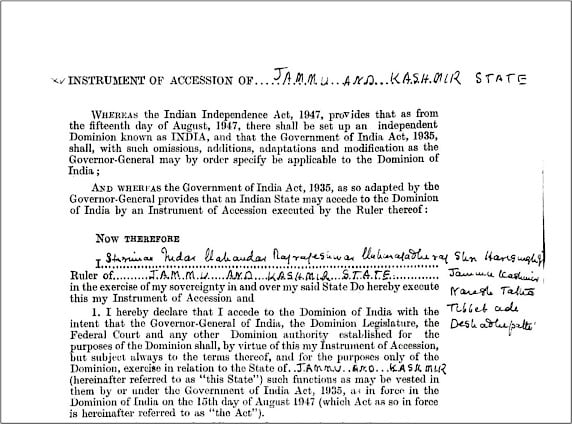
India’s independence was followed by the integration of the princely state of Jammu and Kashmir into the Indian Union. Consequently, the Instrument of Accession was signed by Maharaja Hari Singh on 26 October 1947. This enabled the Indian Government to exercise its control over the entire territory of the erstwhile princely state of Jammu and Kashmir. As stated in Section 4 of Constitution of Jammu and Kashmir (which was adopted in 1956 and came into force in 1957) the state’s territory comprises all those territories which, “on the fifteenth day of August 1947, were under the sovereignty or suzerainty of the ruler of the state.” (Stobdan 2019,198)
A careful examination of the instrument of accession of the Jammu and Kashmir state reveals that when Maharaja Hari Singh signed it, he referred to himself as, “Shriman Inder Mahinder Rajrajeswar Maharajadhiraj Shri Hari Singhji, Jammu & Kashmir Naresh Tatha Tibbet adi Deshadhipati.’’ (Stobdan 2019). The adoption of this title validated the Maharaja’s sovereignty over the princely state of Jammu and Kashmir as well as over the adjacent area of eastern Ladakh, including Aksai Chin, and some areas of Western Tibet (Enclave of Minsar) that were under his administrative jurisdiction. This arrangement clearly indicated the continuation of administrative connection between the state of Jammu and Kashmir and Minsar. It further shaped India’s inherited claims and its traditional presence in Minsar.
Reports from the revenue officials of Jammu and Kashmir (from Leh) suggest that they collected revenue from Minsar even after India’s independence and continued to do so until 1962 (Stobdan 2019, 199-200). The Government of India seemed keen to continue exercising its rights over Minsar. In a letter dated 16 December 1949 the Indian Trade Agent stationed at Gartok argued that despite the small size of the village, its meager revenue, and its remote location from the Indian territory, India should not give up its claims to Minsar due to its geostrategic significance of providing a foothold in Tibet. He suggested that the Government of India should take over the possession of this village from the Kashmir Government and use it as a base to monitor communist activities in Western Tibet. (Ministry of External Affairs, Government of India 1950)
Figure 2
Source: Instrument of Accession, File No. P-I/20/47
In 1950, the Kashmir government deputed a civil officer, Mr. N. Rigzen Ghagil Kalon to visit Minsar along with an armed escort. However, he reported back that the Tibetan government had imposed restrictions on armed people entering its territories. Therefore, he proceeded to Rudok without the police escort taking along with him only a few unarmed constables in civil dress. During his visit he interacted with a few Garhwali traders who were in favor of his visit. The local people presented their grievances against the Jammu and Kashmir government before him. The villagers were disappointed that despite multiple pleas, no help was offered to them from the Kashmir government after the Kazak raids had ravaged the entire village in 1941. Besides, they were constantly troubled by the system of double taxation and demands of free transportation by the Tibetan officials. Kalon urged the government to take adequate measures to alleviate the miseries of the local population. This visit took place just a few months before the takeover of Tibet by People’s Republic of China that changed the geo-political landscape of the area for decades to come. Minsar continued to remain under Indian jurisdiction till the mid-1950s.
In 1954, Kushok Bakula Rinpoche, a minister in the Jammu & Kashmir government, visited Minsar enroute his spiritual journey to Mount Kailash. It was a tumultuous time when Chinese military presence in Tibet was quite evident. Rinpoche recalled that the people of Minsar requested him for help to merge their land with India. He expressed concern that during those days the region was infested with bandits. Yet, the local residents came bearing khadag (white ceremonial scarves) and extended a warm welcome to him. Some of the residents requested Rinpoche to impart his teachings following which many of them surrendered their arms and vowed not to resort to criminal activities in the future.[i] (Shakspo 2025, 106-9)
Until mid-1950s, India’s diplomatic relations with China appeared to be harmonious. The slogan Hindi-Chini Bhai-Bhai gained popularity amongst the masses and reflected the strong friendship between the two nations. The highlight during this period was the signing of the Panchsheel Agreement in 1954 which elaborated on five guiding principles of peaceful coexistence, namely mutual respect for sovereignty and territorial integrity, non-aggression, non-interference in internal affairs, equality and mutual benefit, and peaceful coexistence. Together, these ideals reflected an optimistic vision for stronger bilateral ties between India and China. It is important to note that prior to the signing of the Panchsheel Agreement at the 1954 Beijing Conference, the issue of Minsar was brought to the attention of the then Prime Minister Jawaharlal Nehru. He addressed the matter with the Indian representatives appointed for the Conference.
The following are Nehru’s directives and stand on the issue:
Regarding the village of Minsar in Western Tibet, which has belonged to the Kashmir State, it is clear that we shall have to give it up, if this question is raised. We need not raise it. If it is raised, we should say that we recognize the strength of the Chinese contention and we are prepared to consider it and recommend it. But the matter will have to be referred to the Kashmir Government. It can of course be referred to by telegram through us. The point is that we should not come to a final agreement without gaining the formal assent of the Kashmir Government. (Gopal 1999, 599)
Although the Indian Government was well aware of the strategic significance of Minsar for providing a foothold in Tibet, there appears to be no clear conclusion about India’s decision of retaining or renouncing all claims over Minsar before the Beijing conference. In this context, an observation was made by renowned Tibetologist, Claude Arpi in his articles, One Country Which Has Not Been Nice (2016) and Little Bhutan in Tibet (2017), wherein he analyses India’s relinquishment of rights over Minsar as a deliberate ‘gesture of goodwill’ of former Prime Minister, Jawaharlal Nehru towards Communist China. He points out that despite being fully aware of Kashmir’s suzerainty over Minsar, Prime Minister Nehru intentionally surrendered the village of Minsar to China. Arpi further remarks that Nehru was driven by a utopian commitment to establish peaceful coexistence with China, placing excessive faith on the success of the Panchsheel Agreement. This unwavering faith in China, he opines, ultimately undermined India's strategic interests. In his view, Nehru’s actions can be interpreted not merely as a diplomatic failure but futile attempts to negotiate firmly with China. (Arpi 2016)
Another development in the diplomatic exchange between India and China concerning Minsar occurred between 1959-60. This was a crucial juncture in the relationship between the two nations, as events involving the roof of the world (Tibet) became crucial. Tensions escalated in March 1959, when the 14th Dalai Lama was granted refuge in India, after the suppression of the Tibetan uprising in 1959 by the Chinese government. This contributed to the deterioration of relationship between India and China. The Indian intervention and extension of political asylum to the Dalai Lama was seen as a breach of the Panchsheel agreement by the People’s Republic of China. Amidst prevalent contentions, Chinese Premier, Zhou Enlai visited India in 1960.In light of this visit, the issue of Minsar, historically associated with administrative presence of the Kashmir Government in Western Tibet, surfaced as part of the broader bilateral talks on territorial claims over unsettled boundaries. The following excerpt highlights Indian government’s position over Minsar in the bilateral talks between Indian Prime Minister and the Chinese Premier.
To S. Dutt: Minsar
I agree that we should not write to the Chinese Government about Minsar at this stage. But in view of recent developments, I do not think it will be right for us to give up our right to Minsar in theory, even though de facto it is not exercised. When we discuss the general question of eastern Ladakh and Chinese incursions there, we should certainly mention Minsar and its past history. This is important in itself but much more so because it brings out more clearly India's claim to eastern Ladakh. If the J&K Government (that means India) had a treaty right to Minsar, there is some justification for stating that our territories extend to where we show them. A separate paper might be kept dealing with Minsar for our talks with Premier Chou Enlai. (Palat 306)
On 22 April 1960, Prime Minister Nehru discussed India’s historical claims over the principality of Minsar in Tibet with Chinese Premier Zhou Enlai. In the conversation that followed, Nehru highlighted India’s control over Ladakh, citing records of surveys and revenue collection in the region. He mentioned Minsar, an isolated Tibetan village, as a relic of old treaties, where Kashmir officials regularly collected revenue, viewing it as evidence of enduring Indian sovereignty over this enclave under old treaties. Nehru upheld India’s territorial integrity in this matter. He maintained that he is making no new claims but defending established boundaries, proposing evidence-based resolution of disputes, especially on India’s traditional claims over Minsar. Even after such a vocal stance made over India’s position regarding Minsar, the diplomatic talk over the matter reached no substantial end.
In the decades following the 1960s, the focus of India‑China engagement increasingly shifted towards broader concerns. This included demarcation of borders, maintaining strategic stability along them, and later, the expansion of bilateral trade. Within this evolving diplomatic framework, the question of Minsar assumed a marginal position. Although its historical and legal status remained unclear, it was overshadowed by larger territorial disputes and strategic concerns of both nations. Ultimately, Minsar’s status was ‘reduced to a minor footnote in history’ which to this day remains unresolved and awaits clarification (Bray 1997: 97).
Conclusion
The legacy of Dogra jurisdiction and claim over Minsar highlights a forgotten chapter in the history of the region that continues to be overlooked in contemporary geopolitical discourse. Minsar has been intrinsically linked to India through historical, cultural, and religious ties for more than three centuries. Its proximity to Mount Kailash which is a sacred place for Hindus and Buddhist alike greatly enhances the cultural significance of the region. However, in the years following independence, the Government of India never formally staked its claim on the region in its bilateral discussions with China, thereby unilaterally relinquishing its rights over Minsar. Minsar, situated on China’s G219 highway, which links Xinjiang and Tibet, underscores its contemporary strategic relevance. With minimal resistance from India, China has continuously been expanding its territorial and diplomatic foothold in the region. In order to counter the expansionist designs of China in the region, there is an urgent need for India to recalibrate its diplomatic strategy in the region.
Minsar has never been a matter of diplomatic engagement and negotiations since 1960. Nehru clearly instructed the Indian negotiators not to raise the issue of Minsar unless brought up by the Chinese and this clearly illustrates India’s diplomatic miscalculation towards the Minsar issue. The members of Parliament from Ladakh have repeatedly sought clarification over the formal status of Minsar village since 1982 (Stobdan 2019). More recently, in December 2023, the MP of Ladakh, Jamyang Tsering Namgyal in his speech in the Lok Sabha raised the issue of the traditional rights of Ladakh in Minsar. Yet, till date no satisfactory response on the issue has been provided by the Government.[ii]There is an urgent need to revisit the issue of Minsar in academic discourse. India’s lost claim over this small yet significant principality needs to be brought into focus.
ENDNOTE
[i]This incident was narrated to the author of Rinpoche’s biography (Sonam Wangchuk Shakspo) by Sonam Gyaltsan Khangsar who accompanied Rinpoche on this trip as his liaison officer.
[ii] see former Ladakh MP Jamyang Namgyal’s speech at https://www.youtube.com/watch?v=VcRpz3c1qEU
REFERENCES
Ahmad, Zahiruddin. 1963. ‘Tibet and Ladakh: A History.’ Far Eastern Affairs, 3, 23–58.
Arpi, Claude. 2004. ‘Born in Sin: The Panchsheel Agreement - The Sacrifice of Tibet.’ New Delhi: Mittal Publications.
Arpi, Claude. 2016. ‘One Country’ which has not been nice. Claude Arpi’s Blog. 30 June.https://claudearpi.blogspot.com/2016/06/one-country-which-has-not-been-nice.html
Arpi, Claude. 2019. ‘China celebrates its Republic Day in Minsar, the Indian village in Tibet’. Claude Arpi's Blog. 6 October.
https://claudearpi.blogspot.com/2019/10/china-celebrates-its-republic-day-in.html
Bansal, Alok and Ayushi Ketkar (Eds) 2019. Geopolitics of Himalayan Region. New Delhi: Pentagon Press.
Bray, John. 1997. ‘Ladakhi and Bhutanese Enclaves in Tibet’. Recent Research on Ladakh, 7, 89-104.
Datta, Chaman Lal. 1973. Ladakh and Western Himalayan Politics: 1819–1848: the Dogra Conquest of Ladakh, Baltistan and West Tibet and Reactions of Other Powers. New Delhi: Munshiram Manohar Lal Publishers.
Datta, Chaman Lal. 1984. General Zorawar Singh: His Life and Achievements in Ladakh, Baltistan and Tibet. New Delhi: Deep & Deep Publication.
Dolma, Rinchen. 2019. ‘The Early Years of the Dogra Conquest of Ladakh (1834–1846)’. Proceedings of the Indian History Congress, 79(2018–2019), 457–465. https://www.jstor.org/stable/26906279
Elverskog, Johan. 2011. Buddhism and Islam on the Silk Road. Pennsylvania: University of Pennsylvania Press.
Fisher, Margret W., Leo E. Rose, and Robert A. Huttenback. 1963. Himalayan battleground: Sino-Indian rivalry in Ladakh. New York: Frederick A. Praeger, Inc.
Galwan, Ghulam Rassul. 1923. Servant of Sahibs. Cambridge: W. Heffer & Sons Ltd.
Kaul, Hriday Nath. 2003. India China Boundary in Kashmir. New Delhi: Gyan Publishing House.
Lall, John. 1989. Aksai Chin and Sino-Indian Conflict. New Delhi: Allied Publishers.
Mehra, Parshotam. 1992. An "agreed" Frontier: Ladakh and India's Northernmost Borders 1846–1947. New Delhi: Oxford University Press.
Mohammed, Chaudhri Khushi.1908. ‘Preliminary Report of Ladakh Settlement by Settlement Officer Ladakh’. Jammu: Ranbir Prakash Press.
Mohammed, Chaudhri Khushi. 1923. ‘Census of India 1921’. Volume XXII (Part II-232). Lahore: Mufidiam Press.
Palat, Madhavan. K. (Ed.). 2017. Selected Works of Jawaharlal Nehru (Second Series) (Vol. 73). New Delhi: Jawaharlal Nehru Memorial Fund.
Petech, Luciano. 1977. The Kingdom of Ladakh C.950–1842 A.D. Italy: ROMA, Tipografis Don Bosco.
Praag, Michael. 1987. The Status of Tibet: History, Rights and Prospects in International Law. Boulder, Colorado: Westview Press.
Radhu, Abdul Wahid. 2017. Tibetan caravans: Journeys from Leh to Lhasa. New Delhi: Speaking Tiger Books.
Shakspo, Sonam Wangchuk. 2025. Kushok Bakula Rinpoche: The Architect of Modern Ladakh: Life and Times. New Delhi: Pentagon Press LLP.
Stobdan, Phunchok. 2019. The Great Game in the Buddhist Himalayas: India and China’s Quest for Strategic Dominance’. Penguin Random House India.
Wakefield, Edward. 1966. ‘Past Imperative- My Life in India 1927–1947.’ London: Chatto & Windus.
Wakefield, Edward. 1961. ‘A Journey to Western Tibet, 1929’. The Alpine Journal, 66(2), 325-42.
Younten T. (2024). ‘China's Population Invasion of Tibet: A Comprehensive Demographic and Strategic Analysis of Tibet and Tibetan Population Based on Chinese Official Censuses 2020–2023 (14)’.
https://indiafoundation.in/wp-content/uploads/2024/11/Monograph-14-Tenzin-Younten-Chinas-Population-Invasion-of-Tibet-26-Nov-2024-vin-final.pdf
About the Authors:
Ms. Alaknanda Mahajan is a UGC-NET, JRF qualified Ph.D. scholar at the Department of History, University of Jammu. She is currently working on her PhD entitled “British Policy towards the North-West Frontier with Special Reference to the Princely State of Jammu and Kashmir (Mid 19th -20th Century).’’ Her research interests encompass colonial cartography, border making, British policies in the North-West frontier region and the erstwhile princely state of Jammu and Kashmir. She can be reached at [email protected].
Ms. Manvika Bamba is a UGC-NET, JRF qualified Ph.D. research scholar at the Department of History, University of Jammu. Her research interests include border-making, colonial cartography and geopolitics with a special focus on the Indo-China boundary question. Her ongoing PhD research attempts to examine the making of the India-China border focusing on the complexities in the western sector and their geopolitical implications during the period 1834–1962. She can be reached at [email protected].