
Local Response to National Projects: The Siang Hydropower Project in Arunachal Pradesh
Abstract
The opposition to hydropower projects in Arunachal has been as old as the first launch of such mega projects. In most cases, people are not resisting the project per se but the denial of their indigenous right as the first party who will be directly affected, and hence, should be at the negotiation table. However, when such land is integral to their identity, religion and subsistence, indigenous communities have altogether refused any negotiations. Opposition to the Siang Upper Multipurpose Project (SUMP), being led by the Siang Indigenous Farmer’s Forum presents unique glimpse to these complex realities. Adi villagers, elders, and student leaders from four districts are voicing strong opposition to the state-backed SUMP, which threatens to submerge ancestral lands and disrupt cultural continuity. What is unique are their methods and approach of protest. By invoking traditional laws, kinship networks, and spiritual relationships with the land, river and forest, the Adi community reclaims their rights and self-determination. It shows how indigenous communities draw upon their local resources and ancient traditions to make sense of their methods of protests and find legitimacy against state power.
Keywords: indigenous resistance; customary governance; hydropower projects; Siang river; Adi community; environmental justice
On 20 August 2025, the Bogung Bokang Kebang was held at Geku village in Siang district to discuss the proposed Siang Hydropower Dam Project. Hundreds of Adi[i] villagers across four districts gathered. The kebang is a traditional governing council where all village members democratically participate, deliberate on issues and take collective actions. Like in all communities of Arunachal, it is led by village elders with their virtue on customary knowledge and wisdom. For Adis, there are three tiers of councils, each village have their own Kebang or council called the Dolung Kebang, for impending matters affecting the entire village. However, during British period the community had to re-organise itself into two more levels of council in order to resist British interventions. For inter-village matters, the council of many villages is called the Bango Kebang (Panyang, 2018). When it comes to Bogung Bokang Kebang, this means the subject that affects the entire Adi community across all the Adi groups in four districts. People remember the last time this Bogung Bokang Kebang was called was in 2000 when there was a major intercommunity conflict.
This time it was the Siang Indigenous Farmer’s Forum, the organization which is leading the agitation against Siang Upper Multipurpose Project (SUMP), who called for the Bogung Bokang Kebang. The meeting was attended by Adi Student Union, the apex body of student unions of all Adi students, the Gaon Buras who are government appointed community elders to deal with village level matters, community leaders and elders, the former Chief Minister Gegong Apang and most importantly representatives from apex institutions from other communities as well. The communities had to fall back on their traditional means and methods to resist against the large-scale national projects like the hydropower projects which are being vehemently backed by the state government. When their land, heritage, and identity is at threat people are left with no options, and indigenous communities have resorted to indigenous means of resistance – invoking their ties with kins and friends, and spirits and gods.
Damming Arunachal
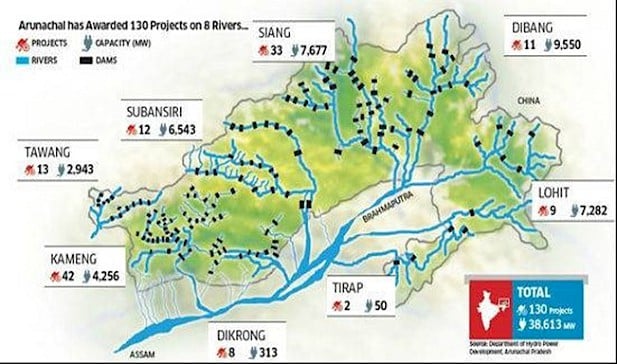
Arunachal Pradesh has eight major river basins – Kameng river, Tawang river, Subansiri river, Siang river, Dibang river, Tirap river and Lohit river, alongside several other tributaries. These rivers are part of the local lores and living traditions of some 25 major tribes and more than a hundred sub-tribes. Many tribes have their lineage and migration oral traditions associated with these rivers – how one brother crossed the river, another settled on one side, and yet another group kept moving downstream to find a shallow point to cross over and settle. Many clans, villages and tribes were born along this path never forgetting their ancient memories of rivers, mountains and journeys. Since time unknown, these memories are archived in their oral traditions.
With concerns of perennial flooding of Brahmaputra river in upper Assam, the first proposal for building of a dam on the Subansiri tributary at Gerukamukh was envisaged by the Brahmaputra Flood Control Commission under Assam government in 1955 (Saikia, 2019). However, it was only in 1982, when the concrete proposal for projects of reservoir dams on the Subansiri and Siang with potential for producing electricity were put forth by the reconstituted Brahmaputra Board, a central body, the Brahmaputra Board was created as the sole authority to handle floods as a national problem (Saikia, 2019). As the proposals could not attract investments, opposition over land submergence and ecological impacts came up particularly from the then Arunachal Chief Minister, Gegong Apang. As a result, several small and micro hydropower projects in cascading mode were commissioned such as the two micro hydel stations in Tafragam (250KW each), four micro hydel stations in Doorah Nallah (100KW each) that were built in the then Lohit district in the mid-1980s, and the three Tato small hydel projects (1,500KW each) to supply power for local needs.[ii]
However, in 2003, under the 12th Five Year Plan, the central government announced that the 50,000MW hydropower potential of Arunachal would be harnessed. The state government began granting concessions to a range of developers,[iii] from large private sector power companies like Jindal Power Ltd., Reliance Power, Jai Prakash, KSK Energy, to many smaller self-identified private firms with no experience in hydropower projects but wanting to own dams or to transfer their contract to the next buyer for quick profits (Mishra, 2013; Rajshekhar, 2016). Between 2005 and 2012, the Arunachal Pradesh government is reported to have collected Rs.1,333 crores for 199 projects as upfront premium and processing fees (Arpi, 2012). However, most of the projects are still awaiting public hearings and environmental clearances to begin construction.
It is important to note that, over the period more and more MoUs have been signed and hence there is no clarity on the exact number of projects (see Figure 1).[iv] According to the Dossier for Ease Of Doing Business created by Investment Division, Government of Arunachal Pradesh (GoAP), a total of 188 Hydropower Projects were identified as investible, of which more than 60 projects are listed as ready for investments (Investment Division, GoAP, 2021). The current government is putting all efforts into attracting investors. The Dossier mentions that the topography with mountainous deep valleys of the state is ideal for the development of Hydro Electric Projects. Apart from several other incentives, the GoAP, promises fast clearances through a single window system for clearing five mandatory NOCs within 45 days, and six mandatory statutory clearances including Ministry of Home Affairs, Ministry of Defence, Forest Clearance, Techno Economic Clearance, within 12 months.
Indigenous Claims: Anti-Dam Agitations in the Siang Valley
Plans for mega dams have been opposed by those affected in downstream Assam. For instance, Rahman (2014) notes the impact of the Ranganadi Hydroelectric Project (405MW) based in Arunachal, which is claimed to be a ‘run-of-the-river’ project – the Ranganadi river water volume has drastically reduced, and silt accumulation, occasional flash floods and increase in the riverbed of the Brahmaputra are major issues. In Arunachal, at the core of these agitations is the question of why the owners of the land, that is the communities themselves, were not consulted or were not made part of the decision-making process when such plans were being conceived; why they were not at the negotiation table as the main party (Ete, 2014; Rahman, 2014). The 2,000 MW Lower Subansiri and 3,000MW Dibang Multipurpose dams were the first to face resistance, and in both the cases, direct negotiations took place between the companies and the communities. Similar direct negotiations were carried for the Etalin Hydroelectric Projects in Dibang valley, where now the dams will be built on the tributaries of Dibang – the Dri and Tangon rivers. Behind the scene were the sustained efforts by the local government and local politicians to broker negotiations and build pressures by pulling the threads of traditional alliances and political ties.
In the Siang protest, unlike in Dibang and Lower Subansiri, the human impact is expected to be wider and more severe. The SUMP was initially planned as two smaller projects – Siang Upper Stage-I (6,000 MW) and Stage-II (3,750 MW) with the MoU signed in 2013. On 26 September 2017, the plan changed after the Chief Minister Pema Khandu and state delegates met with the Niti Aayog think-tank. The revised proposal is to build a single 250-meter-high large project with more capacity (11,200 MW) but at 25 per cent lesser cost (Saikia, 2017). As of now, the SUMP will be the highest capacity dam in the country. The proposed site is being considered either at Ugeng, Dite Dime or Parong. Parong is likely to be avoided because of the Advanced Landing Ground in Tuting. It is feared that this will submerge 27 villages while 43 more villages are likely to be affected, directly or indirectly (Sirur, 2025).
The villages settled along the Siang belt comprise of some of the oldest Adi villages, such as the Riga village, for example. The Riga village is rich in local histories, hallmarks of traditional architecture, and organized cultural spaces. Several Adi clans and groups trace their origin from these ancestral villages. Thanks to its fertile soil, good water sources, and hardworking community, the villages along the river have sustained themselves since time unknown, and flourished further when government introduced developmental activities here.
Unlike in the Lohit, Dibang or Subansiri belts, in the Siang belt, the villages are densely populated and its land is under intensive cultivation. Travelling through, one can see many makeshift platforms on roadsides in the middle of dense jungles and hills, where womenfolk from villages located somewhere ‘uphill’ or ‘downhill’ bring fruits, roots, seeds, vegetables, crafts, meats, and several local herbs to sell to passing travellers. Hills are carefully carved into terraced rice fields, jhum plots and orchards producing oranges and pineapples earning around Rs.4-7 lakhs annually for each farmer.[v] According to SIFF members, the 27 villages that are going to be directly affected are where the core ‘lifeline’ of the people exists. They also spoke about the betrayal by local leaders who changed their position post-elections, about proxy meetings by dam supporters, the stationing of armed military forces in their villages, and of development meetings for ‘new villages and locations’ where displaced people would be rehabilitated. One of the interviewee asked, “Every inch of our land and territories is marked, and traditional boundaries of each community are already established; if we are to leave this land, where will they settle us? Who will give us their land? Aren’t we going to become refugees in their land?”[vi]
Local communities are clear about their interests – they are not motivated by the lofty ideas of environmental or ecological concerns of preserving forests and wildlife. Rather, they are clear about their own survival first, a life with dignity, identity, social relations, traditions and their rights as the owners of their territory with all the resources on it (Chowdhury and Kipgen, 2013). Neither are they swayed by the government’s argument of revenue generation for the state nor buying into the phobia of security threats due to China’s Medong dam project on the same river in Tibet (The Hindu, 2025). Far away from narratives of tribal resistance against environmental disaster, people are actually fighting for their own survival, survival of their social and community integrity, their autonomy (Deka, 2025) and control over their own lives.
In the Bogum Bokang Kebang meeting held on 20 August 2025, people invoked their sacred relation to their Ane Siang (mother Siang), and wrote in their meeting minutes stating that the sacred significance of Ane Siang was similar to that of the Ganga or the Yamuna rivers for the Hindu culture of north India (Arunachal Times, 2025). Such analogies became necessary to communicate to the people of other cultures to express how they feel, and what it means to them.
The protesting community members had to find and rely on their own traditional means and methods to communicate to the people within their culture to mark their dissent. The villages organized Rafbung rituals, invoking spirits of forests and mountains to curse those families who have signed the consent documents that are going to destroy their hills and rivers. When drilling machines for the survey and investigation were secretly brought in at night and security forces were stationed to guard the area, the villagers surrounded and blocked the areas, and performed cleansing rituals invoking spirits of the place to cause malfunctioning of the machines. One village cut off its traditional rope bridge which was their lifeline, so that armed forces and machines could not come to their side of the village. In some places, groups of elderly women sang Ponung songs[vii] to call upon men to join the protest during the festivals. These women, young and old, were always at the forefront of the protests despite several gendered contestations. These methods and means might not make sense to outsiders or might not appear like a serious threat or resistance, but they are coherent within the worldview and cosmology of the community itself. They are using their own capacity to protest and assert themselves against state power. These protests are symbolic demonstrations of their deepest will.
On the other hand, the presence of independent and decentralized media, social media and mobile cameras covering every instance is something new, possible only now due to access to digital technology.[viii] There are local news channels which are covering and using videos taken with mobile cameras to report. There are several local vloggers and individuals or groups with accounts in YouTube, Facebook and Instagram who cover their personal everyday life in the interior villages. But now as their villages and lives get engulfed, they cannot help but become involved. There are some who now have a dedicated mission to use their own unique approaches to deal with these developments in the villages and in their community (Anbo, 2025; Tatung, 2026; Moyong, 2026).
With villages, communities and families getting divided and broken between those who are protesting and those who are supporting the dam project, there are videos documenting these divides and everyday tensions, shared and intensely debated on Facebook forums (Rahman, 2014). One pro-dam farmer, recorded a video showing his dried terrace field where he had just transplanted paddy saplings. The water supply to his fields had been cut by the anti-dam majority villagers. Another video showing an anti-dam villager painfully confronting and urging his pro-dam fellow villager, “How could you betray us? How could you be so selfish? How could you agree to let our villages be flooded? Why?” Meanwhile, there has been an increasing use of security forces against the protestors by local administrators in the region citing internal security, creating more tension and affecting the perceptions among the locals about government intentions.
Conclusion
The Arunachal Pradesh government has been touting the project as a necessary measure against China’s ‘water bomb’ (The Hindu, 2025). The question is, will India behave like China, and engage in this competitive dam-building war? Will India risk the decades of efforts it had put in trust- and loyalty-building in the region?
All occasions of gatherings, festivals, marriages, and so on, are today being used intensely by both anti-dam and pro-dam groups to gain support for their respective cause. Development efforts have begun dividing communities and creating deep polarization. Brothers, families, clans and villages are turning against each other – a crack that will take time to bridge, and will cost too much to recover from. The indigenous tribal communities in Arunachal Pradesh are oral communities. Irrespective of the outcomes, this entire period will be archived in their oral narratives and traditions, people will neither forget nor forgive. Names will be named, and curses once set in motion will have to be suffered by all the generations to come.
ENDNOTES
[i] Adis are one of the major tribes in Arunachal with 14 sub-groups based on lineage, migration, language and territories. Each group might have multiple clans and sub-clans. The traditional villages belong to multiple clans. For more details on Adi social organization, traditional councils and impact of modern governance systems see Mibang (2018).
[ii] For more background on various hydropower projects across Arunachal, see Down To Earth, 2012)
[iii] For detailed reporting on politics and corruption on Hydro Electric Projects allocations in Arunachal read four-part investigative series by M. Rajshekhar for The Economic Times (Rajashekhar, 2013)
[iv] In the State Mega Hydro Power Policy 2008, 135 Hydro Electric Projects are listed out in Arunachal Pradesh State Electricity Regulatory Commission. (n.d.). According to M. Rajshekhar’s report by March 2013, 153 projects are awarded (Rajshekhar, 2016). According to Mishra (2019) nearly 160 MoUs were signed. According to Pardikar (2020) as per the data collated from the MoEFCC website, 169 Hydro Electric Projects are proposed to be built and 20 projects are to be dropped.
[v] Interview with SIFF leaders at Bolleng village in July 2025.
[vi] Interview with SIFF leader at Bolleng village in July 2025.
[vii] These are sung during festivals and special occasions – of blessings, historical narrations, folk stories, or sacred rituals, and sometimes impromptu or just for fun.
[viii] For more critical and comparative analysis of print media coverage on the SUMP dam see, Doley (2025)
REFERENCES
Anbo, Aborman. (2025). Facebook Reels. https://www.facebook.com/reel/770590678902523
Arpi, C. (2012, April 30). 'Dam is Money'. Claude Arpi's Blog. https://claudearpi.blogspot.com/2012/04/with-northeast-identified-as-indias.html
Arunachal Pradesh State Electricity Regulatory Commission. (n.d.). ‘State Mega Hydro Power Policy’. https://apserc.nic.in/pdf/State-Mega-Hydro-Power-Policy-2008.pdf
Arunachal Times. (2025, August 22). 'General Bogum Bokang Kebang rejects SUMP, mega projects on Siang'. https://arunachaltimes.in/index.php/2025/08/22/general-bogum-bokang-kebang-rejects-sump-mega-projects-on-siang/
Chowdhury, A., and Kipgen, N. (2013). 'Deluge amidst conflict: Hydropower development and displacement in the North-east region of India'. Progress in Development Studies, 195-208.
Deka, B. J. (2025). 'The dam will not collapse but the surrounding hills will: Resisting hydropower dams in the Siang valley of Arunachal Pradesh, India'. Indian Ethnicity, 1-22.
Doley, P. (2025). 'Framing development and resistance: A content analysis of media narratives on the Siang Upper Multipurpose Dam'. South Asian Journal of Social Sciences and Humanities, 5-68.
Down To Earth. (2012, Jan 05). 'Reservoir of dams'. https://www.downtoearth.org.in/environment/reservoir-of-dams-4538
Ete, M. (2014, November 14). 'India: Hydropower in Arunachal Pradesh'. Heinrich Boll Stiftung. https://www.boell.de/en/2014/11/14/hydropower-arunachal-pradesh
Investment Division, GoAP. (2021). 'Arunachal Pradesh: "India's Hydropower Hub"'. Ease of Doing Business, Government of Arunachal Pradesh. https://eodb.arunachal.gov.in/investment/hydropower.php
Kaming, P. (2018). 'Democratic Decentralization in Arunachal Pradesh: A case study of Kebang system'. International Journal of Applied Social Science, 283-291.
Mibang, T. (2018). 'Impact of Panchayati Raj System on traditional systems of Governance: A study of Kebang system of the Adis'. International Journal of Applied Social Science, 1058-1064.
Mishra, D. K. (2019). 'Himalayan "Hydro-Criminality"? Dams, development and politics in Arunachal Pradesh, India'. In Barbara Harriss-White and Lucia Michelutti (eds.) The Wild East: Criminal Political Economies in South Asia. UCL Press. 115-139.
Moyong, Katon. (2026). 'Press Conference by Siang Indigenous Farmers Forum Youths Win', 19 March.
https://www.youtube.com/watch?v=YgPADgsfU3U
Pardikar, R. (2020, April 7). 'Arunachal Pradesh poised to restart dam building spree'. Dialogue Earth. https://dialogue.earth/en/water/arunachal-pradesh-dam-2/
Rahman, Mirza Zulfiqur (2014, June). 'Territory, Tribes, Turbine: Local community perceptions and responses to infrastructure development along the Sino-Indian border in Arunachal Pradesh'. Occasional Paper No.7. Institute of Chinese Studies.
Rajashekhar, M. (2013, April 30). 'Hydelgate: Why Arunachal Pradesh's hydel boom is going bust'. The Economic Times https://economictimes.indiatimes.com/industry/energy/power/hydelgate-why-arunachal-pradeshs-hydel-boom-is-going-bust/articleshow/19790466.cms
Rajshekhar, M. (2016). 'The mess in Arunachal Pradesh that no one is talking about'. Scroll.in https://scroll.in/article/802708/why-private-companies-want-to-give-their-hydel-projects-in-arunachal-to-nhpc
Saikia, A. (2017, October 18). 'The Centre’s proposal to build a mega dam in Arunachal Pradesh makes even hydropower companies wary'. Scroll.in.
Saikia, A. (2019, December 04). 'Subansiri dam will produce costly power and won’t control Assam floods. Why is it still being built?' Scroll.in.
Sirur, S. (2025, April 18). 'Caught between a dam and a hard place'. Mongabay. https://india.mongabay.com/2025/04/caught-between-a-dam-and-a-hard-place/
Tatung, Omeng. (2026). 'Breaking News:17 March 2026 Gosang, Ramsing & Pangkang Village Baane Kebang #No Dam, No Survey Over Si', 17 March.
https://www.youtube.com/watch?v=wYxfTkiTypg
The Hindu. (2025, August 03). 'Stop selling China mega dam bogey to push Siang project: Arunachal Pradesh activists to Centre'. https://www.thehindu.com/news/national/arunachal-pradesh/stop-selling-china-mega-dam-bogey-to-push-siang-project-arunachal-pradesh-activists-to-centre/article69889852.ece
About the Author: Dr. Tadu Rimi is former a Post-Doctoral Fellow at the Centre of Excellence for Himalayan Studies. A trained social worker and social scientist, she holds a doctorate from the Tata Institute of Social Sciences, Mumbai, and the Council for Social Development, Hyderabad. She specialises in tribal studies, oral history, and women’s studies in Northeast India and was also a Post-Doctoral Fellow at The M.S. Merian – R. Tagore International Centre of Advanced Studies ‘Metamorphoses of the Political’ (ICAS:MP). Dr. Tadu has conducted extensive fieldwork across the region, including the audio and video documentation of oral histories, with a focus on community history, historical events from popular and local perspectives, and preserving indigenous knowledge systems.