How China sees the Iran War: Beyond State Messaging
Abstract
This article examines how China interprets the Iran war by moving beyond formal diplomatic statements to analyse Party-state media, commercial commentary, self-media, and state media hosted hashtags on social media. It asks how the Chinese strategic and policy community is framing the Iran war for the domestic audience and external messaging. The analysis identifies four dominant themes: condemnation of US and Israeli actions as unlawful hegemonism; scepticism about any quick victory over Iran; emphasis on the conflict’s geopolitical and geoeconomic implications for China; and lessons for China’s future strategy under intensifying great-power competition. The article argues that Chinese narratives portray China as a restrained, responsible, and potentially mediating power while framing the United States as a destabilising actor. At the same time, it shows important tensions between China’s professed support for multilateralism and the stronger nationalist discourse stressing self-reliance, hard power, social cohesion, and preparation for a more conflictual international order, internally.
Keywords: China; Iran; Middle East; US; Israel; Media; Narratives; Foreign Policy
The escalating conflict in the Middle East, sparked by US and Israeli strikes on Iran, has drawn wide attention in China, underlining the country’s strategic ties to Iran and the broader geopolitical and economic stakes in the region. In this context, we ask the following questions. What is China’s diplomatic posture on the Iran War? How are Chinese analysts viewing the situation? What is their assessment of implications for China and the global order? And what are the popular narratives on social media platforms?
While China’s foreign policy is the remit of its top leadership, and the Ministry of Foreign Affairs (MoFA) authoritatively articulates China’s diplomatic stance, it is in a language which is often restrained and leaves room for interpretation. There are other sources to gather granular insights on the official discourse. For instance, People’s Daily, the mouthpiece of the Communist Party of China (CPC), and state-affiliated media, Xinhua carry editorials that are representative of the leadership’s priorities and strategic worldview. Examining their content reveals how the Chinese Party-state intends the conflict to be perceived and interpreted.
Party-state-affiliated media also have an active presence and strong engagement on social platforms, such as Weixin and Weibo. They disseminate consistent, strategic narratives through curated posts and hashtags that amass millions of views and shape public opinion on national and international issues. These hashtags[i] and posts set interpretive frames, vocabulary and moral cues. It also gives observers a window into popular perspectives. Finally, public intellectuals, academics, and “self-media”[ii] commentators interpret policy and express their opinions via think-tank publications, articles on commercial media platforms like Guancha, and posts on social media. When looked at in conjunction, they reveal a nuanced and comprehensive understanding of China’s position beyond the official response and diplomatic parlance.
For this analysis, we examined official statements issued by the MoFA and editorials in Party-state media between 1 and 17 March 2025. We synthesised these with (a) editorial and opinion pieces by area experts like university professors in influential positions, news analysts with domain expertise, as well as popular commentators. These included articles and posts in traditional, social and self-media (articles with readership or views exceeding 100,000 were selected); (b) comments by regional experts in media reporting, and (c) social media hashtags hosted by Party-state media. For social media, we prepared an exhaustive list of hashtags (741) on the conflict using ‘Iran’ as the keyword in our search. A representative sample of these hashtags and their views can be found in appendix (pp. 14–16).
Based on a close reading of these hashtags and the articles, we found four themes to be most prominent. Rather than aiming to represent the full universe of discussion, our analysis focuses on themes that are salient for tracing the principal messaging in Chinese media.
Table 1
List of data sources
|
Media Type |
Source |
|
Official Statements |
Ministry of Foreign Affairs website |
|
Party media |
People’s Daily and Global Times: Editorials and Online Commentary |
|
State media |
Xinhua: editorials and Opinions; Cover News |
|
Social media |
Weibo: Party-state media hashtags and posts |
|
Non-state media |
Guancha: editorials and opinion pieces |
|
Self-Media |
WeChat: Public Accounts |
Source: Authors
China’s stakes in the war and its official response
The conflict that started on February 28 has generated widespread effects, both geopolitical and economic, further sharpening the rift in the international order. China, though not directly involved in the conflict, has become an indirect party due to its close relations with Iran and the global power competition with the US.
At present, China is Iran’s strategic partner, the primary buyer of its crude exports and a key investor in Iran’s banking, telecommunications and infrastructure sectors, critical for the country roiling under US economic sanctions. Technologies provided by Chinese companies have also been reported to enable the surveillance and identification of the regime’s opponents. Iran’s geographical location and control over the Strait of Hormuz make it vital for China’s energy security (Meidan, 2026; Mozur and Krolik, 2026). China imports half of its crude requirements from the Middle East, along with 45% of its LPG. Countries across the world are already facing increasing costs of trade disruption caused by the closure of the Strait. Beyond Iran, the Middle East is an important arena of US-China competition. While the US has had decades of security presence in the region, close alliances with Israel and Saudi Arabia, and has been involved in multiple conflicts, China is an emerging stakeholder. It has developed close economic ties in the MENA region under its Belt and Road Initiative, is a key supplier of weapons and aerospace systems, digital infrastructure and is also involved in high-profile mediation activities (Legarda, 2018; Reeves, 2025).
Figure 1
Timeline of China’s Official Response
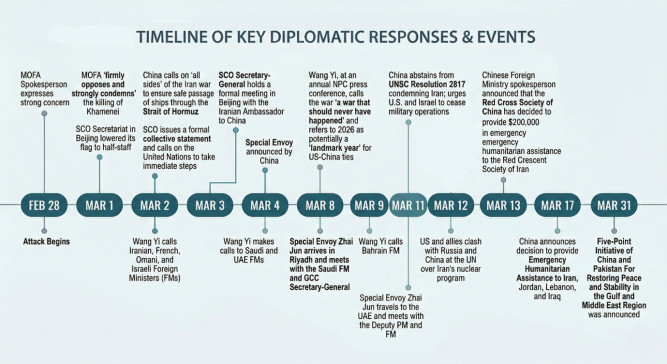
Source: Compiled by the authors using information retrieved from the Ministry of Foreign Affairs of the People's Republic of China (PRC MOFA) website; and Reuters reports, 2026
In this context, much attention is being paid to China’s potential role in and response to the current conflict. The official stance has been straightforward and along expected lines. A MoFA spokesperson strongly condemned the assassination of Iran’s supreme leader, Ayatollah Khamenei, as a violation of international law, and called for an immediate cessation of military operations (FMPRC 2026a). While offering Chinese support for Iran “in safeguarding its sovereignty, security, territorial integrity, and national dignity, and in protecting its legitimate rights and interests” as well as the security and sovereignty of other Gulf countries, officials denied the sale of supersonic anti-ship missiles to Iran (FMPRC 2026b). Further, in his press conference during the Two Sessions, Foreign Minister Wang Yi criticised external influence and alleged plots for a colour revolution in Iran (FMPRC 2026c). He also expressed China’s willingness to cooperate with Gulf countries to achieve regional peace and stability. To this end, China has appointed Zhai Jun, who is Xi Jinping’s special envoy to the Middle East, to lead mediation and de-escalation efforts. Further, China is coordinating its position with Russia, particularly at the UN Security Council and through multilateral institutions like the SCO (FMPRC 2026d). China has also announced its intention to provide emergency humanitarian aid to Iran, along with Jordan, Iraq and Lebanon (FMPRC 2026e). At the time of writing this article, China had jointly with Pakistan announced a ‘Five Point Initiative for Restoring Peace and Stability in the Middle East Region’ (FMPRC 2026f).
Official narrative on the issue has three major characteristics: strong political and diplomatic support for Iran and criticism of the military escalation by the US and Israel; portrayal of the US and Israel as actors that have violated international law and norms, and are creating a situation of “law of the jungle”; and China’s potential as a positive actor with capability to mediate in cooperation with other regional actors (FMPRC 2026d). This is in line with China’s usual diplomatic messaging on external conflicts, showing reluctance to any direct military involvement and concern for Chinese economic assets, and urging dialogue.
The next four sections elucidate upon the key narratives across media types. Along with the immediate issues of the ongoing war, like assessments of war strategies and military capabilities, commentators also highlight the broader implications for the global order and China’s future.
Breakdown of UN-based Global Order and US Hegemony
Breakdown of the global order due to US hegemonic behaviour and unilateral actions is a prominent theme in Party-state media. For instance, Huan Yuping (2026), an international relations opinion column of the People’s Daily, questioned the credibility of the nuclear weapons claim and argued that the world must not revert to “law of the jungle”, where might makes right. It further asserted that “launching attacks against a sovereign state without UN Security Council authorisation seriously undermines international law and the basic norms of international relations underpinned by the purposes and principles of the UN Charter.” Another commentary on People’s Daily Online argued “When a major power normalises the use of force during ongoing negotiations, it erodes trust, not only between the parties involved, but within the global system as a whole.” (People’s Daily Online 2026a) Zheng Yongnian, director of The Institute for International Affairs at the Chinese University of Hong Kong describes the rules-based order as dead, and replaced by a “fear-based international order, which is what Hobbes termed a complete jungle law.” He further argues for the necessity of a complete reconstruction of the international order (Zheng 2026a).
To counter unilateral actions of the US, Huan Yuping called for a “unified opposition” from the international community. Commentators highlighted the opposition that the US leadership is facing from other Western nations and from its own citizens (Chen 2026). On the other hand, we find that China’s actions are shown as couched in the language of multilateralism and consensus. Instances include highlighting the role of the UN and its Security Council, where China coordinated its actions with Russia or the statement from the SCO (where Iran is a member state), or cooperating with the Gulf Cooperation Council to de-escalate the situation and mediate. Multiple commentaries allude to China’s credibility in the region, its ‘shuttle diplomacy’, and the positive impact of China brokered peace-deal between Saudi Arabia and Iran (Global Times 2026e; 2026f).
Major media channels and commentators also analysed US’ goals for launching the attack.
Some see this as an attempt to assert dominance amid declining hegemony. For instance, Xinhua, China’s official state news agency, characterised the practice of openly attacking a sovereign state and pressuring for regime change as a blatant display of power politics and hegemonism (Xinhua 2026). Zheng (2026a) argues that these manoeuvres by the US reflect a broader shift in American foreign policy. He observes that “from military actions against Venezuela and Iran to threats against Panama, Greenland, and Canada, the White House believes that it will do what it can” to maintain its global position. Zhang Jiadong, professor at the Center for American Studies, Fudan University, calls the US behaviour ‘predatory hegemony’ arguing that “…the US has experienced similar impulses on multiple occasions in its history. This change is essentially a reactive response of its hegemony when it faces challenges” (Global Times 2026g).
Further commentary highlighted the timing of the attack amidst ongoing negotiations, calling it ‘strategic deception’ and characterising US diplomacy as a mere smokescreen for aggression and regional domination (Xinhua 2026; Zhang 2026; Global Times 2026a). Hu Xijin (2026), a former Global Times editor known for his ultra-nationalist views, argued that, no matter who the president is, war-making is the long-term line of the US. Ding Long, a professor at the Middle East Studies Institute of Shanghai International Studies University (SISU), argues that “… a more emboldened US-Israel axis may act with increasing impunity in the region. This drastic shift likely favours a US-led reintegration of the Middle East” (Global Times 2026c).
Others see this as an attempt to gain control over resources in the garb of security. Popular nationalist commentary account, Zhan Hao (2026) argues that the US objective is permanent regional instability in the Middle East through “dismemberment” of Iran and the creation of a US-controlled Kurdistan. State-affiliated media, Cover News, in a Weibo post, contends that the goal of the US is “forced subversion of a sovereign state to secure oil resources and geostrategic chokepoints” and not security (Fengmian Xinwen 2026).
Another line of argument is that this war is ideological, akin to the pro-democracy colour revolutions that led to several regime changes in the MENA region. Zheng Yongnian (2026b) argues that Trump or Israel “see an opportunity…if the people are dissatisfied, could they instigate a colour revolution. Trump has consistently emphasized the need for regime change in this conflict...” Similarly, Zhan Hao (2026) asserts that “Pro-American forces that have been long brainwashed by the West are eager to act, ready to cooperate with external forces to stage a colour revolution.” Liu Qiang, former deputy defence attaché in Iran, considers regime change to be the primary strategic objective of the US (Global Times 2026a).
Taking a non-US-centred perspective, an alternate view is that this is primarily a regional conflict between Israel and Iran, with the interests of Arab countries involved, and the US is acting under the influence of Israel and will have to bear adverse consequences. Liu Yanting (2026), a Middle East observer for Guancha, sees US’ use of force as an outcome of lobbying by Iran’s regional rival, Israel, and not so overtly, by Saudi Arabia. She argues that Iran was not necessarily an urgent issue for the US, whereas Israel “already believes that ‘eradicating the threat of Iran’ is non-negotiable”. Lei Qian, a researcher at Hainan University’s Belt and Road Institute, claimed that “US Support for Israel has no bottom line, no upper limit and no borders” (Jin and Qian 2026). In another widely read Guancha opinion piece, Chen Feng (2026), a freelance commentator on foreign affairs, with a consistently high readership, argues that Israeli Prime Minister, Netanyahu, needed the “flag gathering effect” and “willingly or not, Trump has been tied to Israel’s chariot.” Pan Guang, senior advisor of the Chinese Association of Middle East Studies, highlights “…this round of military actions against Iran is likely to deepen fear and insecurity among regional states and negatively affect future US-Arab relations” (Global Times 2026c). In this view, domestic and international opposition to US’ participation, as well as the economic and human costs of war, mean that Trump needs to cut the losses as soon as possible.
Thus, Chinese media and analysts assess the ongoing conflict not as an isolated incident, but as part of the US’ behavioural pattern of war and aggression, in violation of international law. They highlight multiple probable causes behind US’ actions, like the threat of Iran’s nuclear weapons program, or desire to control resources, but do not view them as credible or legitimate. The regional instability caused by US and Israeli “overreach” is contrasted with China’s multilateral and cooperative approach.
Disputing the Possibility of Quick Victory
While several analysts highlight the weaknesses of the Iranian economy and military capabilities, the dominant opinion is that this war is unlike the situation in Venezuela, and even though the US has ‘decapitated’ the Iranian leadership, and achieved a tactical success, a quick victory and end to the conflict is unlikely (Zheng 2026b; Bai 2026; Jin and Qian 2026). Zhang Guoqing, an international affairs expert at the Chinese Academy of Social Sciences, notes that “the US didn’t expect Iran to fight so fiercely, so tenaciously, and on such a wide scale” (Daxiang Xinwen 2026). Gu Jiashi, an economist, wrote in Guancha, “the transplanting of Venezuela’s logic to Iran is not valid” (Gu 2026). This is being attributed to three factors: a) the resilience of Iran’s political system, b) asymmetric warfare and c) Strait of Hormuz blockade.
Experts have highlighted the dual-track structure of institutionalised theocracy and an independent chain of command in the armed forces, Iran’s Revolutionary Guards. They also cite the strong population base of 90 million as well as a relatively independent and home-grown military capability as factors. Despite the occurrence of widespread protests in Iran earlier this year, commentators point to the will of the people and the rallying for the flag effect created by the assassination of their Supreme Leader. Accordingly, the US and Israel are seen to have miscalculated Iran’s resilience and readiness for “long-term war.”
Shen Yi, Fudan University’s Professor of International Politics, explained “The foundation of the Iranian regime is not merely the personal decisions of its top leaders; it is a political system with a multi-layered support system... including religious organisations, military institutions, and social foundations” (Shen 2026a). He further highlighted on Weibo that “there have been no large-scale crowds challenging the Iranian government on the streets as the US leaders expected; nor have there been any pro-US political forces taking over the government, contradicting US expectations of a rapid government collapse.” Zhan Hao (2026) argued “when Khamenei is assassinated, or when a primary school in Tehran is struck by missiles, resulting in the deaths of over a hundred innocent children, the issue ceases to be merely a political matter; it transforms into a deep-seated national grievance…those citizens who have remained on the sidelines—or even those whose resolve has wavered—will rally beneath it, united in their shared indignation against the common enemy.” Liu Zhongmin, a professor at the Middle East Studies Institute of SISU, argues that while Iran may be structurally prepared, “…the killing of another country's leader would deepen distrust and anxiety toward the US among other nations, further damaging its global standing” (Global Times, 2026b).
The second factor of asymmetric warfare is being keenly observed in the Chinese media. Multiple commentaries highlight that the use of drones in warfare has changed the rule of quick destruction with overwhelming firepower. Others highlight the exorbitant costs of high-tech US missiles, aircraft, and weapons as compared to Iran’s. Gu Jiashi argues, “The United States and Israel can win every tactical victory in an air raid, but it is difficult to win the war of attrition under this cost structure. Moreover, the sanctions in the past few decades have forced Iran to internalise the whole industrial chain of missiles, unmanned aerial vehicles and ammunition. The production bases are deep in the mountains and underground facilities, and it is extremely difficult to be destroyed by air raids at once.
Self-media channel Rongping Shuoce (戎评说策) claims, “Irrespective of the level of technological sophistication, Iran has consistently maintained an ample supply of weaponry. It stands as the nation with the highest degree of defence-industrial indigenization and the most advanced missile and Unmanned Aerial Vehicle (UAV) technologies in the Middle East. Furthermore, its industrial capacities in the steel, energy, and defence sectors are formidable…” (Rongping Shuoce 2026). As a result, these experts argue that the US would need to send boots on the ground, a proposition that faces deep domestic opposition in the US. Military expert Cao Weidong noted that if this conflict continues, the US and Israel will be bogged down in a quagmire (CCTV Online 2026).
The third factor, the closure of the Strait of Hormuz, has been widely discussed in Chinese media due to its severe economic implications for China and the rest of the world. However, the tone of many of these articles is not critical of Iran but rather focuses on the implications of the closure for energy supply chains and global trade. The aforementioned Rongping Shuoce – in one of the most-read WeChat articles on the topic – argued that “The ultimate strategic trump card is the Strait of Hormuz, which carries 30% of the world’s seaborne oil and 20% of LNG. At its narrowest, it is only 33 km wide. Iran only needs enough mines and drones to fully blockade it; if US carriers dare approach, wolf-pack tactics using suicide speedboats can force them back.” Liu Zhongmin, however, also highlights the negative impact of the closure on Iran’s relations with its neighbours (Global Times 2026f; 2026d). Notably, there is much emphasis on how China is well-prepared and less impacted than other powers like Japan and South Korea due to its structural buffers: diversified imports, reserve capacity and industrial system (China Daily 2026; Gu 2026).
It can thus be seen, that while condemning violence, there is at the same time an implicit appreciation of Iran’s resilience in countering the US-Israel ‘bullying’ tactic. Iran’s retaliation is not shown merely as an emotional rallying in response to Khamenei’s assassination, but as an outcome of strong institutions and military self-reliance. Self-reliance and preparedness are also highlighted in China’s own response to the closure of the Strait of Hormuz.
Geopolitical Implications for China
A prominent theme in media commentaries is drawing implications for broader US-China competition, insistence on China’s advantageous position and its role as a stabiliser in the global disorder. Several analysts, like the prominent internet commentator with a large following, Ren Yi (兔主席 or Chairman Rabbit), dismiss the popular analysis that the war on Iran is directed towards China (Ren 2026). However, the US’ actions are seen as ultimately advantageous for China as they will “accelerate the marginalisation of the United States in the Middle East, exacerbate the alienation of allies and partners from it” and create an opportunity for China to enhance its influence in the region and world.
First, it is argued that this war and attacks on US allies in the Middle East, which host US military bases, have exposed the fallibility of and weakened trust in the US security umbrella. Shen Yi (2026b), for instance, claims, “One of the greatest effects of this situation is to break the ideological steel seal that the United States’ military strength is invincible.” He calls it the end of the “post-Cold War global order” (Shen 2026b). Jin Canrong (2026) goes a step further to argue that “Of course, mainland China is not afraid [of the US], because mainland China is really strong now. If we really clash head-on, we will win.” In his assessment, this confidence comes from “PLA’s absolute advantage over US military and its allies in the Taiwan Strait” and “great improvement in China’s comprehensive national strength.”
Second, on the geoeconomic front, Gu Jiashi (2026) highlights the destabilisation of the “political and financial foundations of the petrodollar system.” In the same vein, Lei Qian argues that the “financial structure of global integration will definitely be broken down,” but goes on to highlight China’s capacity to withstand this “tsunami” by virtue of its efforts at internationalisation of RMB and digital RMB and the safety net China has built in the last ten years “whether in terms of energy, food or finance” (Jin and Qian 2026).
Third, commentators do not restrict this bullish sentiment to China’s borders and argue that while the US faces opposition from its allies and its own population, China will be a stabilising force for the Global South. A Global Times editorial (2026) noted, “Unlike certain major powers [US] where decision-making is inefficient, internal divisions are severe, and foreign policies frequently swing back and forth, China is able to mobilise nationwide consensus and strength to advance shared goals in a coordinated way.” A People’s Daily Online commentary (2026b) proclaimed “While some countries make arbitrary decisions or withdraw from international agreements, China positions itself as a responsible major power…. Amid escalating conflict in the Middle East, which adds a new layer of geopolitical uncertainty, China is advocating for dialogue and negotiation to resolve differences.” Zhang Weiwei (2026), Dean of the China Research Institute at Fudan University, in an interview with Russia Today, also contrasted China’s reliability and US’ inconsistency. He framed China’s aid to Iran as a fulfilment of a public 25-year comprehensive cooperation agreement. This is contrasted with the US failing to uphold the “August 17, 1982, U.S.-China Joint Communiqué” regarding reduced arms sales to Taiwan.
Chinese analysts display confidence in the country’s capacity to withstand the fallout of the war while taking advantage of the US weakened position in the region and globally. In a now familiar pattern, they also portray China as a responsible power, and a stabilising force in a global order disrupted by ‘US’ unilateralism.’
Lessons learnt and future strategy
Alongside assertions of China’s advantageous position, several commentators justify the current position and prescribe what China ought to do for future hedging. For instance, former Xinhua editor Yu Zeyuan (2026) observes that China’s initial refusal to immediately condemn the strikes reflects a strategic choice to “quietly await changes” and avoid getting “overly entangled.” This cautious “wait-and-see approach” is intended to preserve China’s flexibility. Yu suggests that premature support for the current Iranian leadership would have made it difficult for Beijing to “deal with the new authorities” should the conflict result in regime change. Similarly, Jin Canrong (2026) suggests that China’s active involvement should be a matter of timing, waiting until “all parties have exhausted their ammunition” and possessing a genuine “will for dialogue” before stepping in to “carry out mediation.”
In the commentary analysed, little attention is paid to recommending China’s potential involvement in this present conflict beyond a repetition of the state’s position of providing diplomatic support and humanitarian aid and working with the Gulf Cooperation Council (GCC) for mediation. Much more focus is on implications for China’s future strategy as its competition with the US intensifies. Jin Canrong (2026) contends that the “relatively relaxed and comfortable” international environment of the past is “disappearing.” He suggests that China must change its way of looking at the world, and its approach to dealing with it should also change, as the world is increasingly getting dominated by “raw power politics.” While Jin aligns with the official view that “might does not equal right,” he asserts that China’s most effective role is to “desperately develop its own strength” to ensure it has the necessary “vigor” for the [global] contestation. On the other hand, Zheng Yongnian (2026c) calls for a new philosophy of “non-interventionism 2.0” or a positive intervention strategy where China’s overseas interests are affected or overseas factors have the potential to affect China’s internal interests.
The US is referred to as a ‘rogue-superpower’ (Jin and Qian 2026). A People’s Daily commentary (2026a) argues that “this war is an unmistakable hallmark of Washington’s long-lasting ‘maximum pressure’ strategy” where “use of force is…the primary instrument of leverage” and “negotiations are not genuine efforts to bridge differences; they are ultimatums for war wrapped in diplomatic language.” Zheng Yongnian, in an interview given to Beijing News Commentary (Xinjingbao Pinglun, 新京报评论), warns that China must prevent regional neighbours like Japan and the Philippines from becoming the “Israels of East Asia”, i.e., proxies used by the US to maintain regional dominance (Zheng 2026b).
With this understanding, it is argued that while restraining from outright confrontation, China must deal with the US from a “position of strength”, which will come from building a “collective mindset” and solving internal contradictions, enhancing both hard and soft power (including military strength, industrial and technological self-reliance, and supply chain security), and expanding diplomatic outreach (Hu 2026). Wang Zezhuang, Director of the Iranian Studies Center at Beijing Language and Culture University, argues that forms of confrontation will “likely become increasingly diversified and asymmetric. In addition to conventional military clashes, cyberattacks, proxy wars, political and media campaigns, and diplomatic contestation in international forums may all become enduring features” (Global Times 2026c). Zheng Yongnian (2026b) contends that using AI to “strengthen national defence and enhance hard power is an inevitable trend.” He warns that because the US leverages its tech sector for military operations, China must rethink its own technological development path. If China does not use its AI for military purposes, it might find itself at a disadvantage.
The ultimate message distilled for the Chinese audience is of the necessity of self-reliance in the face of the breakdown of a rules-based world order. By framing the Iran conflict as a “lesson in the cold logic of superior firepower,” Party-state-backed actors on Chinese social media reinforce the necessity of building a cohesive social system and powerful, autonomous military-industrial complex to survive a world without rules.
Conclusion
Based on the thematic analysis presented above, several incongruities can be seen in China’s narrative. On the one hand, MoFA statements as well as state media editorials call for ‘joint opposition’ to US unilateralism and hegemonism, indicating preference for a multipolar world order, and adherence to UN principles. On the other hand, analysis of media content reveals a more complicated picture, where China, while engaging with multilateral and international institutions, is calling for ‘reconstruction’ of the world order. While analysts mention Xi Jinping’s various global initiatives, there is little indication of what this new order would look like.
Second, while calling for the rule of international law, Chinese analysts simultaneously use Iran’s example to take the view of ‘raw power’ politics and argue that a ‘rogue’ United States can only be dealt with from a position of national strength. Under Xi Jinping’s comprehensive national security concept, there has been a move towards securitising trade and supply chains, improving social governance and domestic stability, achieving technological self-reliance, and civil-military fusion (Drinhausen and Legarda 2022). Chinese analysts highlight the economic and industrial capacity, superior tech and military capabilities as necessary to achieve an advantageous position vis-à-vis the United States in a rapidly changing global order. We find that media commentary on this issue tends towards nationalist and even sensationalist perspectives. For instance, China’s military preparedness against the US is repeatedly alluded to despite the ongoing upheavals and corruption scandals in the PLA. Similarly, economic strength is highlighted without considering structural problems like debt and an ageing population.
Finally, alongside military and institutional strength, Chinese analysts attribute Iran’s resilience to social cohesion even as Iranian supporters of the US-Israel strikes are dismissed as brainwashed. Notably, in the commentaries analysed above, there is hardly any mention or acknowledgement of the recent anti-regime protests in Iran, which were suppressed. On the other hand, analysts highlight the domestic opposition facing the US leadership and resultant policy fluctuation, implying it is a weakness. This is crucial as protests and social instability are anathema to the CPC. State media commentary contrasts this with the robustness of the Chinese governance system in mobilising domestic consensus and maintaining policy continuity. In a 2012 assessment, Wang Jisi, an influential IR scholar at Peking University, noted that the US actions and policies in Iran were seen as based on injustice and narrow American self-interest, with direct and indirect impact on China’s interests (Lieberthal and Wang 2012). He had characterised the US as the greatest national security threat for China. Based on such assessments, China, in the last decade has been building its strategic reserve capacity of essential commodities and diversifying supply chains.
This examination of media narratives on the war in Iran gives important clues into China’s strategic outlook, as well as the Party-state’s messaging on external issues to its own population. These narratives convert an external crisis into a lesson about China’s strategic environment. Criticism of the US aggression and hegemony goes hand in hand with expansion of internal strength and achieving a comparatively advantageous position amidst intensifying great power competition.
ENDNOTES
[i] Weibo has a system of assigning hosts for hashtags. As hosts, these accounts gain curatorial authority over the topic space by which they can manage content, pin posts, and hence effectively set the interpretive terms of public engagement. Weibo structurally prioritizes state affiliated media as official "hosts" (主持人) of hashtag topic pages for major news and political events.
[ii] Self-media (自媒体) refers to social media accounts that are independently operated by individuals or small teams outside institutional media structures and occupy an analytically ambiguous space, as they can reflect a mix of genuine popular sentiment, commercially driven opinion, and state-aligned messaging.
REFERENCES
Bai Yujing (白玉京). 2026. ‘Yilang hangmu chenmo: beiju yu beizhuang de jiaozhi’ (伊朗航母沉没:悲剧与悲壮的交织) ' [The sinking of the Iranian aircraft carrier: a blend of tragedy and heroism]. Guancha (观察). 7 March.
https://www.guancha.cn/baiyujing/2026_03_07_809125.shtml
China Daily. 2026. Energy crisis dashes global economic outlook. 27 March. https://www.chinadaily.com.cn/a/202603/27/WS69c5d7eca310d6866eb40272.html
Chen Feng (晨枫). 2026. ‘Yilang zhanchang shang, Telangpu yingxue yao jiangbu xiaqule’ (伊朗战场上,特朗普赢学要讲不下去了) [On the Iranian battlefield, Trump's winning strategy is failing]. Guancha (观察). 8 March.
https://www.guancha.cn/ChenFeng3/2026_03_08_809247_2.shtml
Daxiang Xinwen (大象新闻). 2026. ‘Yilang mei xiang dao Meiguo gan zheme jue Meiguo mei xiang dao Yilang da zheme hen #zhuanjia cheng Meiguo mei xiangdao Yilang da zheme hen#’ (伊朗没想到美国干这么绝 美国没想到伊朗打这么狠 #专家称美国没想到伊朗打这么狠#) [Iran didn't expect the US to go this far; the US didn't expect Iran to fight this hard. #Experts say the US didn't expect Iran to fight this hard#] Weibo. |
https://weibo.com/7308140398/QueZjkwcO?refer_flag=1001030103_
Drinhausen, Katja and Helena Legarda. 2022. 'Comprehensive National Security Unleashed: How Xi’s Approach Shapes China’s Policies at Home and Abroad.' MERICS. 15 September.
https://merics.org/en/report/comprehensive-national-security-unleashed-how-xis-approach-shapes-chinas-policies-home-and
Fengmian Xinwen (封面新闻) [Cover News]. 2026. '2 da yuanyin youhuo Meiguo xiji Yilang’ (【#2大原因诱惑美国袭击伊朗#】) [Major Reasons Tempting the U.S. to Attack Iran]. Weibo. https://weibo.com/1496814565/QuGDTxYmJ
Global Times. 2026. 'Editorial: China’s Governance Model and Global Stability amid the Iran Crisis.' People’s Daily Online. 10 March.
https://en.people.cn/n3/2026/0310/c90000-20433977.html
Global Times. 2026a. ‘US, Israel attacks on Iran show intention for regime change with negotiations likely being ‘cover’; air strikes likely to be main focus at current stage: Chinese experts’. 28 February. https://www.globaltimes.cn/page/202602/1355914.shtml
Global Times. 2026b. ‘Khamenei's death to provoke fierce retaliation, potentially draw US into escalation it may struggle to control: Chinese expert’. 1 March. https://www.globaltimes.cn/page/202603/1355967.shtml
Global Times. 2026c. ‘Latest US-Israel strike on Iran jeopardizes regional stability, sets a dangerous precedent: Chinese scholars’. 1 March. https://www.globaltimes.cn/page/202603/1356025.shtml
Global Times. 2026d. ‘Iran reportedly finalizes decision on new supreme leader as US-Israel military operation against Iran enters 9th day’. 8 March. https://www.globaltimes.cn/page/202603/1356596.shtml
Global Times. 2026e. ‘Strait of Hormuz tensions simmer as Iran war lasts; China steps up shuttle diplomacy’. 12 March. https://www.globaltimes.cn/page/202603/1356820.shtml
Global Times. 2026f. ‘China steps up diplomatic push as US-Israeli war against Iran hits two weeks’. 14 March. https://www.globaltimes.cn/page/202603/1356946.shtml
Global Times. 2026g. ‘“What's mine is mine, what's yours is negotiable”: How US govt is pushing the country toward 'predatory hegemony’. 20 March. https://www.globaltimes.cn/page/202603/1357283.shtml
Gu Jiashi (顾嘉时). 2026. ‘Meiyi chongtu yizhou hou, shichang chuxian sange “meixiangdao”’ (美伊冲突一周后,市场出现三个 “没想到”) [A week after the US-Iran conflict, three unexpected events occurred in the market.]. Guancha (观察). 10 March.
https://www.guancha.cn/gujiashi/2026_03_10_809471_2.shtml
Hu Xijin (胡锡进). 2026. ‘Meiguo feichang duxin zhanzheng, zhongguoren yao chedi kan touzhi’(美国非常笃信战争,中国人要彻底看透之 ) [The United States is extremely convinced of the power of war; the Chinese must see through this completely.]. Guancha (观察). 9 March. https://user.guancha.cn/main/content?id=1612099
Huan Yuping. 2026. ‘The world must not revert to a "law of the jungle" where might makes right’. People’s Daily Online. 5 March.
https://en.people.cn/n3/2026/0305/c90000-20432045.html
Jin Canrong (金灿荣). 2026. ‘Women shuxi de waibu huanjing zhengzai xiaoshi, dan "quantou ying bu dengyu daoli ying"’ (我们熟悉的外部环境正在消失,但 “拳头硬不等于道理硬”) [The familiar external environment is disappearing, but "strength does not equal justice."]. Guancha (观察). 9 March. https://www.guancha.cn/JinCanRong/2026_03_09_809301_2.shtml
Jin Canrong and Lei Qian (金灿荣,雷倩). 2026. ‘Zhongguo yi wei zhanzheng chongtu bu hao chongchong “anquan wang”’ (中国已为战争冲突布好重重 “安全网”) [China has already laid out a multi-layered "safety net" for war and conflict]. Guancha (观察). 4 March.
https://www.guancha.cn/JinCanRong/2026_03_04_808709_2.shtml
Liu Yanting (刘燕婷). 2026. ‘Zai Yilang zhanchang, Telangpu yu shijian de saipao yijing kaishi le’ (在伊朗战场,特朗普与时间的赛跑已经开始了) [On the Iranian front, Trump's race against time has begun]. Guancha (观察). 6 March.
https://www.guancha.cn/LiuYanTing/2026_03_06_808998_2.shtml
Legarda, Helena. 2018. 'China as a Conflict Mediator: Maintaining stability along the Belt and Road'. MERICS. 22 August.
https://merics.org/en/comment/china-conflict-mediator
Lieberthal, Kenneth and Wang Jisi. 2012. ‘Addressing U.S.–China Strategic Distrust’. Brookings Institution.
https://www.brookings.edu/wp-content/uploads/2016/06/0330_china_lieberthal.pdf
Ministry of Foreign Affairs, People’s Republic of China [FMPRC]. 2026a. ‘Waijiaobu fayanren jiu Yilang zuigao lingxiu Hameinei yuhai da jizhe wen’ (外交部发言人就伊朗最高领袖哈梅内伊遇害答记者问) [The spokesman of the Ministry of Foreign Affairs answered reporters' questions about the murder of Iran's Supreme Leader Khamenei].1 March.
https://www.fmprc.gov.cn/fyrbt_673021/dhdw_673027/202603/t20260301_11866721.shtml
Ministry of Foreign Affairs, People’s Republic of China [FMPRC]. 2026b.'Waijiaobu fayanren Mao Ning zhuchi lixing jizhehui' (外交部发言人毛宁主持例行记者会) [Spokesperson Mao Ning’s Regular Press Conference]. 2 March.
https://www.fmprc.gov.cn/fyrbt_673021/jzhsl_673025/202603/t20260302_11867140.shtml
Ministry of Foreign Affairs, People’s Republic of China [FMPRC]. 2026c. ‘Zhonggong zhongyang zhengzhi ju weiyuan, waijiao buzhang Wang Yi jiu zhongguo waijiao zhengce he duiwai guanxi huida zhongwai jizhe tiwen’ (中共中央政治局委员、外交部长王毅就中国外交政策和对外关系回答中外记者提问) [Member of the Political Bureau of the CPC Central Committee and Foreign Minister Wang Yi Meets the Press]. 8 March.
https://www.mfa.gov.cn/wjbzhd/202603/t20260308_11870706.shtml
Ministry of Foreign Affairs, People’s Republic of China [FMPRC]. 2026d. 'Waijiaobu fayanren Mao Ning zhuchi lixing jizhehui' (外交部发言人毛宁主持例行记者会) [Spokesperson Mao Ning’s Regular Press Conference]. 3 March.
https://www.fmprc.gov.cn/fyrbt_673021/jzhsl_673025/202603/t20260303_11867941.shtml
Ministry of Foreign Affairs, People’s Republic of China [FMPRC]. 2026e.Waijiaobu fayanren Lin Jian zhuchi lixing jizhehui' (外交部发言人林剑主持例行记者会) [Spokesperson Lin Jian’s Regular Press Conference]. 17 March.
https://www.fmprc.gov.cn/fyrbt_673021/202603/t20260317_11876240.shtml
Ministry of Foreign Affairs, People’s Republic of China [FMPRC]. 2026f. ‘Five-Point Initiative of China and Pakistan for Restoring Peace and Stability in the Gulf and Middle East Region’. 31 March. https://www.fmprc.gov.cn/eng/wjbzhd/202603/t20260331_11884511.html
Mozur, Paul and Aaron Krolik. 2026. ‘Iran Turns to Digital Surveillance Tools to Track Down Protestors.' New York Times. 13 February.
https://www.nytimes.com/2026/02/13/technology/iran-protests-surveillance-facial-recognition.html
Meidan, Michal. 2026. ‘Disruption in the Strait of Hormuz: Implications for China’s energy markets and policies’. Oxford Institute for Energy Studies. March.
https://www.oxfordenergy.org/wpcms/wp-content/uploads/2026/03/Comment-Turmoil-in-the-Middle-East.pdf
Reeves, Jeffrey. 2025. 'China’s Expanding Influence in the Middle East and North Africa.' Peace Diplomacy. 24 February.
https://peacediplomacy.org/2025/02/24/chinas-expanding-influence-in-the-middle-east-and-north-africa/
People’s Daily Online. 2026a. ‘Commentary: When Washington bombs during talks, the world order pays the price’. 2 March.
https://en.people.cn/n3/2026/0302/c90000-20430352.html
People’s Daily Online. 2026b. ‘Observer: China is injecting greater stability into the world’. 11 March.
https://en.people.cn/n3/2026/0311/c90000-20434742.html
Ren Yi (任谊) (pen name兔主席 (Chairman Rabbit)). 2026. ‘Telangpu wufa tuichu, shang yige dui Yiselie shuo “bu” de zongtong shi Kenedi’ (特朗普无法退出,上一个对以色列说 “不” 的总统是肯尼迪……) [Trump cannot back down; the last president to say "no" to Israel was Kennedy…]. Guancha (观察). 8 March.
https://www.guancha.cn/TuZhuXi/2026_03_08_809205.shtml
Rongping Shuoce (戎评说策). 2026. ‘Yilang yingmian dazeng? Meiguo yinglai zhi'an shike’ (伊朗赢面大增?美国迎来至暗时刻) [Has Iran's chances of winning increased significantly? The United States is facing its darkest hour.]
WeChat Public Account. 1 March.
https://mp.weixin.qq.com/s/o0B3a7bZYYwC12mG2nTuig
Shen Yi (沈逸). 2026a. ‘Zhujian tuise de susheng fangan, jiang tiaozhan benjie Meiguo zhengfu de diyuan zhanlue juece nengli’ (逐渐褪色的速胜方案,将挑战本届美国政府的地缘战略决策能力) [The fading appeal of quick-win strategies will challenge the geostrategic decision-making capabilities of the current US administration]. Weibo. 2 March.
https://weibo.com/1157864602/QufnyjwOJ
Shen Yi (沈逸). 2026b. ‘Yiyu daopo: wulun duiyu Meiguo haishi Yilang, zhe chang zhanzheng doubuneng “qingyi zhongzhi’ (逸语道破:无论对于美国还是伊朗,这场战争都不能 “轻易中止”) [The insightful commentary reveals that this war cannot be "easily ended" for either the United States or Iran.] Guancha (观察). 14 March.
https://www.guancha.cn/ShenYi/2026_03_14_810003.shtml
Yangshi Wang (央视网) [CCTV Web]. 2026. Fenxi lai le! #Zhongdong chongtu ruo chixu mei yijiang xianru zhanzheng nitan' (分析来了!#中东冲突若持续美以将陷入战争泥潭#) [Analysis has arrived! #If The Middle East Conflict Persists, the US and Israel will be dragged into a quagmire of war]. Weibo. https://weibo.com/3266943013/QufWUeXG5?refer_flag=1001030103_
Xinhua She (新华社) [Xinhua News Agency]. 2026. ‘Kuai ping | Qiongbing duwu daibulai zhenzheng de anquan’ (快评|穷兵黩武带不来真正的安全) [Quick Comment | Aggressive militarism cannot bring true security] Weibo. 1 March.
https://weibo.com/1699432410/Qu1CPDEEX?refer_flag=1001030103_
Yu Zeyuan (于泽远). 2026. ‘Meiguo daji Yilang dui zhongguo de yingxiang’ (美国打击伊朗对中国的影响) [Impact of US attack on Iran on China]. Lianhe Zaobao (联合早报). 1 March.
https://www.zaobao.com.sg/news/china/story20260301-8657755
Zhan Hao (占豪). 2026. 'Shengsi shike, Yilang bixu like gan yijian dashi’ (生死时刻,伊朗必须立刻干一件大事) [At the moment of life and death, Iran must do a big thing immediately]. WeChat Public Account. 5 March.
https://mp.weixin.qq.com/s/W6IbnzC5gg-zK-aC2Tq9-g
Zhang Weiwei (张维为). 2026. ‘Waimei wen wo Zhongguo shifou gei Yilang gaochao yinsu daodan? Wo hui le si ze’(外媒问我中国是否给伊朗高超音速导弹?我回了四个字) [Foreign Media asked me if China gave Iran Hypersonic Missiles? I replied in four words]. Guancha (观察). 14 March.
https://www.guancha.cn/ZhangWeiWei/2026_03_14_810005.shtml
Zheng Yongnian (郑永年). 2026a. ‘Na shi jiyu
guize jiushi conglin faze’ (哪是基于规则 就是丛林法则) [It’s based on the rules; it’s the law of the jungle] Weibo. 2 March.
https://weibo.com/ttarticle/p/show?id=2309405272338144297224
Zheng Yongnian (郑永年). 2026b. ‘Zhongguo ruhe yingdui bianju zhong de Zhongdong jushi’ (中国如何应对变局中的中东局势) [How China Should Respond to a Changing Middle East], interviewed by Xinjingbao Pinglun (新京报评论) [Beijing News Commentary]. WeChat Public Account. 3 March. https://mp.weixin.qq.com/s/K9m25tVnpSMinm9aeDyFUw
Zheng Yongnian (郑永年). 2026c. ‘Duihua Zheng Yongnian: Conglin shijie, Zhongguo poqie xuyao “buganyazhuyi 2.0 ban”’ (对话郑永年:丛林世界,中国迫切需要 “不干预主义2.0版”) [Conversation with Zheng Yongnian: In the Jungle World, China Urgently Needs a "Non-Interventionism 2.0"], interviewed by Dawanqu Pinglun (大湾区评论) [Greater Bay Area Commentary]. 9 March. WeChat Public Account. https://mp.weixin.qq.com/s/KOYCrAjyZZx2Hs86nPHQyg
Appendix
Sample list of hashtags hosted by Party-state media
|
S. No. |
Hashtag |
Views |
Host |
|
1 |
#俄外长灵魂拷问海湾国家双标# (E waizhang linghun kaowen haiwan guojia shuangbiao) [Russian Foreign Minister’s "soul-searching" challenge to Gulf nations’ double standards] |
340,000 |
Phoenix News Web |
|
2 |
#加州州长质问为何炸死伊朗儿童# (Jiazhou zhouzhang zhiwen weihe zhasi Yilang ertong) [California Governor questions why Iranian children were killed in bombings] |
340,000 |
Beijing Youth Daily |
|
3 |
#美民主党人质问为何又重回中东战场# (Mei minzhu dangren zhiwen weihe you zhonghui Zhongdong zhanchang) [U.S. Democrats Question the Rationale for Re-engaging in the Middle East Theatre] |
390,000 |
CCTV World Express |
|
4 |
#伊朗称已为长期战争做好准备# (Yilang cheng yi wei changqi zhanzheng zuohao zhunbei) [Iran Claims It Is Prepared for a Protracted War#] |
810,000 |
Global Times |
|
5 |
#特朗普曾批评奥巴马为了连任打伊朗# (Telangpu ceng piping Aobama weile lianren da Yilang) [Trump once criticized Obama for attacking Iran to secure his re-election] |
1.24 million |
CCTV News |
|
6 |
#面对美以屠杀西方文明沉默骇人听闻# (miandui Mei yi tusha xifang wenming chenmo hairen tingwen) [Appalling silence of Western civilisation in the face of U.S.-Israeli massacres] |
1.26 million |
CCTV World Express |
|
7 |
#165名学生遇难美国不能默不作声# (165 ming xuesheng yunan Meiguo bu neng mobuzuosheng) [165 students killed: The United States cannot remain silent] |
1.4 million |
CCTV Military |
|
8 |
#伊朗非对称作战搅动中东# (Yilang feiduichen zuozhan jiaodong Zhongdong) [Iran's Asymmetric Warfare Roils the Middle East] |
1.4 million |
Southern Weekly |
|
9 |
#美议员批对伊朗战争建立在谎言上# (Mei yiyuan pidui Yilang zhanzheng jianli zai huangyan shang) [U.S. lawmaker criticises war on Iran as built on lies] |
1.41 million |
CCTV World Express
|
|
10 |
#拳头硬不等于道理硬# (quantou ying bu dengyu daoli ying) [A strong fist does not equal a strong justification] |
1.49 million |
CCTV News |
|
11 |
#加拿大称美以对伊朗袭击不符合国际法# (Jianada cheng Mei yi dui Yilang xiji bu fuhe guojifa) [Canada states U.S.-Israeli attacks on Iran violate international law] |
1.65 million |
Huanqiu web |
|
12 |
#伊朗袭击中东所有美军基地# (Yilang xiji Zhongdong suoyou Meijun jidi) [Iran Conducts Strikes on All U.S. Military Bases in the Middle East] |
2 million |
CCTV World Express |
|
13 |
#美民众说美国是当今世界最大威胁# (Mei minzhong shuo Meiguo shi dangjin shijie zui da weixie) [U.S. citizens say the United States is the world's greatest threat] |
2.5 million |
Xinhua net |
|
14 |
#西方联盟因伊朗之战再次撕裂# (xifang lianmeng yin Yilang zhi zhan zaici silie) [Western alliance fractured again by war with Iran] |
2.92 million |
Global Times |
|
15 |
#美以再袭伊朗点燃中东火药桶# (Mei yi zai xi Yilang dianran Zhongdong huoyaotong) [U.S.-Israeli strikes on Iran ignite Middle East powder keg] |
2.94 million |
CCTV World Express |
|
16 |
#无人机已成伊朗反击杀手锏# (wurenji yi cheng Yilang fanji shashoujian) [Drones Have Become Iran's Ultimate Retaliatory Weapon] |
3.1 million |
CCTV Web |
|
17 |
#美媒称美国 4天打击花费110亿美元 (Mei mei cheng Meiguo 4 tian daji huafei 110 yi meiyuan) [U.S. Media Reports $11 Billion Expenditure in Four-Day Strike Campaign] |
3.3 million |
Beijing Daily |
|
18 |
#伊朗的导弹开始让以色列防不胜防# (Yilang de daodan kaishi rang Yiselie fangbu shengfang) [Iranian Missiles Increasingly Overwhelm Israeli Defence Systems] |
3.6 million |
CCTV Web |
|
19 |
#示威者称美国正发动三战# (shiweizhe cheng Meiguo zheng fadong san zhan) [Protesters Claim the United States is Instigating World War III] |
4.6 million |
CCTV News |
|
20 |
#美国围堵伊朗的真实目的# (Meiguo weidu Yilang de zhenshi mudi) [The real purpose of the US's containment of Iran]
|
5 million |
CCTV Web |
|
21 |
#记者连续质问遭以色列发言人无视# (jizhe lianxu zhiwen zao Yiselie fayanren wushi) [Reporter’s persistent questioning ignored by Israeli spokesperson] |
9.1 million |
CCTV News |
|
22 |
#美假谈判真备战声誉扫地 (Mei jia tanpan zhen beizhan shengyu saodi)# [US engaging in sham negotiations while preparing for war has completely ruined its reputation.] |
9.5 million |
CCTV World Express
|
|
23 |
#中方反对以美对伊朗发起军事打击# (Zhong fang fandui yi Mei dui Yilang faqi junshi daji) China opposes US-Israeli military strike against Iran |
9.7 million |
CCTV News |
|
24 |
#打伊朗美国弹药不够用了# (da Yilang Meiguo danyao bugou yong le) [US Running Low on Ammunition to Strike Iran] |
10 million |
China Media Group |
|
25 |
#中方强烈呼吁立即停止军事行动# (Zhong fang qianglie huyu liji tingzhi junshi xingdong) [China strongly urges an immediate cessation of military operations]
|
14.3 million |
Xinhua News Agency |
|
26 |
#伊朗低成本武器正耗空美国高端弹药# (Yilang di chengben wuqi zheng haokong Meiguo gaoduan danyao) [Iranian Low-Cost Weaponry Draining U.S. High-End Munitions] |
16.6 million |
Global Times |
|
27 |
#伊朗最高权力平稳过渡# (Yilang zui gao quanli pingwen guodu) [Smooth Transition of Iran’s Supreme Power] |
24 million |
CCTV News |
|
28 |
#伊朗称将抵抗到最后一滴血# (Yilang cheng jiang dikang dao zuihou yi di xue) [Iran Vows to Resist to the Last Drop of Blood] |
25 million |
CCTV News |
|
29 |
#公然击杀主权国家领导人不可接受# (gongran jisha zhuquan guojia lingdaoren buke jieshou) [The overt assassination of a sovereign state leader is unacceptable] |
26.5 million |
Beijing Daily |
|
30 |
#伊朗避实就虚打击美军# (Yilang bishi jiuxu daji meijun) [Iran Employs "Avoid Strengths, Attack Weaknesses" Tactics Against U.S. Forces] |
30.5 million |
CCTV Web |
|
31 |
#伊朗拥有中东最大弹道导弹库存# (Yilang yongyou Zhongdong zuida dandao daodan kucun) [Iran Possesses the Largest Ballistic Missile Arsenal in the Middle East] |
36.5 million |
CCTV Web |
|
32 |
#今天是伊朗明天可能是任何国家# (jintian shi Yilang mingtian keneng shi renhe guojia) [Today it is Iran; tomorrow, it could be any country] |
37.7 million |
Jimu News
|
|
33 |
#伊朗用廉价无人机消耗百万美元导弹# (Yilang yong lianjia wurenji xiaohao bai wan meiyuan daodan) [Iran Utilizes Low-Cost UAVs to Deplete Million-Dollar Missiles] |
39 million |
Toutiao Xinwen |
|
34 |
#伊朗导弹突防能力拉满# (Yilang daodan tufang nengli laman) [Iranian Missile Penetration Capabilities Reach Maximum Threshold] |
41.9 million |
CCTV Web |
|
35 |
#伊朗遇难学生一个个墓穴让人心碎# (Yilang yunan xuesheng yi ge ge muxue rang ren xinsui)[The Graves of the Deceased Iranian Students Are Heartbreaking] |
50.1 million |
CCTV News
|
|
36 |
#伊朗学校葬礼上的中国书包令人心碎# (Yilang xuexiao zangli shang de Zhongguo shubao lingren xinsui) [Chinese schoolbag at Iranian school funerals is heartbreaking] |
67.9 million |
Global Times |
|
37 |
#伊朗165名小学生遇难西方集体沉默 (Yilang 165 ming xiaoxuesheng yunan xifang jiti chenmo) [165 Iranian primary school students killed: West collectively silent] |
68.4 million |
Beijing Daily |
|
38 |
#伊朗导弹突破以色列防御系统# (Yilang daodan tupo Yiselie fangyu xitong) [Iranian missile penetrates Israeli defence system]
|
230 million |
CCTV News |
Source: Compiled by authors from Weibo
About the Authors: Raj Gupta is a PhD Candidate at the Centre for Chinese Studies, Jawaharlal Nehru University and an ICS-HYI Fellow.
Shruti Jargad is a Visiting Fellow at the Australian Strategic Policy Institute, Canberra.