Number 18
HIMALAYAS PLUS
JANUARY-FEBRUARY 2026
Dear All,
Greetings from the Centre of Excellence for Himalayan Studies (CHS), Shiv Nadar Institution of Eminence (SNIoE). We are pleased to present the 18th edition of our Newsletter, covering the months of January and February 2026. Previous editions of HIMALAYAS PLUS can be accessed on our website.
PUBLICATIONS
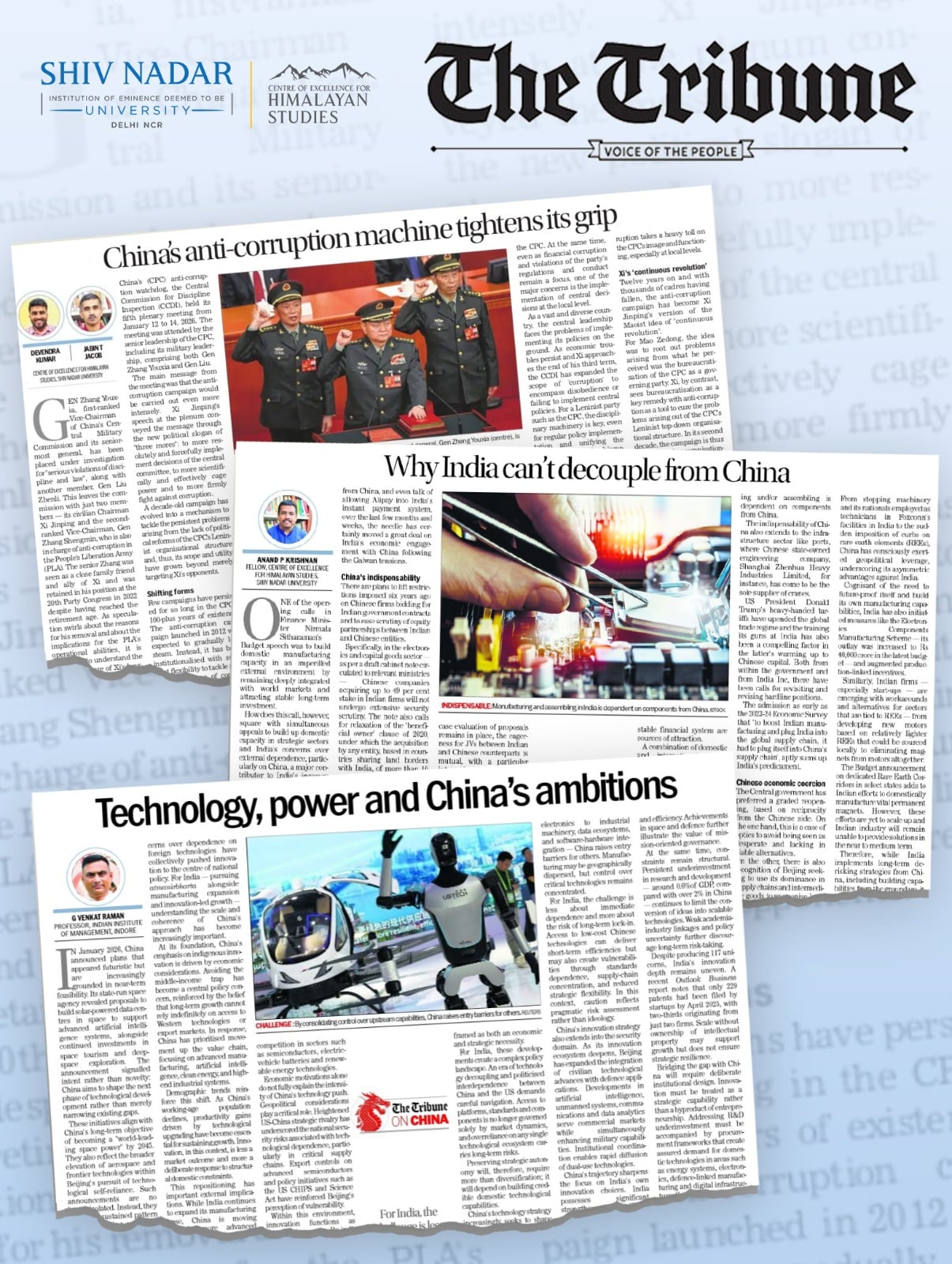
CHS has launched a tie-up with the Chandigarh-based national daily, The Tribune for regular column, titled “On China” that will feature articles curated by the Centre. In the first of these, Devendra Kumar, CHS Associate Fellow and Jabin T. Jacob, CHS Director, co-authored an article examining the intensification of China’s anti-corruption campaign, arguing it has shifted from a political tool to an institutionalised governance mechanism across the military and civilian sectors. CHS Fellow, Anand P. Krishnan, published an article in The Tribune analysing why India cannot decouple economically from China, highlighting structural interdependence and strategic trade-offs. G. Venkat Raman, Professor, IIM Indore, in his focused on China’s accelerating, state-driven innovation strategy across frontier technologies, including space, artificial intelligence, and advanced manufacturing.
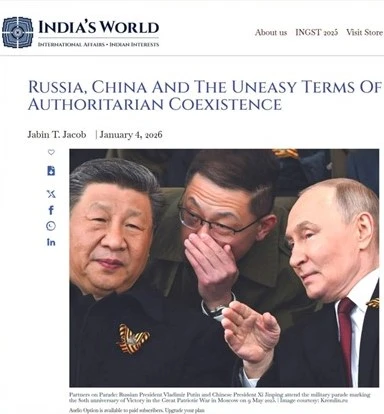
In the January issue of the foreign policy magazine, India’s World, Jacob wrote an article examining the evolving Russia–China partnership, shaped by Western pressure on Moscow and Beijing’s growing leverage in the relationship. He highlighted the economic imbalances, political tensions, and historical mistrust that coexist with strategic cooperation between the two countries.
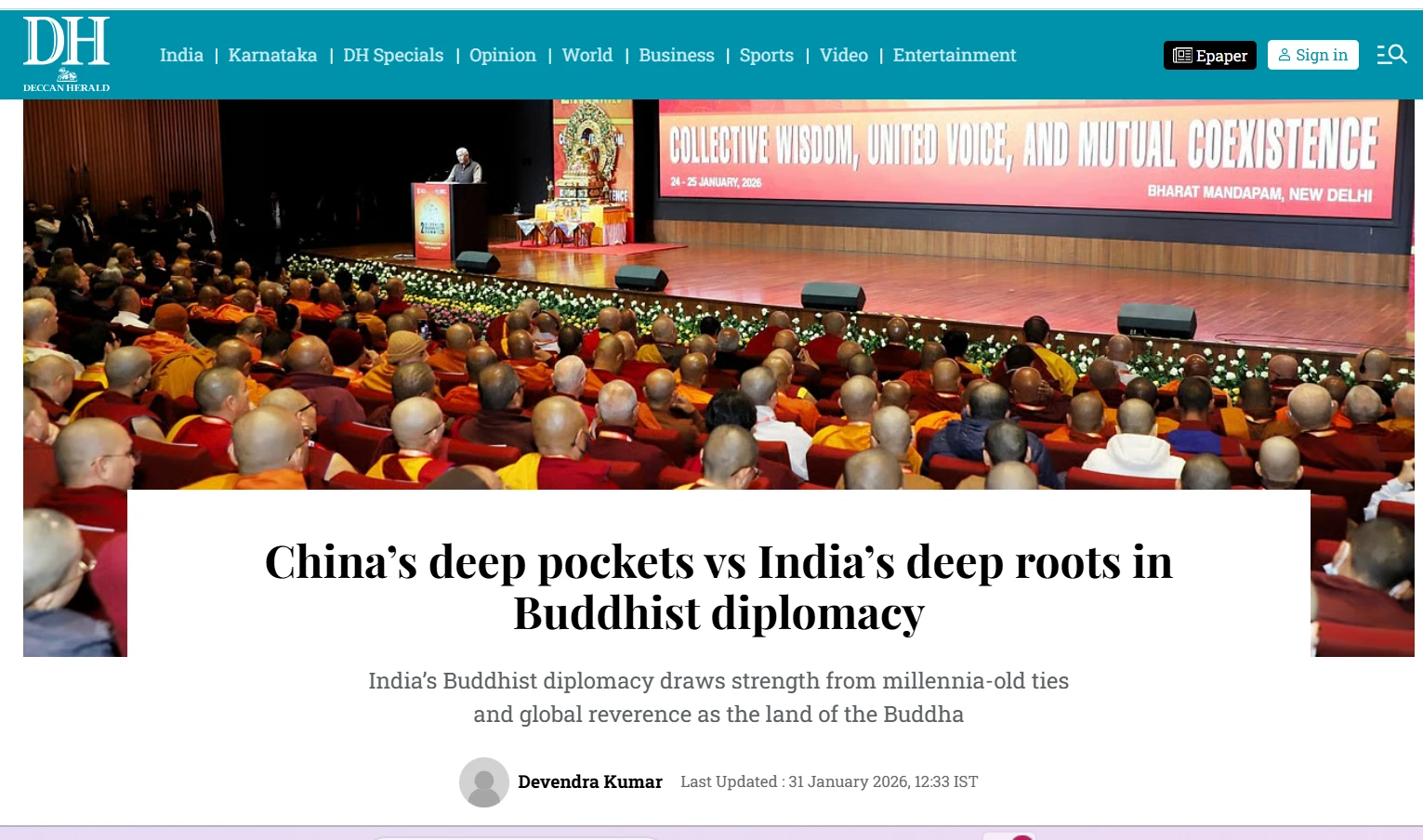
Kumar, meanwhile, authored an article for Deccan Herald analysing the significance of the second global Buddhist summit for India’s Buddhist diplomacy in the context of India-China competition in the domain.
An Issue Brief by Aishwarya Sanas, Doctoral Scholar, at the Department of International Relations and Governance Studies at the University examines the role of the organisation, ICIMOD in Hindu Kush–Himalaya environmental governance, arguing that its project-driven, politically neutral approach limits deeper regional cooperation, and proposing instead, a diplomacy-for-science framework to strengthen transnational governance.
In another Issue Brief, University of Hyderabad PhD Scholar, Bahram Kalviri, writes about China’s engagement with Afghanistan. He notes that the relationship is driven not so much by economic ambition as by security imperatives.

An Issue Brief by Rinan Shah, CHS Post-Doctoral Fellow, examines the paradox of water scarcity in Darjeeling despite high rainfall in the Eastern Himalayan Region while in his Issue Brief, CHS Post-Doctoral Fellow, Sangay Lachenpa, examines the Bharat Rannbhoomi Darshan initiative in Sikkim, exploring how borderland memory and strategic tourism intersect.

An Issue Brief by our Post-Doctoral Fellow Tadu Rimi examines how indigenous communities in Arunachal Pradesh experienced the 1962 India–China war through oral histories, highlighting how the conflict disrupted everyday life in the borderlands. The study foregrounds layered and sometimes contradictory memories of the period and reflects on how local narratives complicate state-centred histories of the conflict.
Finally, a Commentary by Garima Bhandari, Doctoral Scholar at the IIT Roorkee, analysed the growing crisis in government schooling in Uttarakhand’s hill regions and its implications for rural communities.
Several CHS publications were translated. These included translations of Jacob’s writings on China’s global initiatives in and wolf-warrior diplomacy into Chinese, and Nepali and Urdu translations of works by Rinan Shah on disaster risk in the Himalayas , and two Punjabi translations of joint pieces by Jacob and Krishnan on evolving India-China dynamics .

IN THE MEDIA
Jabin T. Jacob was quoted in StratNews Global on Beijing’s use of cartoons in state media to mock rivals and shape geopolitical narratives, and in a separate article, on debates over India’s reported plan to ease curbs on Chinese firms.
He also published an article in Geopolitico on the Global Buddhist Summit in New Delhi, highlighting the relevance of Buddhist principles for promoting peace and cooperation in today’s world. In an extended interview to Rediff.com, Arpi also discussed the Panchsheel Agreement and its historical implications for India–China relations.
FACULTY UPDATES
Claude Arpi participated in a workshop in Dharamsala on a new map of Tibet, presenting on the historical legacies of the Indo–Tibetan border and perspectives for the future. He also delivered a lecture to senior officers of the Indian Air Force Central Air Command in Prayagraj on the importance of Tibet for India, participated in the 2nd Global Buddhist Summit in New Delhi, and delivered an online lecture for Tibetology classes in Gangtok on the India–Tibet border and the Sinicisation of Tibetan Buddhism.
Jabin T. Jacob served as Scholar-in-Residence at the Department of International Studies, Stella Maris College, Chennai in the month of January. He also delivered two lectures for the Tibetology course of the Eastern Command of the Indian Army.
Devendra Kumar participated in several strategic and policy forums during this period. He spoke on China’s xiaokang villages policy and its implications for India at a seminar organised by the Central Command of the Indian Army in Dehradun and attended a seminar on Arunachal Pradesh at Dinjan in Dibrugarh. He also served as a panelist on India’s approach to China and as a discussant on the Tibet question at the Takshashila Institution’s annual NASC Fellowship Conference in Bengaluru.
You can stay updated with our publications, events, and activities through our website, X (@Himalayas_SNU), Facebook, LinkedIn and Instagram. You can also find previous Newsletters on our website.
Share this: