HIMALAYAS PLUS
November-December 2025
Dear All,
Greetings from the Centre of Excellence for Himalayan Studies (CHS), Shiv Nadar Institution of Eminence (SNIoE). The 17th edition of our Newsletter covers the months of November and December 2025. Previous editions can be accessed on our website.
PUBLICATIONS
Kalzang Dorjee Bhutia, CHS Non-Resident Senior Fellow, published a peer-reviewed journal article in Museum Anthropology examining ritual care, provenance, and relationship repair of artifacts in the British Museum. Drawing on material from the Sikkim Himalayas, the article explores how ritual engagements with cultural belongings in colonial museums relate to repairing disrupted relationships between communities and knowledge systems.
Devendra Kumar, CHS Associate Fellow, authored a journal article in Asian Affairs analysing the implications of BRICS expansion for China–India relations, situating emerging frictions within broader debates on institutional influence and strategic alignment.
Kaveri Gill, CHS Non-Resident Senior Fellow, published a lead article in ANTIQVVS (University of Oxford) tracing the evolution of Buddhist thought from ancient to modern contexts.
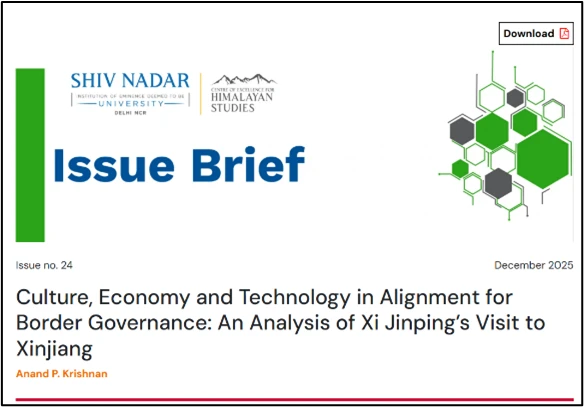
An Issue Brief by Anand P. Krishnan, CHS Fellow, analysed Xi Jinping’s September 2025 visit to Xinjiang, examining how cultural integration, economic strategy, and technological development are being aligned within China’s evolving border governance framework.
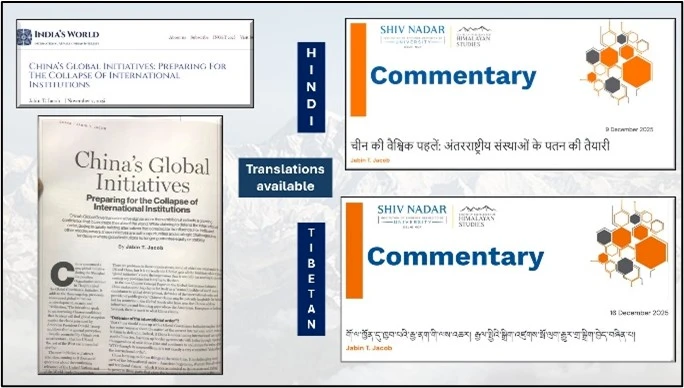
Jabin T. Jacob, CHS Director, published an article in International Affairs: Politics, Economics, Law examining the limits of regional cooperation in the absence of strong bilateral ties. Using the Shanghai Cooperation Organization as a case study, the article highlights persistent Sino–Indian tensions and contradictions within the Russia–India–China trilateral that complicate the organisation’s trajectory. He wrote an article in the foreign policy magazine, India’s World examining China’s global initiatives arguing they were designed to take over if and when current international institutions failed. The article situates China’s initiatives within a broader effort to shape alternative frameworks of global governance. This article was later translated into Tibetan, and Hindi.
Another Issue Brief by Aniruddha Jena, Assistant Professor, Indian Institute of Management, Kashipur, examined the role of community radio in disaster communication across the Indian Himalayan Region, highlighting its importance for last-mile information flow during floods, landslides, forest fires, and other climate-related emergencies, and arguing for its formal integration into disaster governance frameworks.
An Issue Brief by Jeet Singh, Policy Researcher at the Rajiv Gandhi Institute for Contemporary Studies, examined emerging conservation challenges in Himalayan alpine meadows or bugyal, drawing on field research from Uttarakhand to assess pressures from tourism, resource extraction, and climate change.
Rinan Shah, CHS Post-Doctoral Fellow, authored two Commentaries. One examined how hydropower development in the eastern Himalaya is shaped by top-down governance and knowledge asymmetries that limit community engagement. The other analysed how intensifying rainfall and unplanned urban development in Darjeeling, Kalimpong, and the Sikkim Himalaya are increasing disaster risk, highlighting the need for multi-scalar approaches to water and disaster governance.
An Issue Brief by CHS Post-Doctoral Fellow Padma Ladon analysed changes in soil health in Ladakh’s alpine pastures, showing how shifts in grazing practices, livelihoods, and weakening local institutions are affecting fragile mountain ecosystems and pastoral sustainability.
In his Issue Brief CHS on border trade at Nathu La, Post-Doctoral Fellow Sangay Lachenpa examined the impact of its suspension on Sikkimese trading communities and their expectations following recent diplomatic developments between India and China.
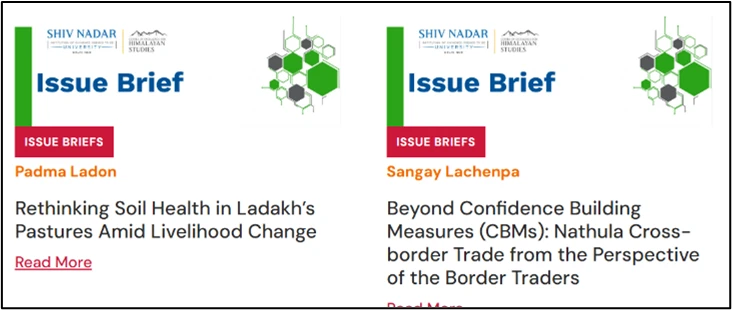
Several CHS commentaries were translated and published in Chinese, Urdu, Tibetan, Punjabi. Hindi was introduced as a new translation language for select CHS publications.
EVENTS
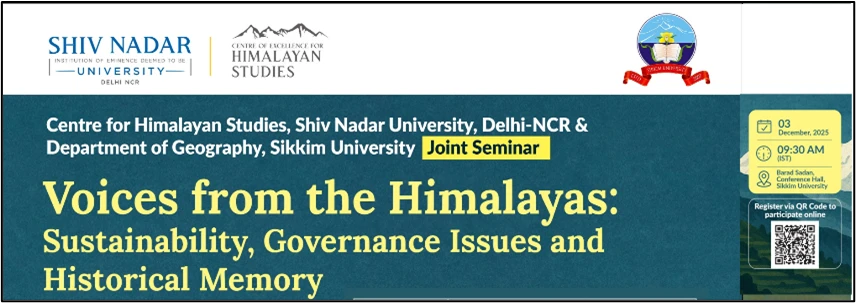
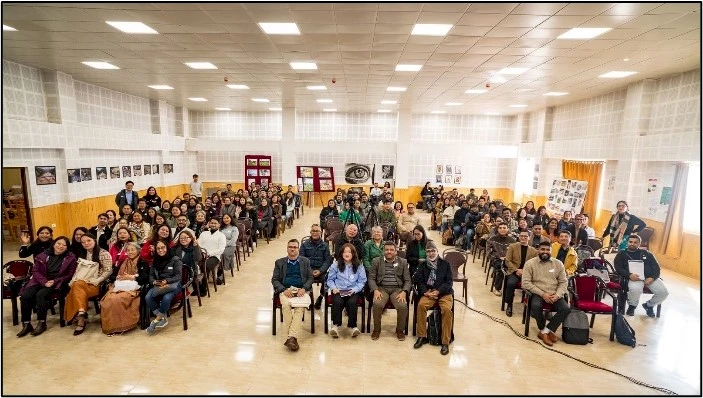
On 3 December, CHS and the Sikkim University, jointly organised a seminar in Gangtok on sustainability, governance, and historical memory in the Himalayas, marking the culmination of year-long fieldwork by CHS Post-Doctoral Fellows. As part of the seminar, Padma Ladon presented research on tourism and traditional livelihoods in Leh–Ladakh, Sangay Lachenpa examined shared authority and the institution of the Dzumsa in Sikkim, Rinan Shah discussed domestic water scarcity in water-rich Himalayan regions, and Rimi Tadu reflected on questions of memory and lived experience in Arunachal Pradesh. The seminar also featured presentations by doctoral scholars from Sikkim University.
This was followed by the Shared Futures Conclave held in Gangtok on 4 and 5 December, jointly organised by CHS, Reading Himalaya, and Sikkim University. The Conclave brought together researchers, policymakers, community representatives, and practitioners for discussions on climate resilience, disasters, urbanisation, tourism, water, and governance in the Sikkim–Darjeeling Himalaya. Lachenpa and Shah participated as panellists, contributing to discussions on borderland governance, water security, and climate-related risks.
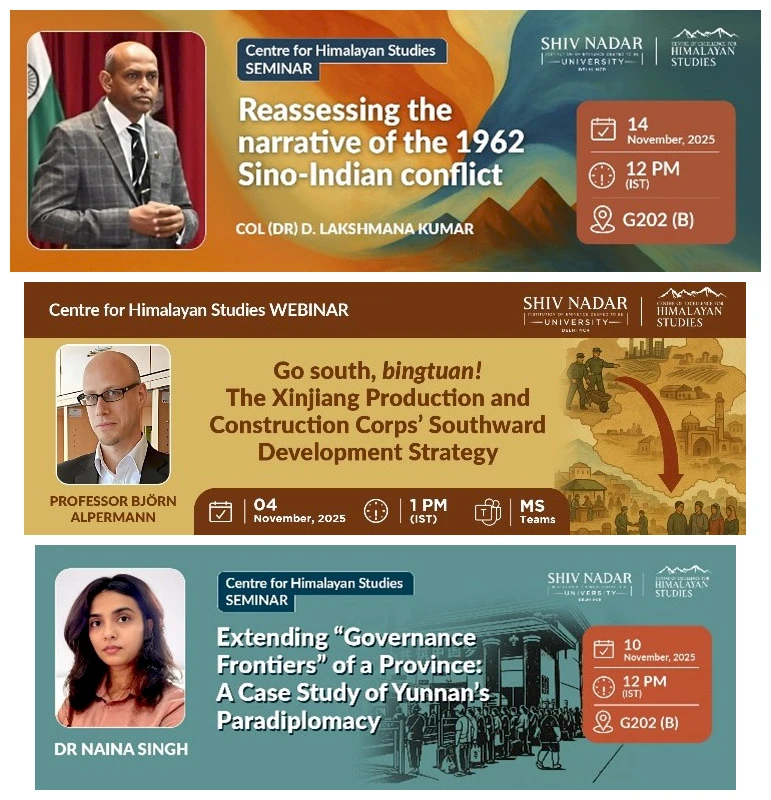
In addition, CHS hosted two seminars and one webinar during November 2025. These included a seminar on reassessing the narratives of Indian defeat in the 1962 Sino–Indian conflict delivered by Col (Dr) D. Lakshmana Kumar on 14 November, a seminar on paradiplomacy by Yunnan province presented by Dr. Naina Singh of National Chung Hsing University, Taichung, Taiwan on 10 November, and a webinar on the Xinjiang Production and Construction Corps’ southward development strategy delivered by Prof. Björn Alpermann of the Julius-Maximilians-Universität Würzburg on 4 November.
IN THE MEDIA
Claude Arpi, CHS Distinguished Fellow, published a series of op-eds in Firstpost examining Buddhism in Bhutan, debates on Tibetan autonomy, China’s positions on Arunachal Pradesh and India’s rushed recognition of Communist China in 1949. He also wrote for the Asian Age on civil–military dynamics in China, and on climate risk ignored in the pursuit of development. He contributed a historical reflection on Tibetan passes in Rediff, and was quoted in StratNews Global on Tibetan historical legacies.
Jacob was quoted in The Washington Post on India–China border developments and in StratNews Global on China’s internal security debates. He also participated in a podcast for the the National Bureau of Asian Research’s Documenting China’s Borderlands series discussing China’s Himalayan rim and borderlands.
FACULTY UPDATES
Claude Arpi undertook a series of academic and institutional engagements during November and December 2025. He visited the Dalai Lama Institute for Higher Education, Bengaluru, for discussions with senior academic and medical institutions, delivered an online lecture on Tibet and the 1962 border war at Rashtriya Raksha University, Gandhinagar and gave a lecture on the importance of Tibet at the Army War College, Mhow. He also participated as a special guest at the Gyalwa Tsangyang Gyatso International Conference in Tawang, Arunachal Pradesh.
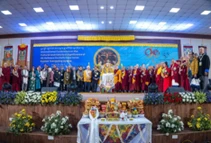
Jabin T. Jacob also delivered an online lecture on China’s strategic approach to the Tibet Autonomous Region and its implications for India for the Rashtriya Raksha University
Kaveri Gill delivered multiple invited lectures and teaching engagements across India during November and December 2025. These included an online lecture on ethics in everyday life at the FERCICON bioethics conference hosted by Jorhat Medical College, Assam, an all-day philosophy teaching session on Eight Verses for Training the Mind at the Menlhai Jamtse Centre in Mumbai, and a lecture on the Dalai Lama’s philosophy of non-violent resistance at Symbiosis School for Liberal Arts, Pune. She also chaired and presented panels at a conference on the life and legacy of Atisha Dipamkara Srijana at the India International Centre, New Delhi, chaired a student panel at a psychology conference organised by Tibet House, delivered an online lecture on The Four Seals for ARTH Mumbai students, and participated in a panel on universal ethics commemorating the Dalai Lama’s Nobel Peace Prize.
Rinan Shah was a presenter at a webinar on the legal landscape of Himalayan springs for water security, organised by IWMI–Tata Water Policy Research, where she discussed how Indian states approach spring governance and the pathways for strengthening water security.
Anand P. Krishnan participated in a national workshop on promoting China Studies in Indian higher education organised by the Institute of Chinese Studies, New Delhi contributing to discussions on curriculum development and institutional capacity building.
Padma Ladon delivered a lecture at the South Asia Institute, Heidelberg University in Germany examining tourism in Leh–Ladakh from the perspective of local communities.
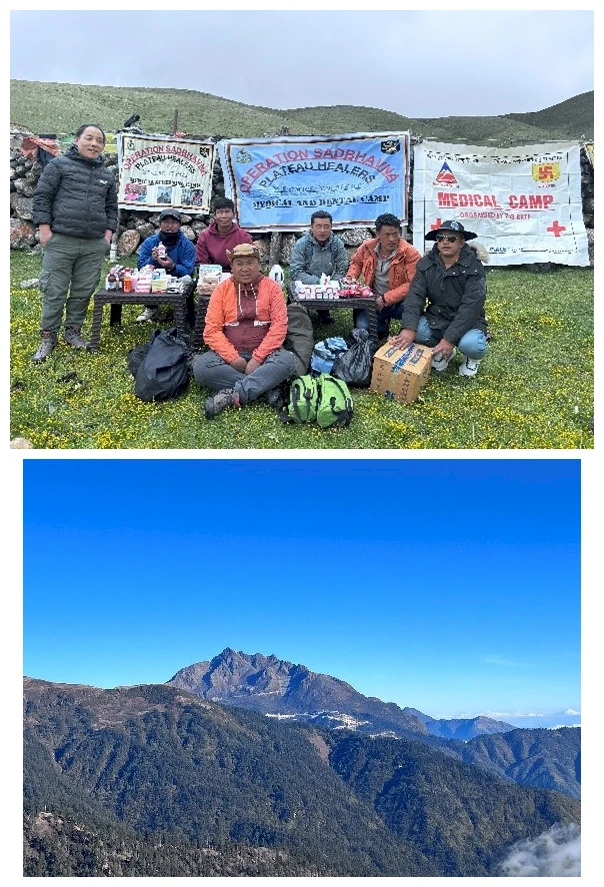
Sangay Lachenpa also recorded visual material from Sikkim’s borderlands, including photographs of Dzumsa members collaborating with the Indian Army to organise a medical camp, and images of Mount Gipmochi, the tri-junction between India, China, and Bhutan, as seen from the Indian side in Sikkim.
2025 reflected CHS’s continued focus on fieldwork-based research dialogue connecting scholarship, policy, and community practice across the Himalayan region as well as an increased emphasis on multilingual dissemination and public engagement.
You can stay updated with our publications, events, and activities through our website, X (@Himalayas_SNU), Facebook, and LinkedIn. You can also find previous Newsletters on our website.
Share this: