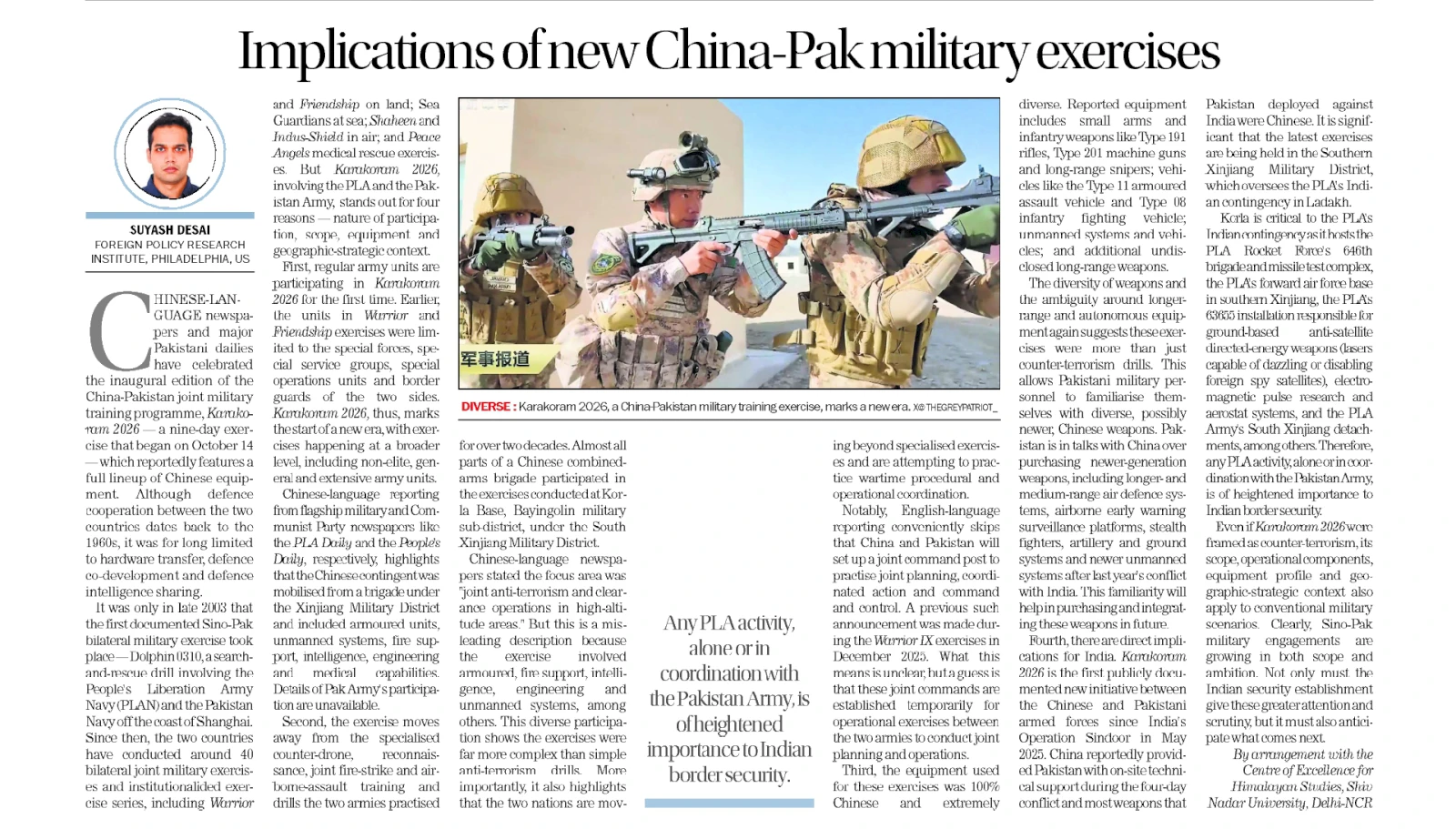
Chinese-language newspapers and major Pakistani dailies have celebrated the inaugural edition of the China-Pakistan joint military training programme, Karakoram 2026 – a nine-day exercise that began on 14 October – which reportedly features a full lineup of Chinese equipment. Although defense cooperation between the two countries dates back to the 1960s, it was for long limited to hardware transfer, defense co-development, and defense intelligence sharing. It was only in late 2003, that the first documented Sino-Pak bilateral military exercise took place – Dolphin 0310, a search-and-rescue drill involving the People’s Liberation Army Navy (PLAN) and the Pakistan Navy off the coast of Shanghai. Since then, the two countries have conducted around 40 bilateral joint military exercises and institutionalized exercise series, including Warrior and Friendship on land; Sea Guardians at sea; Shaheen and Indus-Shield in air; and Peace Angels medical rescue exercises, among others. But Karakoram 2026, between the PLA and the Pakistan Army stands out for four reasons – nature of participation, scope, equipment, and geographic-strategic context.
First, regular army units are participating in Karakorum 2026 for the first time. Earlier, the participating units in Warrior and Friendship exercises were limited to the special forces, special service groups, special operations units, and border guards of the two sides. Karakorum 2026, therefore, marks the start of a new era, with exercises happening at a broader level, including non-elite, general, and extensive army units. Chinese-language reporting from flagship military and Communist Party newspapers like the PLA Daily and the People’s Daily respectively highlights that the Chinese contingent was assembled from a brigade under the Xinjiang Military District, and included armored units, unmanned systems, fire support, intelligence, engineering, and medical capabilities while details of the Pakistani Army’s participation are unavailable.
Second, the exercise moves away from the specialized counter-drone, reconnaissance, joint fire-strike, and airborne-assault training and drills the two armies practiced for over two decades. Although details of the Pakistan Army’s participating units are unavailable, almost all parts of a Chinese combined-arms brigade participated in the exercises conducted at Korla Base, Bayingolin military sub-district, under the South Xinjiang Military District. Chinese-language newspapers stated the focus area was “joint anti-terrorism and clearance operations in high-altitude areas,” but this is a misleading description because the exercise involved armored, fire support, intelligence, engineering, and unmanned systems, among others. This diverse participation shows the exercises were far more complex than simple anti-terrorism drills. More importantly, it also highlights that the two nations are moving beyond specialized exercises and are attempting to practice wartime procedural and operational coordination. Notably, English-language reporting conveniently skips that China and Pakistan will set up a joint command post to practice joint planning, coordinated action, and command and control. A previous such announcement was made during the Warrior IX exercises in December 2025. What this means is still unclear, but an educated guess is that these joint commands are established temporarily for joint operational exercises between the two armies to conduct joint planning, coordination, and operations.
Third, the equipment used for these exercises was 100 percent Chinese and extremely diverse. Reported equipment includes small arms and infantry weapons like Type 191 rifles, Type 201 machine guns, and long-range snipers; vehicles like the Type 11 armoured assault vehicle and Type 08 infantry fighting vehicle; unmanned systems and vehicles; and additional undisclosed long-range weapons. The diversity of weapons and the ambiguity around longer-range and autonomous equipment again suggests these exercises were more than just counter-terrorism drills. This allows Pakistani military personnel to familiarise themselves with diverse, possibly newer, Chinese weapons. Pakistan is already in talks with China over purchasing newer-generation weapons, including longer- and medium-range air defence systems, airborne early warning surveillance platforms, stealth fighters, artillery and ground systems, newer unmanned systems, and more after last year’s conflict with India. This familiarity will help with purchasing and integrating these weapons in the near future.
Fourth, there are direct implications for India. Karakoram 2026 is the first publicly documented new initiative between the Chinese and Pakistani armed forces since India’s Operation Sindoor in May 2025. China reportedly provided Pakistan with on-site technical support during the four-day conflict and most weapons that Pakistan deployed against India were Chinese. It is significant that the latest exercises are being held in the Southern Xinjiang Military District, which oversees the PLA’s Indian contingency in Ladakh. Korla is critical to the PLA’s Indian contingency as it hosts the PLA Rocket Force’s 646thbrigade and missile test complex, the PLA’s forward air force base in southern Xinjiang, the PLA’s 63655 installation responsible for ground-based anti-satellite directed-energy weapons (lasers capable of dazzling or disabling foreign spy satellites), electromagnetic pulse research, and aerostat systems, and the PLA Army’s South Xinjiang detachments, among others. Therefore, any PLA activity, alone or in coordination with the Pakistan Army, is of heightened importance to Indian border security.
Even if Karakoram 2026 were framed as counter-terrorism, its scope, operational components, equipment profile, and geographic-strategic context also apply to conventional military scenarios. Clearly, Sino-Pak military engagements are growing in both scope and ambition, and not only must the Indian security establishment give these greater attention and scrutiny, but it must also anticipate what comes next.
About the Author: Suyash Desai is a scholar at the Foreign Policy Research Institute, Philadelphia, USA, where his work focuses on Chinese foreign, defence and security policy.