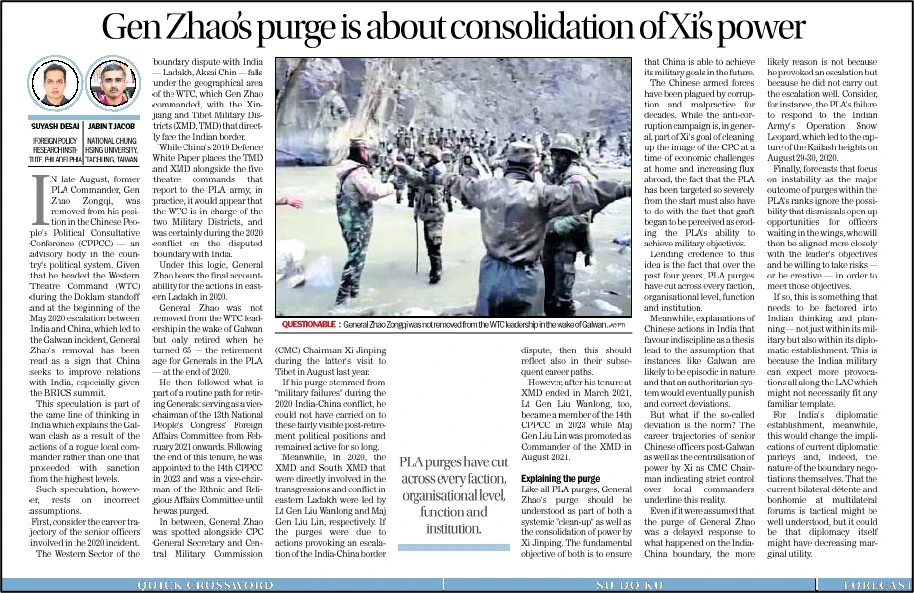
In late August, former PLA Commander Gen. Zhao Zongqi (赵宗岐) was removed from his position in the Chinese People’s Political Consultative Conference (CPPCC) – an advisory body in the country’s political system. Given that he headed the Western Theatre Command (WTC) during the Doklam standoff and at the beginning of the May 2020 escalation between India and China, which led to the Galwan incident, Gen. Zhao’s removal has been read as a sign that China seeks to improve relations with India, especially given the upcoming BRICS summit. This speculation is part of the same line of thinking in India which explains away the Galwan clash as the result of the actions of a rogue local commander rather than one that proceeded with sanction from the highest levels.
Such speculation, however, rests on incorrect assumptions.
Career Paths
First, consider the career trajectory of the senior officers involved in the 2020 incident. The Western Sector of the boundary dispute with India – Ladakh, Aksai Chin – falls under the geographical area of the WTC, which Gen. Zhao commanded, with the Xinjiang and Tibet Military Districts (XMD, TMD) that directly face the Indian border. While China’s 2019 Defence White Paper places the TMD and XMD alongside the five theatre commands report to the PLA Army, in practice, it would appear that the WTC is in charge of the two Military Districts, and was certainly during the 2020 conflict on the disputed boundary with India. Under this logic, Gen Zhao bears the final accountability for the actions in eastern Ladakh in 2020.
Gen. Zhao was not removed from the WTC leadership in the wake of Galwan but only retired when he turned 65 – the retirement age for generals in the PLA – at the end of 2020. He then followed what is part of a routine path for retiring generals serving as a Vice-Chairman of the 13th National People’s Congress’ Foreign Affairs Committee from February 2021 onwards. Following the end of this tenure, he was appointed to the 14th CPPCC in 2023 and was a Vice Chairman of the Ethnic and Religious Affairs Committee until he was purged. In between, Gen. Zhao was spotted alongside CPC General Secretary and Central Military Commission (CMC) Chairman Xi Jinping during the latter’s visit to Tibet in August last year. If his purge stemmed from “military failures” during the 2020 India-China conflict, he could not have carried on to these fairly visible post-retirement political positions and remained active for so long.
Meanwhile, in 2020, the XMD and South XMD under it that were directly involved in the transgressions and conflict in eastern Ladakh were led respectively by Lt Gen. Liu Wanlong (刘万龙) and Maj. Gen. Liu Lin (柳林). If the purges were due to actions provoking an escalation of the India-China border dispute, then this should reflect also in their subsequent career paths. However, after his tenure at XMD ended in March 2021, Lt. Gen. Liu Wanlong, too, became a member of the 14th CPPCC in 2023 while Maj. Gen. Liu Lin, was promoted to commander of the XMD in August 2021.
Explaining the Purge
Like all PLA purges, Gen. Zhao’s purge should be understood as part of both a systemic “clean-up” as well as the consolidation of power by Xi Jinping. The fundamental objective of both is to ensure that China is able to achieve its military goals in the future.
The Chinese armed forces have been plagued by corruption and malpractice for decades. While the anti-corruption campaign is, in general, part of Xi’s goal of cleaning up the image of the CPC at a time of economic challenges at home and increasing flux abroad, the fact that the PLA has been targeted so severely from the start must also have to do with the fact that graft began to be perceived as eroding the PLA’s ability to achieve military objectives. Lending credence to this idea is the fact that over the past four years, PLA purges have cut across every faction, organizational level, function and institution.
Meanwhile, explanations of Chinese actions in India, that favour indiscipline as a thesis lead to the assumption that instances like Galwan are likely to be episodic in nature and that an authoritarian system will eventually punish and correct deviations. But what if the so-called deviation is the norm? The career trajectories of senior Chinese officers post-Galwan as well as the centralization of power by Xi as CMC Chairman indicating strict control over local commanders underline this reality.
Even if it were assumed that the purge of Gen. Zhao was a delayed response to what happened on the India-China boundary, the more likely reason is not because he provoked an escalation but because he did not carry out the escalation well. Consider, for instance, the PLA’s failure to respond to the Indian Army’s Operation Snow Leopard, which led to the capture of the Kailash heights on 29-30 August 2020.
Finally, forecasts that focus on instability as the major outcome of purges within the PLA’s ranks ignore the possibility that purges open up opportunities for officers waiting in the wings who will then be aligned more closely with the leader’s objectives and be willing to take risks – or be creative – in order to meet those objectives. If so, this is something that needs to be factored into Indian thinking and planning – not just within its military but also within its diplomatic establishment. This is because, the Indian military can expect more provocations all along the LAC which might not necessarily fit any familiar template. For India’s diplomatic establishment, meanwhile, this would change the implications of current diplomatic parleys and, indeed, the nature of the boundary negotiations themselves. That the current bilateral détente and bonhomie at multilateral forums is tactical might be well understood but it could be that diplomacy itself might have decreasing marginal utility.
Originally published as Suyash Desai and Jabin T. Jacob. 2026. 'Gen Zhao's purge is about consolidation of Xi's power', The Tribune, 12 September.
(The article appeared in The Tribune as part of an arrangement with the Centre of Excellence for Himalayan Studies.)
About the Authors: Suyash Desai is a scholar at the Foreign Policy Research Institute, Philadelphia, USA, where his work focuses on Chinese foreign, defence and security policy.
Jabin T. Jacob is the director of the Centre of Excellence for Himalayan Studies, and Associate Professor at the Department of International Relations and Governance Studies, and, at Shiv Nadar Institution of Eminence, Delhi-NCR
The authors would like to thank Brig. Anshuman Narang (retd), Devendra Kumar, and Capt. TSV Ramana (retd) for their valuable comments on earlier drafts.